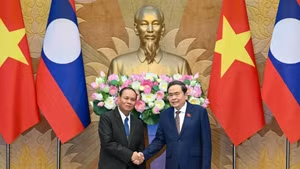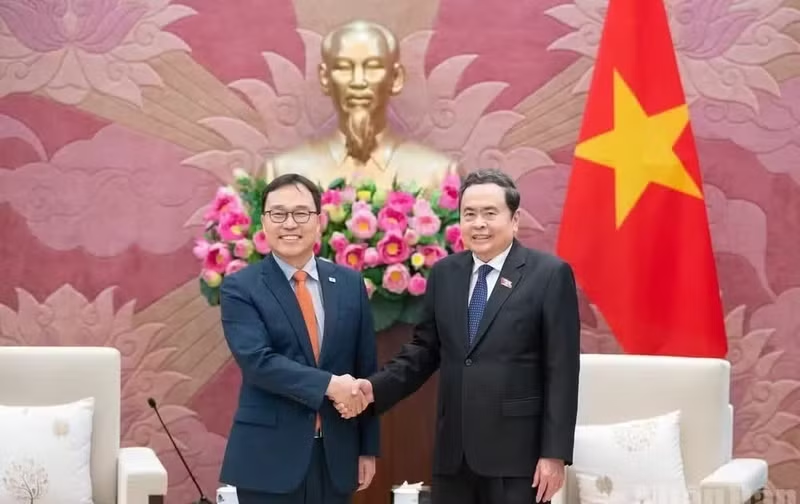
At the invitation of the Speaker of the National Assembly of the RoK, Cho Jeong Sik, and his spouse, the President of the National Assembly of the Socialist Republic of Viet Nam, Tran Thanh Man, accompanied by his spouse and a high-level Vietnamese delegation, will undertake an official visit to the RoK from September 6–9, 2026. On this occasion, a Nhan Dan newspaper reporter spoke with Vietnamese Ambassador to the RoK, Vu Ho, about the significance of this visit.
A visit with multifaceted significance
Reflecting on the significance of NA President Tran Thanh Man’s official visit to the RoK, Ambassador Vu Ho noted that the visit unfolds amid a robust, comprehensive, and deepening relationship between Viet Nam and the RoK. It sustains the recent momentum of high-level exchanges, notably including the state visit to the RoK by General Secretary To Lam, the visit to Viet Nam by the Speaker of the National Assembly of the RoK in 2025, and, most recently, the state visit to Viet Nam by President Lee Jae-myung in April 2026.
This continuity demonstrates that the bilateral relationship is progressing cohesively across Party, State, and National Assembly channels. More importantly, it reflects the reality that Viet Nam and the RoK increasingly regard each other as vital, long-term partners in their respective development and foreign policy strategies.
The visit’s importance is magnified as both nations confront the imperative of innovating their development models. Viet Nam is intensifying efforts to refine its institutional framework, advance science and technology, foster innovation, and enhance the quality of its economic growth.
The RoK is simultaneously pursuing new markets, production bases, and technology partners amid intensifying strategic competition, supply chain shifts, and the green transition. While the two economies are highly complementary, translating this potential into tangible results demands clear political direction and a stable legal framework.
Against this backdrop, according to Ambassador Vu Ho, the visit by National Assembly President Tran Thanh Man and his spouse carries profound weight. Cooperation between the two legislative bodies not only complements the relationship between the two governments but also secures the continuity, stability, and implementability of bilateral commitments. As major agreements increasingly involve legal, budgetary, technological, labour, and environmental aspects, the role of the National Assembly grows increasingly critical.
Ambassador Vu Ho outlined that the visit targets four key areas. First, consolidating political trust and enhancing strategic dialogue. Second, deepening cooperation between the two countries’ legislatures in areas such as lawmaking, oversight, and the refinement of development frameworks. Third, shifting economic cooperation from mere scale expansion to quality enhancement, aiming for a balanced and sustainable trade volume of 150 billion USD by 2030. Fourth, strengthening the social foundation of the bilateral relationship through cooperation at the local level, education, culture, tourism, people-to-people exchanges, and support for the respective communities in each country.
These four priorities are interconnected. Political trust lays the foundation; parliamentary cooperation provides the framework; economics and technology generate momentum; and people-to-people exchanges ensure long-term resilience. If implemented comprehensively, the visit will not only forge new pacts but also resolve outstanding issues in the bilateral relationship.
“The message of the visit remains unequivocal: to advance the Vietnam–RoK relationship from a solid political framework toward concrete, measurable outcomes that deliver tangible benefits to the people and businesses of both nations,” Ambassador Vu Ho emphasised.
Trust paves the way; shared interests bind the relationship together
According to Ambassador Vu Ho, the current Viet Nam–RoK relationship can be summarised by three words: frequent, substantive, and trusting.
This is evident in high-level exchanges that have been consistently maintained, even amid regional and international volatility. The bilateral relationship is not tied to a specific term or moment in time; rather, it rests on a solid foundation and internal momentum, backed by broad public support in both nations. Consequently, the “comprehensive strategic partnership” is more than just a label; it is being translated into action through regular dialogue, cooperation programmes with clear objectives, and defined implementation responsibilities for each agency.
Ambassador Vu Ho asserted that these figures clearly attest to the vitality of the Viet Nam–RoK relationship. In 2025, bilateral trade turnover reached 89.5 billion USD — a 9.6% increase from the previous year — comprising 28.9 billion USD in exports and 60.5 billion USD in imports from Viet Nam. This growth momentum has persisted; in the first five months of 2026 alone, two-way trade hit approximately 47.4 billion USD, up nearly 35% year-on-year.
As of May 2026, the RoK’s accumulated investment in Viet Nam reached roughly 101 billion USD across more than 10,000 projects. There were over 5 million traveller movements between the two countries in 2025. Currently, nearly 400,000 Vietnamese reside in the RoK, while over 200,000 RoK citizens live in Viet Nam.
Behind these statistics lie thousands of enterprises participating in shared production chains, students studying at each other’s universities, sister-locality relationships, and numerous multicultural families. While economic complementarity drove the rapid growth of the relationship over the past three decades, political trust and people-to-people ties now supply the depth and resilience needed for the journey ahead.
Notably, the bilateral relationship has transcended central government agencies. Numerous provinces and cities in Viet Nam and the RoK have established direct cooperative ties; RoK businesses maintain a presence in most of Viet Nam’s key economic zones; and the culture, cuisine, and language of each nation have become increasingly familiar to the public in the other. This represents a unique asset that not every bilateral relationship possesses.
Leveraging the National Assembly’s pioneering role
Speaking to Nhan Dan newspaper reporters, Ambassador Vu Ho affirmed that parliamentary cooperation anchors the Viet Nam–RoK Comprehensive Strategic Partnership.
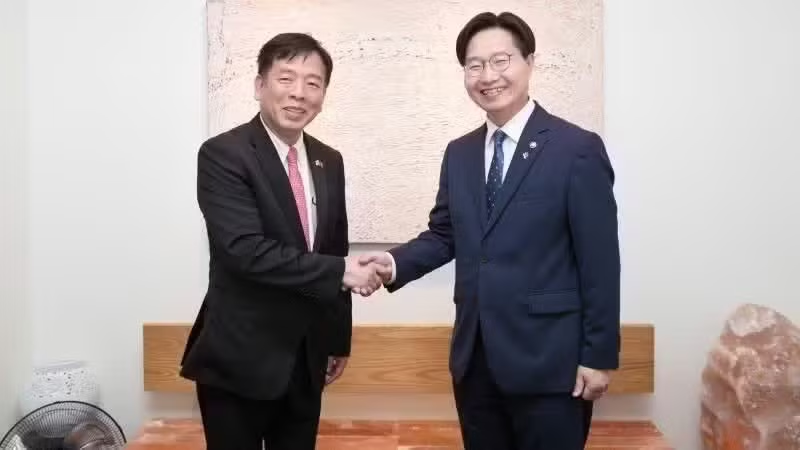
According to Ambassador Vu Ho, the legislatures of both countries not only establish legal frameworks, allocate resources, and oversee implementation but also ensure that high-level commitments materialise as concrete policies and programmes.
This role unfolds across four dimensions. First is the role of institutional building, creating a transparent and stable legal environment for long-term cooperation. Second is the oversight role, ensuring agreements are implemented on schedule and resources are used effectively. Third is the representative role, conveying the voices of constituents, the business community, and the public into the policymaking process. Fourth is the role of parliamentary diplomacy, fostering consensus and enhancing mutual understanding between the two nations.
Ambassador Vu Ho noted that relations between the National Assembly of Viet Nam and the National Assembly of the RoK have matured significantly, spanning exchanges between parliamentary leaders, specialised committees, and the activities of lawmakers and advisory bodies.
Notably, the Viet Nam–RoK and RoK–Viet Nam Parliamentary Friendship Groups serve as practical bridges, cultivating connections between the two legislative bodies while assisting in addressing issues concerning businesses, workers, the Vietnamese community, and multicultural families.
Moving forward, parliamentary cooperation should focus on three areas. First, maintaining regular exchanges among parliamentary leaders, committees, and young lawmakers; ...fortify the sharing of legislative experience in emerging fields such as artificial intelligence, data, the digital economy, energy transition, and innovation.
Furthermore, tighten oversight over the implementation of high-level agreements, particularly large-scale programmes that directly impact citizens and businesses. At the same time, deepen alignment within multilateral parliamentary forums to contribute to peace, stability, and respect for international law, while upholding ASEAN’s centrality.
Parliamentary cooperation must serve both as a trailblazer and as a flexible, practical channel for dialogue; it should not only foster friendship but also enable the early detection and timely resolution of issues arising in the bilateral relationship.
From “more” to “better”
Reflecting on the evolution of the Viet Nam–RoK Comprehensive Strategic Partnership, Ambassador Vu Ho observed that the most notable shift is the transition from “more” to “better” — moving from mere scale expansion to enhancing quality, effectiveness, and broader impact.
Over the past three decades, investment capital and the production capacity of RoK enterprises have heavily driven Viet Nam’s industrialisation, export growth, and job creation. The new phase requires profound elevation: shifting from mere production sites to hubs for research and innovation; moving from assembly to deeper involvement in design, component manufacturing, and technology services; and evolving from relationships centred on major conglomerates and their RoK supplier networks to closer linkages with Vietnamese enterprises.
In the economic sphere, Viet Nam pursues not merely capital injections but robust technology tranfer, higher localisation rates, and opportunities for Vietnamese businesses to integrate more deeply into the supply chains of the RoK conglomerates. The scope of cooperation is also expanding to new growth drivers such as semiconductors, artificial intelligence, biotechnology, digital transformation, clean energy, railways, smart cities, and the defence industry.
This marks a shift from labour-intensive industries to sectors relying more heavily on technology, knowledge, and a high-quality workforce. Consequently, cooperation in education, training, and science–technology must pivot strictly toward market demands, focusing on developing a workforce of engineers, experts, and technical personnel for emerging industries.
In the semiconductor sector, for instance, cooperation opportunities transcend simply securing a few major projects. It is crucial to build an ecosystem comprising enterprises, research institutions, universities, and a skilled technical workforce. Regarding artificial intelligence and digital transformation, both sides must concurrently tackle data infrastructure, management standards, information security, and the commercialisation of research outcomes. These are areas requiring concerted cooperation among the Government, the National Assembly, businesses, and educational institutions.
The official visit to the RoK by National Assembly President Tran Thanh Man and his spouse will inject fresh impetus for parliamentary cooperation and align with new development priorities. Building on a foundation cultivated over more than three decades, there is every reason to believe that the Viet Nam–RoK relationship will reach new heights — characterised by greater political trust, more substantive economic ties, broader cooperation, and greater sustainability rooted in strong people-to-people connections.
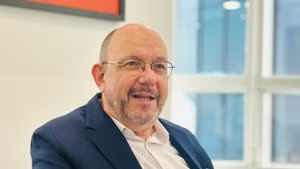
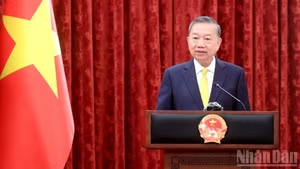
Vietnamese Ambassador to the Republic of Korea Vu Ho
Alongside these achievements, Ambassador Vu Ho emphasised the need to confront lingering challenges head-on. In 2025 alone, Viet Nam’s trade deficit with the RoK exceeded 31 billion USD. This highlights the urgent need to improve the trade balance, increase the participation of Vietnamese enterprises in supply chains, promote technology transfer, and continue addressing labour and residency issues in a spirit of cooperation and shared responsibility.
Improving the trade balance transcends merely reducing imports. Many goods Viet Nam imports from the RoK — such as machinery, raw materials, and components — are essential for production and exports. The fundamental solution lies in enhancing domestic supporting industry capabilities, strengthening business linkages between the two nations, and expanding access to the RoK market for Vietnamese agricultural produce, processed foods, and high-tech, high-value-added products.
The coming period must prioritise substantive effectiveness as the key metric. Each visit should unlock a new avenue for cooperation; each agreement requires a designated responsible agency and an implementation roadmap; every programme must deliver tangible benefits to the people and the business community.
To achieve this, both sides must shift decisively from a mindset focused on signing agreements to one focused on implementation. Major agreements must materialise as concrete project lists, timelines, designated points of contact, and mechanisms for periodic review. The legislatures of both countries can play a supporting role by refining legal frameworks, overseeing key programmes, and swiftly eliminating bottlenecks related to procedures, standards, and resources.
The official visit to the RoK by National Assembly President Tran Thanh Man and his spouse will inject fresh impetus for parliamentary cooperation and align with new development priorities. Building on a foundation cultivated over more than three decades, there is every reason to believe that the Viet Nam–RoK relationship will reach new heights — characterised by greater political trust, more substantive economic ties, broader cooperation, and greater sustainability rooted in strong people-to-people connections.