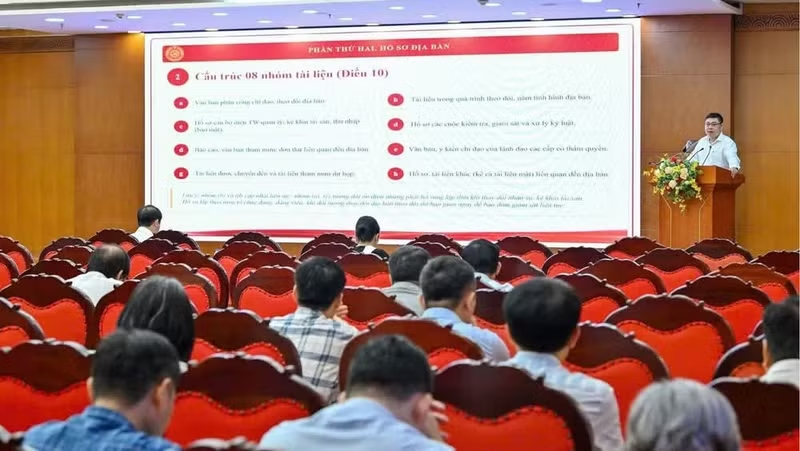
Incorporating numerous new provisions, Regulation No. 212-QD/TW timely addresses issues arising from the practical realities of inspection, supervision, power control, and the fight against corruption, waste, and misconduct in the current context (hereinafter referred to as Regulation 69, Regulation 264, and Regulation 212).
The overarching goal is education, deterrence, rectification, and improvement
The progression from Regulation 69 and Regulation 264 to Regulation 212 demonstrates the evolution of the Party’s theoretical thinking and practical insights regarding inspection, supervision, and the enforcement of Party discipline. Compared to the 4 chapters and 58 articles of Regulation 69, Regulation 212 comprises 4 chapters and 60 articles; this revision deepens the substance of existing articles and clauses while introducing new ones.
Reflecting a systematic and strategically profound approach, Regulation 212 represents more than a mere numerical adjustment of articles and clauses; it signifies a shift toward greater depth and specialisation, clearly situating Party inspection, supervision, and discipline within the broader context of the nation's rapid and sustainable development.
In the aforementioned regulations, the Party Central Committee clearly affirms that all Party organisations and members are equal before Party discipline; any violations must be reviewed and met with disciplinary action that is fair, accurate, and timely.
However, Regulation 212 marks a fundamental shift in the approach to disciplining Party organisations and members. It mandates that disciplinary action be coupled with enhanced education and management, ensuring that organisations and members recognise their shortcomings and violations, thereby enabling them to rectify errors and improve their performance. In essence, this institutionalises the Party’s stance—as articulated at the 14th National Congress, in Central Committee resolutions and regulations, and in the directives of General Secretary and President To Lam—regarding inspection, supervision, and the enforcement of Party discipline in the new era.
Accordingly, the Party Central Committee emphasises that inspection and supervision serve not only to detect wrongdoing but also to prevent it—identifying risks at an early stage to allow for timely correction before they escalate into major violations. The ultimate purpose of Party discipline extends beyond merely penalising misconduct; it aims to educate, warn, deter, rectify, and foster improvement.
This approach is grounded in the principle of strictly punishing all violations—adhering to the rule that there are “no forbidden zones and no exceptions”—while simultaneously upholding humanitarian values, the rule of law, and development objectives. This new feature reflects a more comprehensive understanding of Party inspection, supervision, and disciplinary work: it is viewed not merely as a “sword” for addressing violations, but as a method of leadership, a tool for power oversight, and a mechanism for prevention, warning, education, and the protection of officials who dare to think and act for the common good—thereby helping to foster and drive development.
Regulation 212 meets the new requirement that inspection activities must proceed in tandem with the leadership, direction, and implementation of directives, resolutions, and guiding documents issued by Party committees immediately upon their entry into force; it affirms both the continuity and the evolution of the Party’s fundamental principles within the new context.
While Regulation 69 established a crucial framework for tightening discipline and order—specifically defining violations and disciplinary measures—and Regulation 264 promptly addressed practical demands (particularly regarding the prevention of corruption, waste, and misconduct, as well as personnel management), Regulation 212 was issued within the new strategic mindset of the 14th National Congress term.
This new regulation systematises all sanctions while clearly delineating the responsibilities of organisations and individuals—especially heads of entities—regarding Party organisation violations; it ensures a deterrent effect while creating an institutional environment that fosters innovation, creativity, and development.
Together with Regulation No. 21-QĐ/TW on Party inspection, supervision, and discipline, and Resolution No. 05-NQ/TW of the 14th Party Central Committee, the work of Party inspection, supervision, and discipline has been elevated to a higher level. It is now recognised as a vital leadership method and function of the Party; a mechanism for the Party’s self-rectification, self-improvement, and the enhancement of its leadership and governing capacity; and a tool for controlling power, upholding discipline and order, and ensuring the strict and effective implementation of the Party’s guidelines in practice.
Strict discipline goes hand-in-hand with protecting dynamic and creative officials acting for the common good
The directives issued by General Secretary and President To Lam at the 14th Party Central Committee’s second plenum position inspection and supervision work within the broader context of innovating leadership methods, refining institutions and organisational structures, managing personnel, and enhancing the quality of national governance. The regulations issued by the Central Committee at this conference are designed to establish a “legal framework”, “operational rules”, “disciplinary principles”, and “standards of conduct” to translate the Party’s resolutions into practice.
With Regulation 212, the Central Committee further reaffirms the stance that Party discipline must keep pace with evolving realities. Building upon previous regulations, the scope of violations now encompasses not only areas such as organisation, personnel management, finance, assets, land, investment, and the prevention of corruption, waste, and misconduct, but also extends to emerging fields like science and technology development, innovation, and digital transformation.
Notably, the Regulation updates the definitions of violations and disciplinary measures to address modern developments involving artificial intelligence, data, the unauthorised use of new technologies, and the fabrication of images, videos, voices, and signatures.
The new regulation reinforces a key principle—grounded in both theory and practical experience—that strict discipline must go hand in hand with the encouragement of innovation and creativity.
While Regulation 69 provided for mitigating circumstances regarding Party members who committed violations while implementing innovation initiatives or pilot programs authorised by competent authorities, Regulation 212 goes further. It explicitly states that if a Party member implements an authorised innovation proposal in accordance with established policy—acting with pure motives and for the common good—yet causes damage, the competent authority may consider waiving disciplinary action (Point dd, Clause 14, Article 2 of Regulation 212-QĐ/TW).
These timely addresses the need to build a cadre of officials—particularly leaders—who possess competence and credibility, and who “dare to think, speak, act, take responsibility, innovate, and be creative”, ensuring that disciplinary measures do not stifle the drive for innovation and creativity, while simultaneously guaranteeing the control of power and the strict handling of violations.
As the country pursues high growth targets and implements numerous strategic decisions alongside more open mechanisms and policies, the risk of corruption, waste, and misconduct rises, with violations becoming more complex and widespread. Areas offering significant incentives are particularly prone to becoming hotspots for risk if preventive, inspection, and control mechanisms are lacking.
Therefore, it is essential to establish institutional frameworks that make corruption “impossible”, “too risky to attempt”," and “undesirable”. Furthermore, effective mechanisms must be implemented to protect dynamic, creative officials who dare to think, act, and take responsibility for the common good, while clearly distinguishing between violations driven by self-interest and errors made during the process of experimentation and innovation—in accordance with the directives of General Secretary and President To Lam.