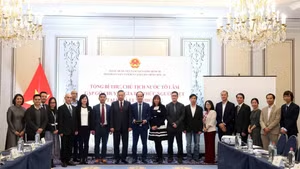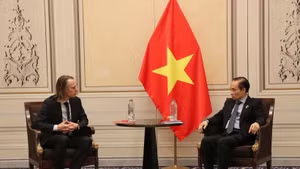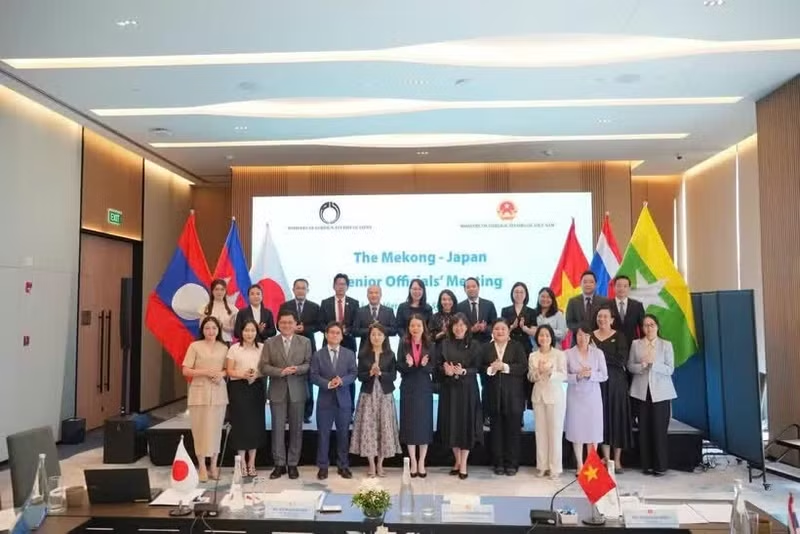
The meetings brought together senior officials and representatives from the foreign ministries and other agencies of Cambodia, Laos, Myanmar, Thailand, Viet Nam and Japan. They reviewed opportunities and challenges, discussed cooperation priorities for the coming period and prepared for the 12th CLMV Summit and the 13th Mekong-Japan Summit.
At the CLMV Senior Officials’ Meeting (SOM), Hang said developments over the past five years had reaffirmed the long-term value of CLMV cooperation in narrowing the development gap, strengthening economic connectivity and ensuring that ASEAN integration benefits all member states.
Ahead of the 12th CLMV Summit, she proposed that senior officials focus on three areas. The first is to complete summit documents with a new approach, a shared vision and priorities suited to new development requirements. The second is to recommend priorities and initiatives for the next phase, particularly in economic connectivity, tourism, human resource development and sustainable water-resource management. The third is to renew cooperation commitments to consolidate solidarity and improve implementation of initiatives through shared responsibility, clear roadmaps and regular reviews.
Viet Nam will work with member states and the ASEAN Secretariat to boost greater participation and support from development partners and the private sector, she said.
At the Mekong-Japan SOM, Hang highlighted the partnership’s contributions to connectivity, sustainable development, responses to non-traditional security challenges and the building of a trusted partnership between Japan and Mekong countries.
She welcomed Japan’s promotion of the partnership under the principle of co-creation and said the upcoming summit would provide an opportunity for leaders to reaffirm the strategic importance of the Mekong-Japan partnership to stability, cooperation and prosperity in the subregion and the wider region.
Noting that cooperation outcomes had yet to match the expectations and potential of the partnership, she called on senior officials to identify several annual priority areas for consideration by leaders. Immediate priorities should include smart supply chains, renewable energy, the application of artificial intelligence and emerging technologies, and the fight against transnational crime.
She also called for greater mobilisation of resources for Mekong-Japan cooperation, including promoting existing Japanese frameworks and initiatives such as POWER ASIA.
Participants held frank and open discussions on opportunities and challenges facing the two frameworks and supported Viet Nam’s proposed priority areas and initiatives for submission to the two upcoming summits. The 13th Mekong-Japan Summit is expected to be the first meeting of Mekong and Japanese leaders in six years and is expected to produce practical outcomes and new momentum for the partnership’s next stage.
Other areas of common interest included digital transformation and green transition, transport-corridor connectivity, disaster early warning, food security and greater private-sector participation.
The participants agreed on the need to further improve the substance and effectiveness of both cooperation frameworks.
![[In Pictures] General Secretary and President To Lam and his spouse visit and present books to Royal Library of Belgium](https://en-cdn.nhandan.vn/images/3NY4Z6Du1Md1PrS_s0ZZOrwc5xDfq4rRua69depr-TBkwatGjBcD9lagzrI2BmGDo4nKYA9qjKDjuB3-yYloL_1KbNBr00klMZQFyHQxQ6Jq6GzFfAiY0m5agKw6jNtArN4QnVntX8RQeUmD7pdCq7nwvn3e235v3kufpokBN_s/1-tong-bi-thu-chu-tich-nuoc-va-phu-nhan-tham-tang-sach-cho-thu-vien-hoang-gia-bi.jpg.avif)