This includes the implementation of key investment projects aimed at supporting Laos in developing its role as a “connecting nation” in the region, while expanding development space and strengthening economic linkages with Viet Nam.
The Lao–Viet Nam railway project, with a total length of approximately 562 km, is a strategic project supported by the governments of both countries and prioritised in bilateral cooperation.
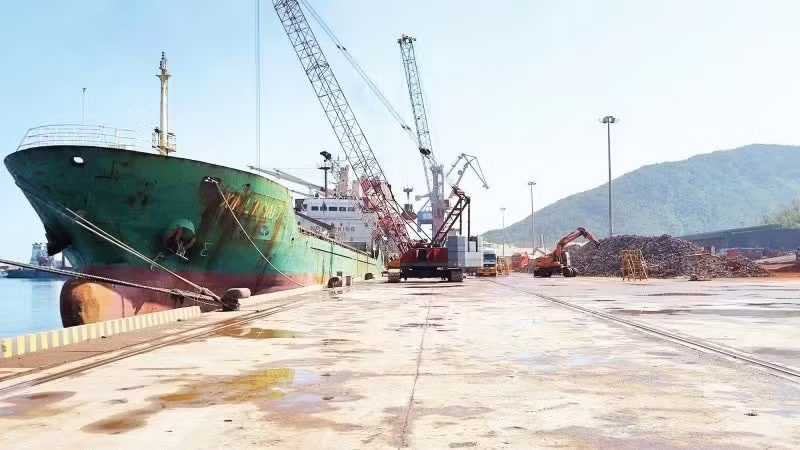
With Vung Ang Port (Viet Nam) as its gateway to the sea, this project also aligns with the plan to connect the East–West Economic Corridor, in line with the policy of transforming Laos from a landlocked country into an integrated and connected nation in transportation, logistics, and trade in the region and the world. This is not simply a transportation route, but also an economic lifeline that will enhance Laos's position on the international stage.
The Lao government and the Lao–Viet Nam Railway Company Limited have officially signed a design–construction–capitalization–operation and maintenance concession agreement for the railway project connecting Thakhek Town in Khammuon Province, Central Laos, to Mu Gia (in Quang Tri Province) in the border area between the two countries. This is an important starting point towards the early realisation of the construction of a railway line connecting Laos and Viet Nam.
Lao Minister of Public Works and Transport Leklay Sivilay emphasised that, in the future, the Lao–Viet Nam railway line will be a symbol of cooperation in the new era.
With an investment of approximately 600 million USD, Star Telecom (Unitel) — a joint venture between Viet Nam’s Viettel Military Industry and Telecoms Group and Lao Asia Telecom, a subsidiary of the Lao Ministry of Defence — has officially launched Unitel Logistics.
The establishment of Unitel Logistics lays the foundation for Unitel to become a multi-service industrial group in Laos, significantly impacting all aspects of the country’s economy and social life.
Notably, Unitel Logistics’ infrastructure will be deployed on an unprecedented scale in Laos, with the construction of three “Mega Hubs” in Oudomxay (3 ha), Vientiane (7.2 ha), and Savannakhet (5 ha) Provinces; and the development of six bonded warehouses at strategic border crossings with Viet Nam, Thailand, and China.
In addition, Unitel Logistics will establish a network of 1,500 transaction points covering all 18 provinces of Laos, ensuring connectivity even to the most remote villages. According to Unitel’s General Director, Tran Trung Hung, Unitel’s goal is to contribute to Laos’ development of a modern telecommunications and information technology infrastructure, ensuring seamless connectivity with countries in the region and around the world.
The development of logistics infrastructure will create a competitive advantage, helping to reduce costs and shorten the time for transporting goods between Viet Nam and Laos. Thanks to Unitel’s network covering Laos, goods can be delivered directly to consumers. This also enhances the competitiveness of Vietnamese businesses operating in Laos, while simultaneously expanding opportunities for Lao businesses to access the Vietnamese market.
Bounmi Malavong, a Lao investor currently operating services at Vung Ang International Port, believes that Unitel’s launch of its logistics services will act as a bridge in transporting goods from Laos to countries in the region and internationally. This is also considered a significant strength contributing to the promotion of cooperation and support between Unitel and Vung Ang International Port in the future.
The potential for logistics cooperation between Viet Nam and Laos is still very large, as Viet Nam has advantages in its seaport system, logistics network, and international connectivity, while Laos has a strategic location in the Greater Mekong Subregion, playing a crucial role as a bridge between the Association of Southeast Asian Nations (ASEAN) and the Asian interior.
If effectively connected, the Vietnamese and Lao economies will strongly complement each other in developing regional supply chains, not only meeting the needs for transporting and circulating goods between the two countries but also attracting goods from third countries, bringing higher added value to the logistics activities of businesses in both countries.
Deputy Director of the Import–Export Department, Ministry of Industry and Trade, Tran Thanh Hai, believed that in the context of global trade shifting strongly towards digitalisation, greening, and increased resilience to supply chain disruptions, Viet Nam–Lao logistics cooperation needs to be further promoted in a more modern, synchronised, and sustainable direction.
Both sides need to strengthen coordination in developing logistics infrastructure and multimodal transport, promote digital transformation in logistics, and create a more favourable environment for investment, import–export, and business connections between the two countries.
Unlocking cross-border logistics “lifelines” enhances the competitiveness of each country’s economy and serves as a strategic leverage to achieve the goal of exceeding 4 billion USD in bilateral trade by 2026 and reaching 10 billion USD by 2030.