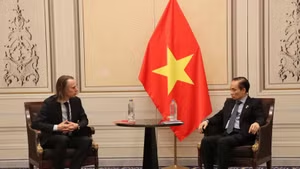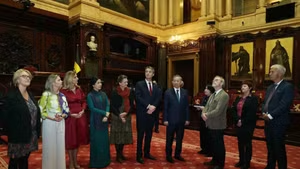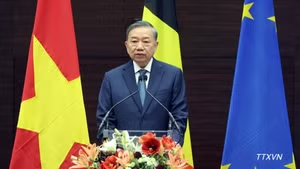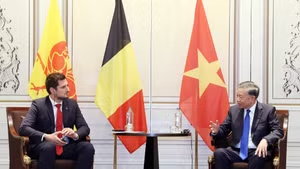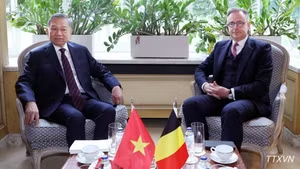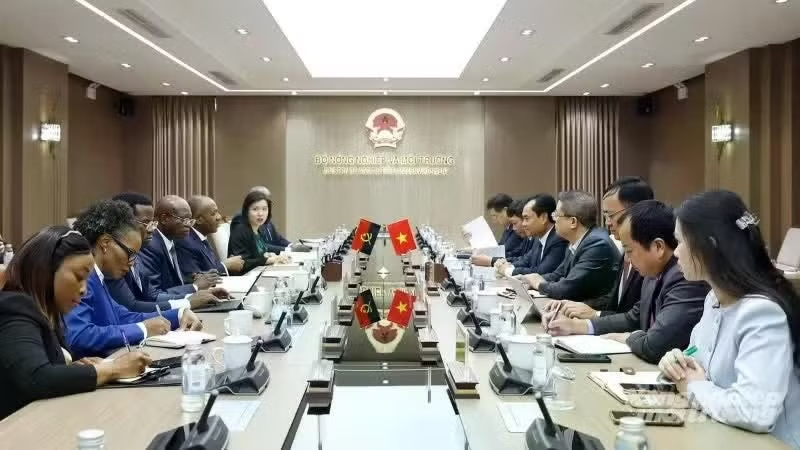
The meeting, held during the delegation’s June 15–22 visit to Viet Nam, followed ministerial-level talks earlier the same day, and focused on implementing the agricultural cooperation action plan in 2025–2030 between Viet Nam’s Ministry of Agriculture and Environment and Angola’s Ministry of Agriculture and Forestry.
NAEC Director Le Quoc Thanh shared Viet Nam’s experience in developing its agricultural extension system, highlighting its role in transforming the country from a food-insecure nation into one of the world’s leading agricultural exporters.
He described agricultural extension as a vital bridge connecting scientists, businesses and farmers, stressing that agricultural success depends not only on advanced technologies but also on effective systems that help farmers apply technological advances and innovations in practice.
Thanh affirmed Viet Nam’s readiness to share experience with and support Angola in building a suitable agricultural extension system by sending experienced experts and technicians in crop cultivation, forestry, irrigation, and rural development to Angola.
These specialists, he said, will help conduct field surveys, establish technical demonstration models, provide training, and transfer technologies to local managers and farmers, for tangible and measurable results on the ground.
He added that training local agricultural extension personnel and developing practical demonstration models is key to ensuring the long-term sustainability of all agricultural cooperation projects between the two countries.
For his part, Isaac dos Anjos applauded Viet Nam’s agricultural achievements and its agricultural extension network’s contributions to productivity growth and rural development.
He noted that Angola possesses vast agricultural potential, with abundant arable land and favourable natural conditions, but much of that potential remains underutilised. As the country pursues sustainable agricultural development, national food security, and improved rural livelihoods, Angola is keen to learn from practical and relevant experience of nations that have made significant progress in the sector, including Viet Nam.
The minister said Angola particularly hopes to receive Viet Nam’s support in cultivation techniques, technology transfer, and integrated agricultural solutions for key crops, including rice, cassava, and soybean, as well as forestry development.
Beyond technical assistance, Angola seeks cooperation in capacity building for agricultural technicians, agricultural extension officers, and farmers through training programmes in both countries, he said.
The Angolan side also expressed a desire to revive the rice cultivation project in Canzar, Lunda Norte province, which was first studied with the Vietnamese government’s assistance in 2015. The minister pledged favourable conditions in procedures, land access, and policies for Vietnamese experts and businesses operating in Angola.
The two sides also discussed expanding South-South cooperation as well as trilateral and multilateral partnerships involving international organisations and development partners. These mechanisms, they said, could help mobilise financial and technical resources for projects related to seed systems, nurseries, tissue culture, agricultural mechanisation, and agro-processing value chains in Angola.
The two sides agreed to work together to develop feasible and high-quality projects that can be implemented soon, contributing to Angola’s food security and promoting a successful model for South-South cooperation.
During its visit, the Angolan delegation is also scheduled to work with Vietnamese forestry and agricultural research institutes, visit Ninh Binh province, meet businesses, and study Viet Nam’s rice production, aquaculture, and animal feed models. The visit reflects the determination of the two countries to deepen agricultural cooperation.