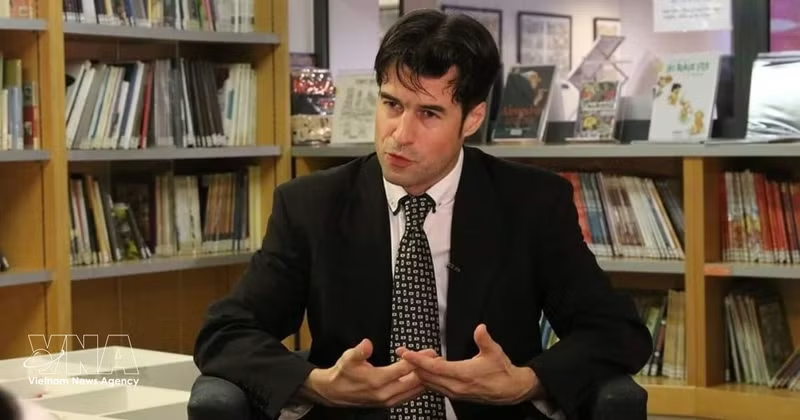
Viet Nam - France relations are living through an “acceleration of history”, with high-level exchanges at an unprecedented pace and trust between the two countries’ leaders increasingly evident, said Prof. Pierre Journoud, a contemporary history scholar at the University of Montpellier Paul-Valéry.
That backdrop gives added weight to the official visit to France by General Secretary of the Communist Party of Viet Nam (CPV) Central Committee and President To Lam, which came as bilateral ties enter a new phase under their Comprehensive Strategic Partnership, Journoud told Viet Nam News Agency reporters in Paris.
Journoud, who heads the Tremplin for Viet Nam University Diploma and cooperation with Viet Nam and serves as President of the France-Viet Nam Initiatives Association, said the visit further underscores the exceptional pace of high-level exchanges in the long history of ties between the two countries.
The French historian broke the relationship into three major phases, including rapprochement from the mid-1950s to the mid-1990s, a deepening of ties through the early 2020s, and acceleration since 2024.
According to him, the rapprochement followed a nearly nine-year war in Indochina and moved cautiously and gradually, driven by leaders on both sides. High-level political dialogue resumed in 1954, laying the groundwork for economic and cultural ties despite pressure from inside and outside both countries. In 1965-1966, President Charles de Gaulle and President Ho Chi Minh achieved a substantive political understanding without ever meeting face to face.
Another key milestone landed in 1993, when President François Mitterrand and General Secretary of the CPV Central Committee Do Muoi opened a major new phase in Viet Nam-France reconciliation, setting the two countries on a path toward cooperation across diplomacy, public administration, economy, science - technology, culture, law and national defence.
Journoud called Mitterrand’s visit to Viet Nam at the time a courageous decision, as it drew criticism even from his own inner circle. Symbolically, the visit marked the end of Viet Nam’s isolation on the global and regional stage. Viet Nam's entry into the Association of Southeast Asian Nations (ASEAN) in 1995 and its hosting of the 7th Francophonie Summit in Ha Noi in 1997 cemented the shift.
Conditions remained favourable through the first quarter of the 21st century as Viet Nam's economy took off, Journoud said. Ties reached a new level in the 2010s with the establishment of the Strategic Partnership in Paris in 2013, President François Hollande’s state visit to Viet Nam in 2016, and Prime Minister Édouard Philippe’s official visit in 2018.
The 2020s, however, have produced truly unprecedented milestones. On May 7, 2024, French Government members attended a ceremony in Viet Nam commemorating the Dien Bien Phu Victory for the first time. The presence of Minister for the Armed Forces Sébastien Lecornu and Secretary of State for Veterans and Remembrance Patricia Mirallès at one of Viet Nam’s major commemorative events was seen by Ha Noi as a strong signal that could pave the way for the next stage in the bilateral ties.
That next stage was reflected in the establishment of a Comprehensive Strategic Partnership in Paris in October 2024, making France the first European country with which Viet Nam established such a framework. It was followed by President Emmanuel Macron’s state visit to Viet Nam in May 2025.
Journoud also noted that relatively few General Secretaries of the CPV Central Committee have visited France. Previously, General Secretary Le Kha Phieu visited in 2000, General Secretary Nong Duc Manh in 2005 and General Secretary Nguyen Phu Trong in 2018. According to media reports, General Secretary Lam has visited France four times, including twice as Minister of Public Security in 2021 and 2022, a third time for the 19th Francophonie Summit in 2024 when Macron hosted him on October 7 and the two sides established their Comprehensive Strategic Partnership, and a visit in September 2026.
In his view, the frequency of high-level visits does not tell the whole story, but at the very least it reflects clear trust at the highest leadership level, which can then spread to government agencies and other stakeholders in both countries. It also demonstrates unprecedented efforts to translate trust into concrete results, despite practical obstacles that remain, primarily in the cultural, economic and financial spheres.
He said the development of constructive, long-term partnerships in clearly identified areas such as trade, ecological transition, transport, energy, space, defence industries, and education - training should be based on a shared ambition to propel each country’s socio-economic development and safeguard common geopolitical interests in a world very different from that of the 1990s when the Cold War ended.
Against the backdrop of Viet Nam’s ambitious economic development goals, including double-digit growth during 2026-2030, a transformation from the “world’s factory” into one of the leading countries in technology and artificial intelligence by 2045, a green transition and net-zero carbon emissions before 2050, Journoud said the top Vietnamese leader’s visit holds major significance for Viet Nam and France as Paris adjusts its Indo-Pacific strategy, seeking a more active and prominent diplomatic role while fueling its economic and trade interests.
Like many other middle powers, France and Viet Nam have shared concerns over latent imperial tendencies and a stake in bolstering strategic autonomy, he said, pointing to room for deeper cooperation in critical areas, such as jointly exploiting strategic minerals or France's training of Vietnamese engineers and experts, which will help Viet Nam build toward technological sovereignty.
![[In Pictures] General Secretary and President To Lam and his spouse visit and present books to Royal Library of Belgium](https://en-cdn.nhandan.vn/images/3NY4Z6Du1Md1PrS_s0ZZOrwc5xDfq4rRua69depr-TBkwatGjBcD9lagzrI2BmGDo4nKYA9qjKDjuB3-yYloL_1KbNBr00klMZQFyHQxQ6Jq6GzFfAiY0m5agKw6jNtArN4QnVntX8RQeUmD7pdCq7nwvn3e235v3kufpokBN_s/1-tong-bi-thu-chu-tich-nuoc-va-phu-nhan-tham-tang-sach-cho-thu-vien-hoang-gia-bi.jpg.avif)