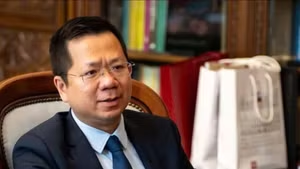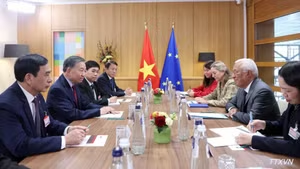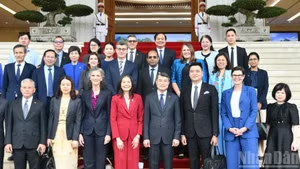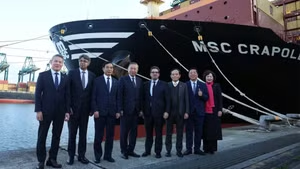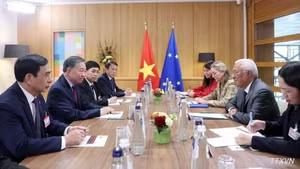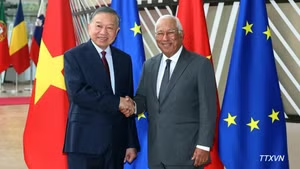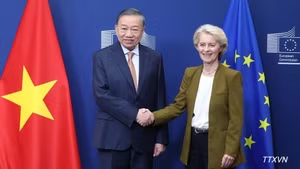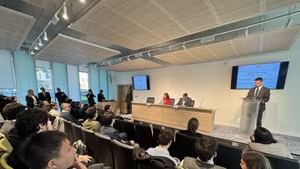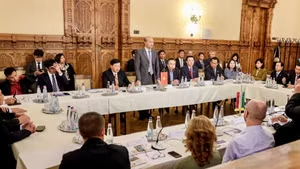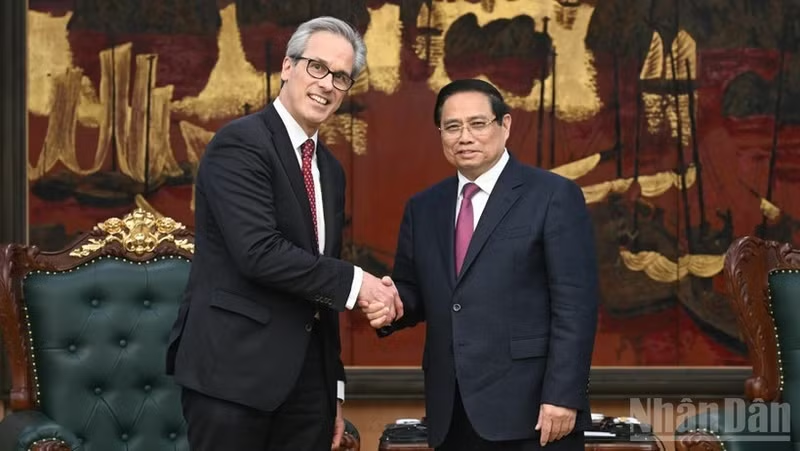
PM Chinh made the affirmation while receiving an inspection delegation from the European Commission (EC), led by its Director for International Ocean Governance and Sustainable Fisheries Fernando Andresen Guimaraes, who are on a working visit to Viet Nam to conduct the fifth inspection of the country's fight against IUU fishing.
Welcoming the delegation’s practical and effective visit, the government leader stressed that the EU is a leading important partner in Viet Nam’s foreign policy.
Reviewing the bilateral ties, particularly following the recent upgrade to a Comprehensive Strategic Partnership, the PM noted that political trust continues to be strengthened, while economic, trade and investment cooperation has maintained strong growth with ample room for expansion. The EU is currently Viet Nam’s fourth-largest trading partner, while the latter is the former’s largest trading partner in the Association of Southeast Asian Nations (ASEAN) and its 16th globally, with two-way trade reaching nearly 74 billion USD in 2025. The EU is also Viet Nam’s sixth-largest investor.
Highlighting the significance of the EU–Viet Nam Free Trade Agreement (EVFTA) and the EU–Viet Nam Investment Protection Agreement (EVIPA), he said these frameworks provide fresh momentum for investment cooperation and help EU businesses better connect with ASEAN markets.
Sharing Viet Nam’s development strategy toward its centennial goals of becoming an upper middle-income developing country by 2030 and a high-income developed nation by 2045, PM Chinh underscored that sustainable fisheries development remains a key national priority.
He stressed that Viet Nam’s efforts to combat IUU fishing are driven not only by the EC’s recommendations, but also by the country’s commitment to sustainable fisheries and its national reputation. He expressed his sincere appreciation to the EC for accompanying Viet Nam throughout this process, noting that Viet Nam has maintained proactive and close coordination with EC agencies over the years.
The Government, ministries, localities, businesses and fishing communities of Viet Nam have implemented comprehensive and resolute measures to tackle IUU fishing such as improving the legal framework, strictly penalising violations, tightening fleet management, enhancing control over imported aquatic product origins, and introducing policies to support livelihood transitions for fishermen.
On the basis of the EU-Viet Nam Comprehensive Strategic Partnership and with a constructive approach, PM Chinh affirmed Viet Nam’s continued close cooperation in combating IUU fishing, while expressing his hope and confidence that the EC will consider lifting the “yellow card” warning against Vietnamese seafood, thereby further strengthening effective and substantive cooperation between Viet Nam, the EU and its member states.
For his part, Guimaraes thanked PM Chinh for the reception, describing it as a clear signal of the Vietnamese Government’s strong commitment to combating IUU fishing.
He noted that the EC has accompanied Viet Nam in this effort for over eight years and has observed significant and steady progress, particularly in establishing a robust fisheries control system, including vessel monitoring systems (VMS) and seafood traceability mechanisms.
The EC delegation expressed confidence that Viet Nam successfully addresses shortcomings, meets the EC’s recommendations and achieves effective fisheries governance.