Vietnam and Cambodia are neighbouring countries with time-treasured relations. Their shared border is approximately 1.137km long running through 10 provinces of Vietnam and nine provinces of Cambodia. Promoting the traditional friendship and comprehensive co-operation between the two countries and building a peaceful, stable, friendly, co-operative and sustainably developed border are always strategic targets prioritised and followed by both countries’ high-level leaders. The two countries have signed many agreements on marking the whole shared land border and fulfilled over 80% of boundary delimitation.
Vietnam and Cambodia signed a Treaty on the Principle for Border Issues Resolution on July 20, 1983, which became effective on September 27, 1983 (1983 Treaty). Based on principles regulated in the Treaty 1983, a Treaty on the Delimitation of National Boundaries between the two countries was inked on December 27, 1985 (1985 Treaty), which came into effect on February 22, 1986. Then on October 10, 2005, a Supplementary Treaty to the 1985 Treaty (2005 Supplementary Treaty) was concluded and became effective on December 6, 2005.
On the basis of the 1985 Treaty and the 2005 Supplementary Treaty, the two countries have so far fulfilled over 80% of boundary delimitation.
Based on the situation, representatives from the Vietnamese and Cambodian Governments inked a Memorandum of Understanding (MoU) on land border adjustment in remaining areas (2011 MOU) on April 23, 2011. The two sides agreed to maintain the border under their actual management based on a balanced converted legal border in terms of area and interests without affecting the lives and production of people living along the shared border. They fulfilled land exchanges in several regions of six province duos: Tay Ninh-Tboung Khmum, Tay Ninh-Svay Rieng, Dong Thap-Prey Veng, An Giang-Takeo, Kien Giang-Takeo and Kien Giang-Kampot.
While waiting for the completion of land border demarcation, the two countries pledged to manage their border in accordance with the 1983 Treaty and the joint press communique issued on January 17, 1995 (1995 Communique) during the working visit to Vietnam of First Prime Minister of the Royal Government of Cambodia, Prince Norodom Ranariddh.
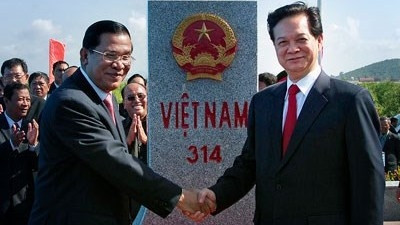
The two markers No.30 and No.275, together with marker No.314, were agreed on by the two PMs in an MOU dated April 23, 2011. Representatives from both sides agreed to commence the construction of the two markers in Phnom Penh on November 20, 2015. With the completed construction of the two markers, the two countries have fulfilled identification and construction of all ten big markers engraved with both countries’ national emblems at shared international border gates between the two countries. Together with the marker at the border junction between Vietnam, Laos and Cambodia, the marker No.314 and 297 other main markers, it can be said that markers between the two countries have been basically completed. The inauguration ceremonies are significant, affirming the boundary delimitation and demarcation carried out by both countries, reflecting the resolution of leaders and people of the two countries in completing the land border demarcation and contributing to consolidating and promoting the traditional friendship between Vietnam and Cambodia.
In the coming time, the two sides will continue collaboration to complete the boundary delimitation, border demarcation and management in accordance with the 1983 Treaty and the 1995 Communique.