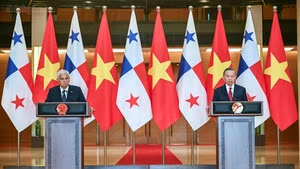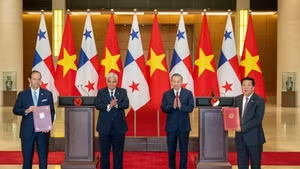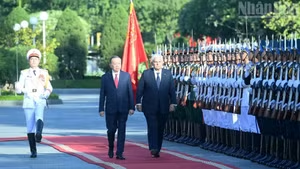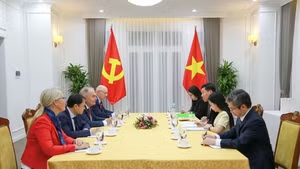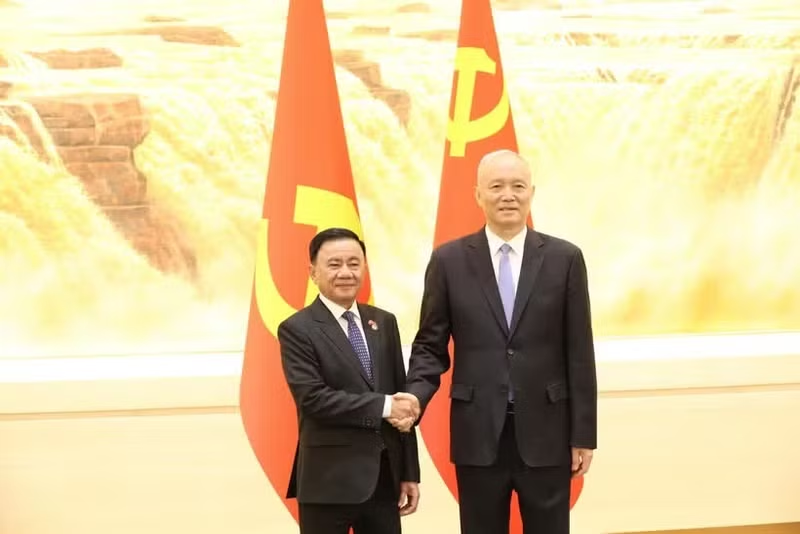
Politburo member and Permanent member of the Communist Party of Viet Nam (CPV) Central Committee’s Secretariat Tran Cam Tu held talks with Cai Qi, member of the Standing Committee of the Political Bureau of the Communist Party of China (CPC) Central Committee, Secretary of the CPC Central Committee’s Secretariat and Chief of the CPC Central Committee’s Office on April 15 in Beijing.
The talks took place within the framework of the state visit to China by General Secretary of the CPV Central Committee and State President To Lam.
Both sides noted with satisfaction that under the leadership of the two Party General Secretaries and Presidents, Viet Nam–China relations have have grown positively, comprehensively, substantively and intensively.
They underscored that Party-to-Party exchanges have continued to play a pioneering role in guiding strategic orientation and effectively implementing high-level common perceptions.
Affirming the important outcomes of the high-level talks between the top leaders, the two sides discussed measures to further realise these shared understandings, promote the distinctive advantages of Party channels, and elevate strategic connectivity to a new level in the coming period.
Both sides agreed to maintain regular exchanges between the two top leaders through flexible formats, while enhancing the effectiveness of high-level Party-to-Party exchanges as well as the coordinating role of the annual meeting mechanism between the Party Committee of the Ministry of Foreign Affairs of Viet Nam and the International Department of the CPC Central Committee. They stressed the importance of implementing the bilateral cooperation plan for 2026–2030, including training for officials, especially those at the strategic level, and expanding theory exchanges between the two Parties.
They consented to step up cooperation between central Party agencies and local Party organisations, particularly in border localities. The Chinese side affirmed its readiness to share experience and coordinate with Viet Nam in the construction of a CPV museum.
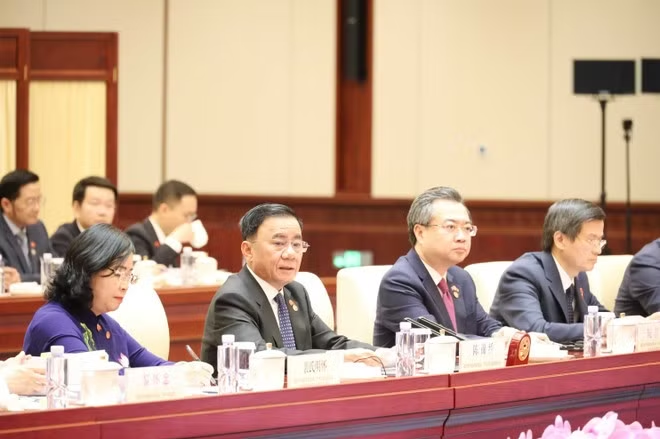
Tu proposed closer coordination to further strengthen strategic trust, safeguard political security, and enhance cooperation among key agencies of both countries. He also emphasised the effective implementation of the ministerial-level “3+3” strategic dialogue on diplomacy, defence and public security. The official called for differences to be settled satisfactorily based on high-level common perceptions and in line with international law, helping maintain a peaceful and stable environment for both countries.
He highlighted the need to build a solid material foundation for bilateral ties by accelerating strategic infrastructure connectivity, giving top priority to railway cooperation, promoting more balanced and sustainable trade, and advancing collaboration in science and technology, innovation and digital transformation.
He also called for stronger people-to-people exchanges and effective implementation of the Viet Nam–China Tourism Cooperation Year 2026–2027, as well as closer cooperation in culture and education. Both sides were urged to support each other in hosting major international events, including APEC 2026 in China and APEC 2027 in Viet Nam.
The Chinese official expressed strong agreement with the proposals, stressing the irreplaceable importance of strategic exchanges between the two Party chiefs. He called for prompt implementation of the high-level consensus reached during General Secretary and President Lam’s visit, while further deepening theory exchanges and experience sharing in Party building and national governance.
He affirmed that China is ready to share development opportunities with Viet Nam, promote modernisation, and create new breakthroughs in emerging areas such as science and technology, innovation, and high-quality human resources training.
Both sides agreed to further strengthen people-to-people exchanges and better manage and resolve differences on the basis of high-level common perceptions and in line with international law.