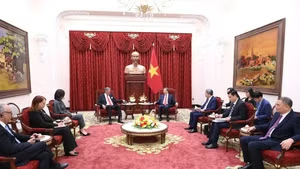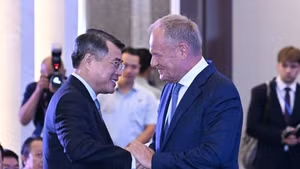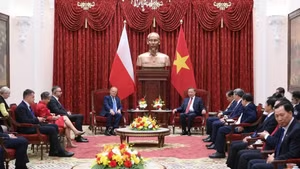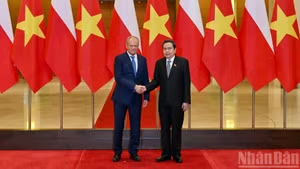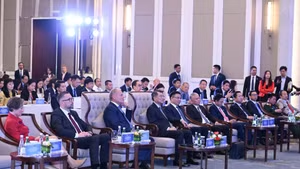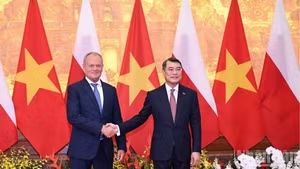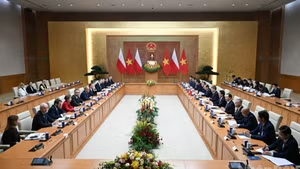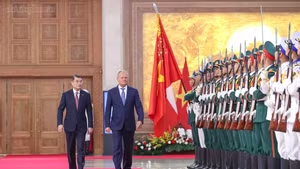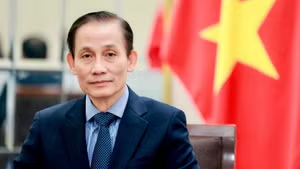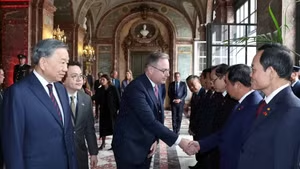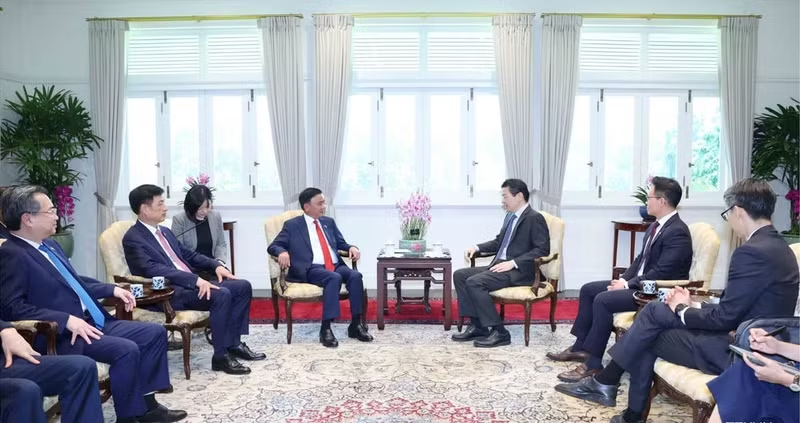
Welcoming Tu and the high-ranking CPV delegation, Wong described the visit and the first Singapore-Viet Nam Strategic Dialogue as significant milestones in the bilateral relations. He said the new mechanism will help complete the three pillars of bilateral relations – Party diplomacy, State diplomacy and people-to-people diplomacy, thus strengthening political trust and creating fresh momentum for the Singapore-Viet Nam Comprehensive Strategic Partnership.
Tu congratulated Singapore on its important achievements in socio-economic development, growth model transformation and the enhancement of its international standing, while affirming that Viet Nam always attaches importance to its relations with Singapore and wants to work closely with Singapore to make the Comprehensive Strategic Partnership increasingly substantive and effective, in line with the two countries’ interests and long-term development visions.
Speaking highly of the outcomes of the first Strategic Dialogue, he said it marked the first meeting of a mechanism agreed upon by the two sides during General Secretary of the CPV Central Committee and President To Lam’s state visit to Singapore in May 2026. He hailed the early organisation of the mechanism as a strong demonstration of the two Parties’ commitment to implementing high-level agreements.
The two sides agreed that the dialogue will help establish a direct, regular and strategic channel for exchanges between the two Parties, through which they can conduct in-depth discussions on Party building, policy making, governance and national development, while sharing views on strategic issues of mutual concern, thereby strengthening the Party-to-Party channel’s role in providing strategic orientations for the bilateral ties.
The two leaders agreed to maintain high-level and all-level delegation exchanges and meetings, promote existing cooperation mechanisms, and enhance connections among Party and State agencies, legislative bodies, localities and people’s organisations, in order to create a solid political foundation for effectively implementing the Comprehensive Strategic Partnership.
Regarding new drivers of cooperation, the two sides underscored the need to make science, technology and innovation an important pillar of the bilateral relations. They committed to stepping up connectivity in emerging technologies, artificial intelligence (AI), digital transformation, digital economy, semiconductor technology, clean energy and green finance, while leveraging complementarities between the two innovation ecosystems.
The key Vietnamese leader proposed strengthening links among the State, universities and research institutes and businesses in Viet Nam and Singapore in the field of innovation cooperation.
The two sides also discussed personnel training and high-quality human resources development. They agreed to expand exchanges and experience sharing in Party building, governance, policy making, personnel training and human resources development, considering these areas an important foundation for long-term and sustainable collaboration.
Wong affirmed that Singapore highly evaluates Viet Nam’s role, potential and development prospects and wishes to continue accompanying Viet Nam in its development process. He agreed that there remains considerable room for the two countries to expand cooperation beyond traditional areas into sectors with higher technological, knowledge and value-added content.
The two sides stressed the need for ministries, sectors, localities, businesses, universities, research institutes and innovation centres to work together to translate common perceptions and high-level agreements into concrete programmes and projects with clear objectives, roadmaps and products, with businesses playing a central role in turning cooperation commitments into reality.
They also reached consensus on continued close coordination within the Association of Southeast Asian Nations (ASEAN) and other multilateral mechanisms, contributing to ASEAN's solidarity and unity, enhancing the bloc’s self-reliance and strengthening its central role in the regional architecture.
Tu expressed his belief that the outcomes of his visit and the first Strategic Dialogue will create new momentum for relations between the two Parties and countries, helping turn potential into projects, agreements into action, and cooperation into joint value creation, thus advancing the Comprehensive Strategic Partnership in a deeper, more substantive, effective and sustainable manner.