Vietnamese representatives highlighted that ASEAN remains one of the world’s most dynamic and resilient growth regions, with the potential to become the fourth-largest economy globally by 2030. Emerging growth drivers include industrial transformation, digital innovation and green growth, with the digital economy, artificial intelligence and energy transition playing a pivotal role in boosting productivity and competitiveness.
In this context, Viet Nam proposed that ASEAN should focus on developing trusted common frameworks for digital identity, data governance and cybersecurity to reduce fragmentation and foster digital trade and innovation; promoting linked industrial clusters, technology transfer, skills development, and ASEAN’s position in regional and global value chains; prioritising sustainable and transition finance to mobilise private resources for green growth; and accelerating the development of the ASEAN power grid and cross-border clean electricity trade to ensure energy security and inclusive growth.
At the forum, Viet Nam reaffirmed its commitment to fast, inclusive and sustainable growth, along with institutional reform, digital transformation and the transition to a low-carbon economy, with the goal of achieving net-zero emissions by 2050. The country also underscored its readiness to work closely with other ASEAN members and international partners for shared regional prosperity.
Taking place from January 19 to 23, the WEF Annual Meeting brings together nearly 3,000 delegates from more than 130 countries, including around 60 heads of state and governments, leaders of major international organisations, ministers in charge of economy, finance, foreign affairs, trade and industry, central bank governors, as well as nearly 850 CEOs and chairpersons of leading global corporations, unicorn enterprises and technology pioneers. It is among the largest global leadership gatherings outside the United Nations since the COVID-19 pandemic.
Held amid intertwined complex global challenges, the meeting is expected to serve as a platform for dialogue and cooperation to identify common interests and devise practical pathways for government – business collaboration.
Over four working days, more than 400 panel discussions are organised, including over 200 public sessions livestreamed on social media, focusing on five key themes: cooperation in a fragmented world, unlocking new growth drivers, deploying responsible innovation at scale, building prosperity within planetary boundaries, and investing better in people.
On the sidelines of the meeting, events jointly organised by the Ho Chi Minh City and Da Nang administrations and the Ministry of Foreign Affairs introduced special mechanisms and policies for Viet Nam’s International Financial Centre in Ho Chi Minh City and Da Nang to international partners, along with new investment opportunities in the country. These efforts aim to attract high-quality resources, green and digital finance, and innovation, thereby helping to enhance national competitiveness, support sustainable development, and realise Viet Nam’s long-term goal of becoming an upper-middle-income developing country by 2030 and a developed country by 2045.
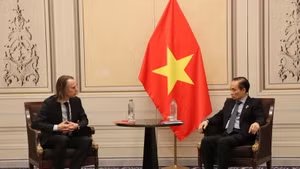
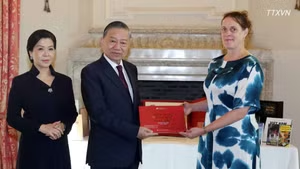
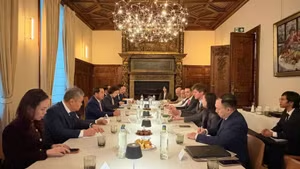
During the meeting, the Vietnamese delegation also held bilateral engagements with WEF leaders, representatives of the Swiss and Cambodian governments, and major international corporations such as Allianz SE and JTI.
Partners praised Viet Nam’s investment and business environment and reaffirmed their commitment to expanding substantive cooperation in the coming period.