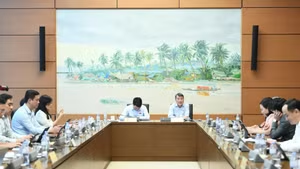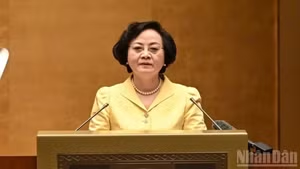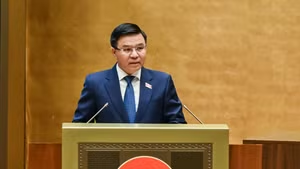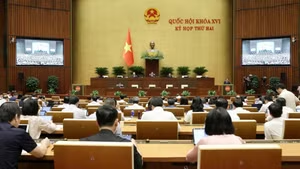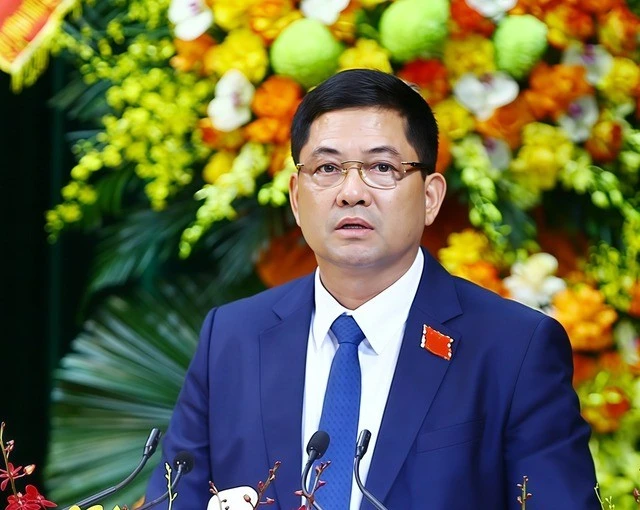
According to Thai, the 14th National Party Congress marks the beginning of a new development phase for the country, with higher requirements for growth quality, autonomy and sustainability. Within this overall framework, Bac Ninh has clearly identified its goal of becoming a centrally governed city as a process of comprehensive upgrading, not only in terms of administrative status, but also in its development model, governance capacity and quality of life for its people.

Following the recent administrative merger, Bac Ninh has entered a new stage of development with a larger space, greater development potential and more abundant resources, alongside higher governance demands. The province’s overarching vision is to achieve rapid yet sustainable growth, modernisation while preserving cultural identity, and economic expansion closely linked with social progress, environmental protection and improved living standards.
On the foundation of the orientations set by the 14th National Party Congress, Bac Ninh has identified science and technology, innovation and digital transformation as key driving forces; people and businesses as the centre of development; Kinh Bac cultural heritage as a spiritual foundation and endogenous strength; and discipline, order, effectiveness and efficiency of the political system as essential guarantees.
Thai stressed that this approach will enable Bac Ninh to grow fast while remaining resilient and sustainable in the long run, fully meeting the conditions required to become a centrally governed city before 2030.
Reviewing recent development performance, the provincial Party Secretary noted that Bac Ninh has maintained high and stable growth, remaining among the country’s leading localities. In 2025, the province’s gross regional domestic product (GRDP) at current prices was estimated at over 522 trillion VND (nearly 19.9 billion), up 10.27%, placing Bac Ninh among the group of provinces recording double-digit growth. Its economic structure has continued to shift in a positive direction, with industry as the main growth engine.
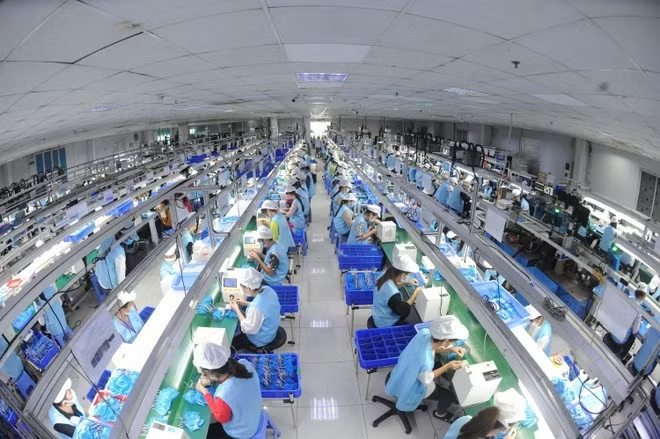
Notably, Bac Ninh’s total import-export turnover reached 182 billion USD, accounting for nearly 20% of the national total and making it one of Vietnam’s two largest import-export hubs. Foreign direct investment attraction and State budget revenue have also remained among the highest nationwide, underscoring the province’s strong investment appeal and providing important resources for development.
Alongside economic growth, Bac Ninh’s socio-economic landscape has become increasingly comprehensive and balanced. Trade and services have expanded dynamically in tandem with urbanisation and economic space expansion. Transport, urban and digital infrastructure have been invested in synchronously, opening up new development opportunities. Agriculture has shifted toward an ecological, high-tech and multi-value orientation, while culture, education, healthcare and social welfare have received greater attention, contributing to improved material and spiritual living standards for the people.
However, to sustain high growth while shifting toward greater depth, quality and sustainability, Bac Ninh has identified the need to create new, decisive growth drivers. The focus is on transitioning from scale-based growth to growth driven by quality, efficiency and productivity. Key measures include reviewing and adjusting provincial and urban master plans; restructuring the economy toward high-tech, green and supporting industries and the digital economy; accelerating investment in strategic and inter-regional transport infrastructure; promoting private sector development and stronger linkages between foreign-invested and domestic enterprises; and advancing comprehensive digital transformation as a form of “soft infrastructure” for new growth.
To realise the goal of becoming a centrally governed city, Bac Ninh has defined three strategic breakthroughs. The first one is institutional reform and improved development governance, with an emphasis on decentralisation combined with stronger supervision, administrative discipline and the building of a digital, service-oriented government.
The second breakthrough is human resource development, regarded as the most sustainable breakthrough, focusing on building a capable, responsible cadre contingent and attracting high-quality talent in key sectors.
The third breaksthrough is the development of modern, synchronised infrastructure, particularly transport, industrial, urban and digital infrastructure, to expand development space and strengthen connectivity with Hanoi and the capital region.
Throughout this process, Thai underscored that people are both the centre and the ultimate goal of development. Preserving and promoting Kinh Bac cultural identity is seen not only as safeguarding heritage, but also as creating a long-term competitive advantage and endogenous resource. Coupled with strict environmental protection and green development, this approach aims to make Bac Ninh a truly liveable, investable and sustainable city in the years ahead.