These days, the small house in Van Phuc Silk Village (Ha Dong, Ha Noi), where President Ho Chi Minh wrote the Call for National Resistance, have welcome many visitors who come to learn about the history of this significant place.
Here, in late 1946, during the urgent preparations for the resistance against the French colonial invaders, President Ho Chi Minh stayed and worked at the house of Nguyen Van Duong from December 3-19, 1946.
During his time here, he worked with the Party and government leaders to resolve important revolutionary tasks.
At this house, on December 18 and 19, 1946, President Ho Chi Minh presided over the expanded meeting of the Central Standing Committee, launching the nationwide resistance against the French colonial invasion.
Just stepping through the small gate, a simple yet sacred space unfolds. Many artifacts associated with the time President Ho Chi Minh lived here are still preserved, such as the khaki jacket he wore, the copper basin, and the dumbbells he used daily. The site dedicates a separate space to introduce the family of Nguyen Van Duong. Later, his family donated the house to the state to be used as a place to display and preserve historical memories.
The second floor features the display of a restored version of how Uncle Ho lived and worked. The small room on the left, less than 12 square metres, still contains the simple wooden bed Uncle Ho used, with a red painted wooden pillow. Next to the bed is a work desk with a baluster base; on the desk is an oil lamp and the manuscript of the “Call for National Resistance”. After 79 years of historical upheavals, the room where Uncle Ho wrote the Call has been still well-preserved, protecting the artifacts he used back then.
Returning to visit the house for the second time, Pham Van Hai (75 years old, from Ninh Binh Province) emotionally shared: “At the Ho Chi Minh Memorial House in Van Phuc, I felt the warmth, simplicity, and modesty of Uncle Ho; it reminded me of the comrades who fell for the independence and freedom of the nation. Places like this are the best places to educate the younger generation about revolutionary traditions.”
Responding to President Ho Chi Minh’s Call National Resistance and driven by patriotism and a determination to defend the homeland and the nation’s fledgling independence, the people and soldiers of Han Noi embarked on a life-or-death struggle against the French invaders. Ha Noi became the main battlefield in the early days of the nationwide resistance.
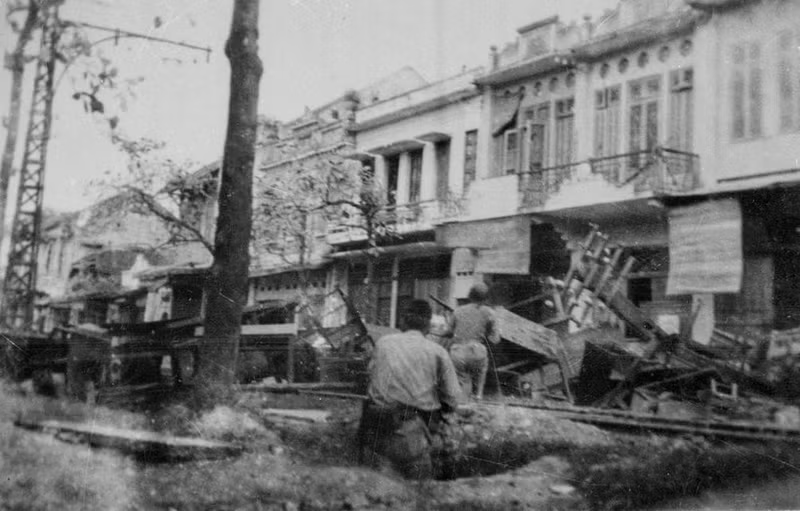
According to Le Duc Van (one of the early members of the Hoang Dieu National Salvation Youth Union), as early as October 1946, the people of Ha Noi were mobilised to evacuate, leaving only young people, volunteers, police, soldiers, and cadets behind. The digging of trenches and the breaking of walls connecting houses were carried out day and night. Each area had a weapons depot, a logistics depot, and a first-aid station. Short-term courses on military skills, first aid, and propaganda were quickly opened in many neighbourhoods.
In early December 1946, Le Duc Van was assigned to work at the Inter-Regional II Resistance Committee, in charge of communication and transmitting coded orders from the command to the combat units. He led a squad of about 10 cadets aged 14-15 who worked as liaisons.
Van recalled: “Back then, communication means were very limited; only special units were equipped with hand-crank telephones. Therefore, to ensure military secrecy, secret messages were written in the form of numbers and given to the liaison boys to deliver to the operational headquarters. The numbers were converted into letters through a system of characters based on page and line numbers in some books.”
During the 60 days and nights of fighting to defend Ha Noi and trap the French enemy, Vietnamese forces secretly dug combat fortifications, trenches, created obstacles, and formed barricades at the city gates and on the streets to hinder enemy mechanised forces. Having joined the revolution in 1944, Nguyen Tien Ha (from the Hoang Dieu National Salvation Youth Union) volunteered for the army as soon as the nationwide resistance began. Even at the age of 98, he still vividly remembers the heroic moments of his first battle in military uniform: the decisive battle of “O Cau Den” in Bach Mai, within Military Zone II (now Bach Mai Ward).
Recalling that challenging yet proud period, Nguyen Tien Ha recounted: “The Ha Noi War Zone was divided into three zones: Zones I, II, and III, forming a continuous battle formation. The task of these zones was to wear down the enemy's forces and hold back the French army from expanding the front.
“The armed forces and self-defence units, armed with rifles, grenades, three-pronged bombs, machetes, knives, and swords, erected fortifications and obstacles to continuously repel enemy attacks. At that time, I participated in the Bach Mai self-defence force (belonging to Military Zone II).”
At the O Cau Den fortifications, fierce battles took place from December 20, 1946, to January 17, 1947; the enemy launched numerous large-scale attacks on O Cau Den and other areas of Military Region II such as the Mai Hac De intersection, the Thai Phien intersection, Hue Street, Dai Co Viet, and the Vietnam Academy. In the battle at Hom Market, our soldiers embraced three-pronged bombs and charged into enemy tanks.
In the Dong Thanh area, a rifle team shot down a French aircraft on the spot. Vietnamese troops and people stopped and repelled the enemy’s attacks. This courageous spirit struck fear into the enemy. With indomitable spirit, the soldiers of Hanoi, symbolised by the “O Cau Den” defensive line, bravely fought to hold back the enemy for 21 days (from December 25, 1946 to January 15, 1947), contributing to the defeat of the French colonialists’ “quick attack, quick victory” plan and the overall victory in the 60 days and nights of defending the capital city of Ha Noi.
According to Dang Thanh Tu, Secretary of the Hoan Kiem Ward Youth Union: For the youth of Hoan Kiem Ward, a land rich in revolutionary traditions of the capital, that history becomes even more familiar and a source of pride. It includes the image of the Ha Noi self-defence fighters, the core force in the August 1945 General Uprising; the first soldiers of the Capital Regiment who bravely fought in the early days of the nationwide resistance, such as Political Commissar Le Gia Dinh and the leader of the Hong Ha guerrilla team Nguyen Ngoc Nai; and tens of thousands of Hoan Kiem youths who “put aside their studies” to respond to the movement during the resistance against the US, ready to sacrifice for the independence and freedom of the Fatherland.
“These examples are not only history, but also a reminder and an impetus for today’s youth to raise their awareness and responsibility in studying, working, and contributing; to join hands in building a more civilised, prosperous, and beautiful Ha Noi,” Dang Thanh Tu shared.