Anyone who has been to Thailand will know that despite being a kind of noodle soup, Thailand’s Kuai-tiao bears no resemblance to the flavour of Vietnamese pho. Thai “pho” consists of noodles, pork leaves, minced pork, onion and raw vegetables along with brackish sweet broth. Unable to use Thai “pho” as a substitute any longer, we decided to scour Bangkok and found two Vietnamese pho restaurants.
Located on Din Daeng district’s bustling Ratchadaphisek Street, “Le Hanoi” restaurant was full of diners from noon to midnight. Despite differences in nationalities, all had the same passion for Vietnamese pho and the traditional dishes prepared by owner Nguyen Hong Hoa, aged approximately 60. Meeting with Hanoi compatriots, Hoa could not hide her joy. She said that since arriving in Thailand 18 years ago, she had a number of jobs and eventually decided to open a restaurant. Le Hanoi came into existence from that moment.
Covering an area of 60 square metres, Le Hanoi is always crowded with diners, and sometimes those coming late had to line up to wait to be served. The menu was diverse, ranging from key dishes, such as beef pho and chicken pho, to ‘banh cuon’ (steamed rice rolls) and various types of noodle soups. Le Hanoi’s menu was similar to a tourism journal as well. Besides dishes in Vietnamese, English and Thai, the menu also introduced the historical traditions and beautiful landscapes of Vietnam, including Hanoi, Hoan Kiem Lake, Hoi An Ancient Town and Hue Imperial City.
The restaurant name “Le Hanoi” and the icon of Khue Van Cac (constellation of literature pavilion) has already been registered for copyright at the Thai Ministries of Science and Technology and Commerce. In 2012, Le Hanoi won the second prize in the food contest entitled “Rhythm of the Earth” held in Bangkok with the dish “Mushroom-stuffed chicken thigh” cooked by its owner Hoa. The event is a prestigious international cuisine contest drawing the participation of numerous chefs and restaurants from the US, Europe and Asia.
Hoa is hatching a plan to pass down her dish-cooking experience to several Vietnamese people she considers her offspring, aiming to preserve and develop the art of Vietnamese cuisine in Thailand. If her wish comes true, Hoa will return to Hanoi. After 20 years in Thailand, she still retains her Vietnamese nationality and keeps a house on Giang Vo Street as a place to come back when she’s older.
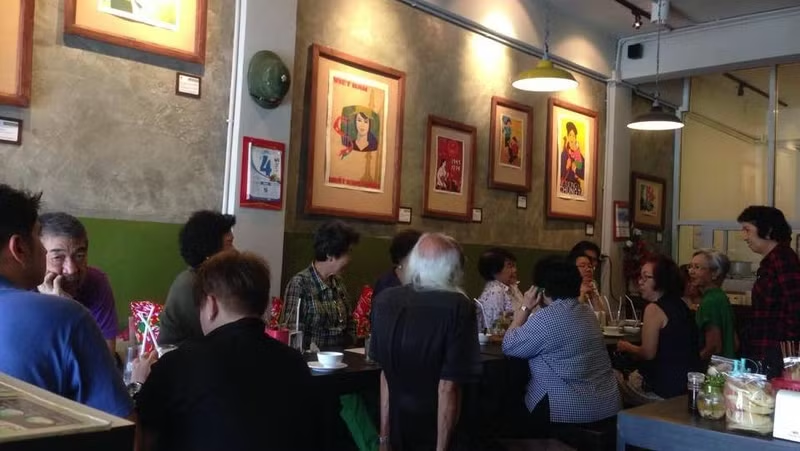
Like Le Hanoi, diners to Pho Van restaurant, located at 506 Ramkhamhaeng Street in Bangkok’s Bang Kapi district, are impressed with “very Vietnamese” decorations by its mistress Nguyen Thi Van Anh. Despite being in operation for just one year and situated in an unfavourable location, Pho Van is a popular destination for those who wish to enjoy the flavour of Vietnamese pho. There are a variety of dishes on offer but it is beef pho that is a highlight for the restaurant.
Despite being born in a locality with no pho traditions, Van Anh still dreamt of introducing pho with the Hanoi-standard flavor to Thai and international friends one day. The 1982-born woman said that it was owing to the affinity that she became the owner of a Vietnamese pho restaurant in Thailand. Ten years ago, her Singaporean husband went on a business trip to Vietnam and fell in love with Van Anh, who was running a clothing shop in Tho Nhuom Street at that time. Determined to get married to each other, he came back to Singapore to prepare marriage procedures, while she both took care of her shop and started studying English.
After several years in Singapore, Van Anh moved to Bangkok along with her husband who had to arrive in Thailand to work as a specialist. Because of her craving for pho, Anh was determined to search for pho cooking secrets, firstly in order to cook for her family and then invite friends to enjoy and give comments. After discovering the standard recipe, she launched a restaurant named “Pho Van”. The greasy flavor, sweetness of broth and the unique smell of well-cooked or rare-cooked beef pho at Pho Van could be compared with those of famous restaurants in Hanoi.
Diners to Pho Van can not only taste pho and traditional Vietnamese dishes but also immerse themselves in a space and music imbued with Vietnamese identities. The symbol of the restaurant is also comparatively special, with an image of a female militia wearing a bucket hat beside the national flag (a red flag with a yellow star). Van Anh came back to Vietnam to collect bucket hats, water canteens, rubber sandals as well as photos and paintings of Vietnamese landscapes and people and put them on display in her restaurant. Those items help bring about an intimate and homey feeling for diners, especially those living away from the homeland.
Pho prices at Le Hanoi and Pho Van are not cheap, ranging from VND60,000 (US$2.7) to VND90,000 (US$4.05) per bowl, but worth the chance to enjoy a bowl of Vietnam-standard pho abroad, thereby feeling more respectful to those who are always conscious of storing and preserving Vietnamese values in foreign countries.