Vietnamese travellers continue to favour beach and island destinations
Prestigious online travel platform Traveloka has released its Traveloka SEA Index report, providing an in-depth analysis of quarterly travel trends. The report is based on the platform’s proprietary search, research, and booking data across Southeast Asia.
The Traveloka SEA Index report recorded notable market movements in the second quarter of 2026, ranging from fast-growing destinations and emerging travel trends to changes in traveller behaviour. It provides useful insights for businesses and management agencies in developing tourism products and destinations.
Accordingly, Ho Chi Minh City, Ha Noi, and Da Nang continued to be the three most-booked destinations on the platform. Specifically, Ho Chi Minh City maintained its role as the country’s urban tourism hub, with approximately one in five domestic trips ending in the city. Meanwhile, Ha Noi maintained steady growth thanks to its cultural and historical advantages and diverse range of services.
Da Nang also recorded growth across multiple categories, from hotel bookings and attraction tickets to family travel. In particular, bookings for tickets to Sun World Ba Na Hills increased 132% year-on-year, reflecting the growing appeal of the coastal city’s experience ecosystem.
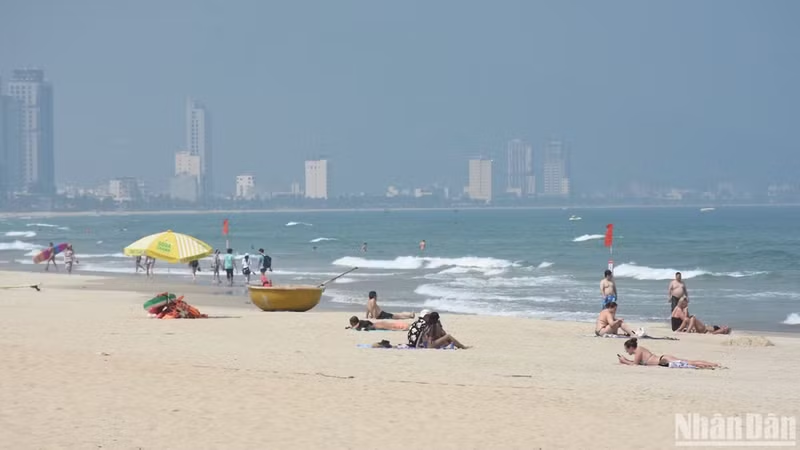
While travel demand in other markets across the region is shifting towards East Asia, tourism growth in Viet Nam continues to be driven by coastal destinations, led by Phu Quoc, Con Dao, Hoi An, and Da Nang.
Traveloka Viet Nam Director Huynh Thi Mai Thy
While the ranking by booking volume features familiar destinations such as Ho Chi Minh City, Ha Noi, and Da Nang, the growth in domestic bookings reveals a different picture. The strongest driver of domestic tourism currently comes from Viet Nam’s islands and coastlines.
According to Traveloka SEA Index’s demand score — a measure of a destination’s booking growth compared with the overall market — Phu Quoc ranked first with a score of 100, while also recording an 86% year-on-year increase in bookings. It was followed by Con Dao with 96 points, Hoi An with 92 points, and Da Nang with 88 points.
Traveloka Viet Nam Director Huynh Thi Mai Thy analysed: "While travel demand in other markets across the region is shifting towards East Asia, tourism growth in Viet Nam continues to be driven by coastal destinations, led by Phu Quoc, Con Dao, Hoi An, and Da Nang."
This shows that domestic travel demand is strongly concentrated on coastal destinations, where relaxation and cultural experiences are harmoniously combined.
Bangkok draws particular interest from Vietnamese travellers
According to Traveloka Viet Nam Director Huynh Thi Mai Thy, the Traveloka SEA Index report shows that Vietnamese travellers continued to favour destinations closer to home during the quarter. At the same time, demand for international travel is gradually picking up again.
"Bangkok was the most-searched destination among Vietnamese travellers this quarter, and travellers also tended to stay longer when visiting the city," Huynh Thi Mai Thy said.
Tracking the next-destination score, which measures travellers’ level of interest through searches before they turn into bookings, the Traveloka SEA Index showed that Bangkok (Thailand) remained the most-searched international destination among Vietnamese travellers during the quarter.
With searches increasing 61% year-on-year, demand among Vietnamese travellers for Bangkok continues to rise. Vietnamese travellers also tended to stay longer in the city, with the average length of stay increasing from 3.2 to 3.6 nights compared with the same period a year earlier.
Singapore also remained among the international destinations with the highest number of bookings by Vietnamese travellers, with its growth momentum strengthening compared with the previous quarter.
In terms of the demand score for the international market, Tokyo (Japan) was the fastest-growing international destination among Vietnamese travellers, with bookings increasing by more than 80% year-on-year. It was followed by Seoul (the Republic of Korea), where Vietnamese travellers spent more than twice the average amount of a typical trip. Meanwhile, Kuala Lumpur (Malaysia) maintained steady growth, continuing to be a reliable and cost-effective choice for Vietnamese travellers.
Overall, the Traveloka SEA Index report shows a distinctive trend among Vietnamese travellers this quarter: while travel demand across the wider region is shifting towards East Asia, Vietnamese travellers are booking destinations closer to home and spending more on coastal destinations.
Drawing on data compiled from millions of searches and bookings across Southeast Asia, the Traveloka SEA Index report gives travellers an overview to help them identify their next destinations. At the same time, it provides tourism partners with data to better understand the constantly changing tourism landscape.