Based on his viewpoints and thoughts, the national sports and physical training sector has reaped strong achievements in high-performance sports developed on the basis of amateur sport.
A constant investment priority
Developing sports and physical training is a crucial guideline and always receives appropriate attention and investment from the Party and State, which has created favourable conditions for the sector to make positive transformations over the past years. According to Prof. Dr. Duong Nghiep Chi, former head of the Vietnam Sport Science Institute, the biggest developments in Vietnam’s sporting sector can be seen in the field of policy. Vietnam has already promulgated a Law on Sports, approved numerous large-scale sporting projects and issued a number of decrees and circulars relating to the field, Chi noted. In recent years, sports policies have contributed to promoting the cause of national sports development, adjusting sports activities and limiting any negative impacts on society.
One of the policy highlights is the prime minister’s approval of the national sports development strategy until 2020, with its contents in line with the new development trend of the world’s sports and the country’s current socio-economic situation. The strategy has set the target of building and developing national sports to improve people’s health, contributing to improving the quality of human resources for the cause of national modernisation and industrialisation and increasing the life span of Vietnamese people. The strategy has laid down specific criteria in each of development contents, with a focus on boosting mass and high sports, sports and physical education in schools and armed forces, building high-performance and professional sports, and remaining among the top three sports powerhouses in the region, step by step approaching international standards.
Along with the strategy, the Politburo issued Resolution No. 08-NQ/TW dated December 1, 2011 on enhancing the Party leadership to develop sports up to 2020. The resolution affirms developing sports is an objective demand of the society and a joint responsibility of authorised agencies and people, contributing to improving the quality of people’s lives, building a healthy cultural environment and lifestyle, strengthening national unity, and expanding friendship and international co-operation. The resolution states that the Party always considers investment for sports as investments for human and for national development. Preserving and honouring the national traditional sports values, and acquiring advances of the world’s sports for national sports development are viewpoints of significance at the time of Vietnam’s integration and development.
Those viewpoints are reflected through the Party and State policies and investments. According to Vuong Bich Thang, director of the General Department of Sports and Physical Training, the Party and State have passed policies increasing budget spending for the sports sector and mobilised social resources to invest in upgrading sports facilities, thus driving the national sports development cause to new levels. The mass sports movement has been expanded in various forms, contributing to improving the cultural and spiritual lives of people, notably the campaign “All people do physical exercise following the example of Uncle Ho”. Physical education at schools has also shown positive transformations in both forms and contents. So far, 45 of 63 cities and provinces have organised regular sports activities for people with disabilities, thereby encouraging them to integrate into the community and practise sports to contribute to improving Vietnam’s disability sports performance on the international stage.
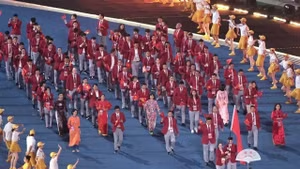
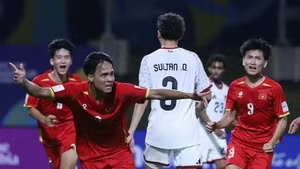
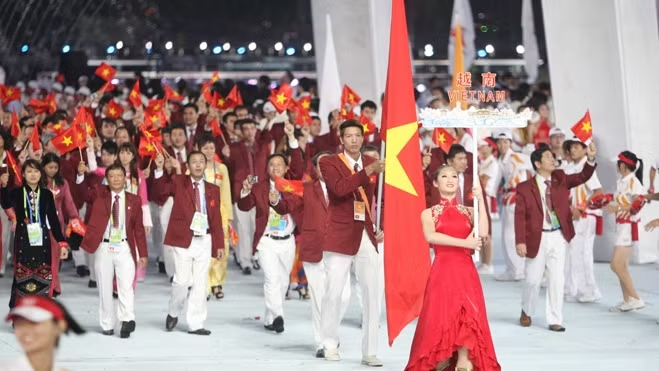
An outstanding achievement of the Vietnamese sporting sector over the past 20 years is the strong emergence of high-performance sports, thus becoming one of the countries with leading accomplishments in the region. The Vietnam sporting contingent made the top three in two consecutive SEA Games editions in 2011 and 2013, and ranked third among 45 countries and territories participating in the 2013 Asian Indoor and Martial Arts Games. Vietnam has approached the Asian and world levels in some sports. International co-operation in sports have also been strengthened, contributing to improving Vietnam’s status in the international arena. All have become ambassadors of solidarity and friendship, and have reflected Vietnam’s active international integration spirit and policy.
After over three years of implementing the national sports development strategy until 2020 and the Politburo Resolution No. 08-NQ/TW, the sports sector has made significant contributions to realising the Party and State’s socio-political tasks and foreign affairs, gradually improving people’s health and building a qualified staff of officials, trainers and athletes for high-performance sports.
Further efforts needed
Despite its achievements, Vietnamese sports still sees limitations and weaknesses that need to be addressed. Synchronous coordination among agencies from central to local levels is of great necessity and urgency to the goal of facilitating Vietnamese sports to fly high in the international arena. It is also essential to enhance Party leadership and administrative procedure reforms, aiming to create strong breakthroughs in sports by 2020.
Vietnam’s high-performance sports can only make breakthroughs on the international stage if it is developed sustainably, with a focus on improving the quality of physical education and sports activities in schools – an important part of sports movements; ensuring comprehensive fitness and motor skill development among students aiming to foster sports skills and talents; and promoting mass sports activities intensively and extensively among all classes of people.
In order to build a solid sports cornerstone, Vietnam needs to focus on training sports talents and qualified successive athlete staff, developing gifted sports schools and classes in localities nationwide, expanding and modernising national sports training centres, and enhancing international co-operation in training, aiming to enable private and social organisations to participate in training sports officials and athletes. Training institutions and athletes in key sports need to be given top investment priority. Recently, the sporting sector has made key investment planning for approximately 50-60 athletes prone to good results in Asian Games and Olympic sports, 100 others with high risks of claiming SEA Games medal and young potential athletes in 2015. In addition to special diets and incentives, athletes will enjoy overseas training courses of high standards with a goal of achieving in the top level of international arenas. This is an innovative, professional and effective direction for Vietnam’s high-performance sports.
The Vietnamese sporting sector has been preparing for the 28th SEA Games and the 2016 Olympic qualification so far this year, with a focus on training athletes in key sports aiming to create breakthroughs – a key task of Vietnamese sports at present and in the future. With its outstanding achievements after 69 years of construction and maturity, we believe that Vietnamese sports will enjoy more and more breakthroughs on its development path.