Digitalisation is reshaping the way financial services are delivered, making access to data a crucial driver of the digital economy, especially in the banking sector.
A legal framework to build a digital ecosystem
According to Pham Anh Tuan, Head of the Payment Department under the State Bank of Viet Nam (SBV), in recent years the SBV has early recognised the significant benefits of promoting data connectivity and interoperability to develop a digital ecosystem and improve service quality for citizens and businesses. As such, it has swiftly issued key strategies, including the Digital Transformation Strategy for the Banking Sector to 2030 and the Banking Sector Data Strategy to 2030. One core task is to “step up research, integration, and expanded connectivity with other sectors and fields to establish a digital ecosystem.”
To realise this goal, the SBV has advised on and issued a range of important legal documents. Notably, Circular No. 64/2024/TT-NHNN provides detailed regulations on implementing open Application Programming Interfaces (APIs) in the banking sector.
Circular 64 establishes a clear and secure legal framework for setting up convenient and safe connectivity and interoperability between the banking sector and other sectors and fields, while better protecting customers’ lawful rights and interests.
The circular marks a significant step forward in promoting an open banking ecosystem, where banks’ roles shift from “data silos” to data sharing for product and service development. “The objective of open-API policy is to promote healthy competition, innovation, and financial inclusion,” said Dinh Tien Dung, a representative of the SBV’s Information Technology Department.
Accordingly, open APIs are APIs provided by banks to “third parties”, which may be a Fintech (a financial technology company) or another bank, to “deliver services to customers”.
Alongside open APIs, the SBV has also been actively implementing connectivity and data sharing with the National Population Database. This is seen as a foundation for electronic identification and authentication under the government’s Project 06. Many credit institutions and payment intermediary service providers have coordinated with the Ministry of Public Security to roll out customer authentication solutions using chip-based citizen ID cards and the VNeID application.
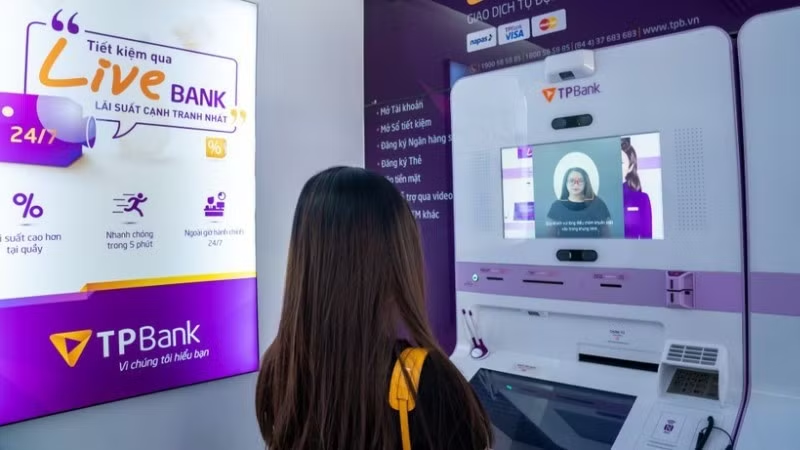
The latest figures from the SBV’s Payment Department show that, as of November 14, the banking sector has verified biometrics for more than 136.1 million individual customer profiles via chip-based citizen ID cards or the VNeID application. This has not only strengthened crime prevention and control but also improved the customer experience.
Ensuring data security
Pham Anh Tuan said that data sharing in the context of open banking requires a balanced approach to multiple requirements, including standardising data and connectivity protocols; strengthening third-party risk governance capacity; ensuring system security and safety against cyberattacks and data misuse; and, most importantly, protecting customers’ lawful rights and interests, narrowing the digital divide, and ensuring no one is left behind in the digital transformation process. These are systemic issues that require close coordination among state regulators, credit institutions, and Fintech companies.
Noting that Viet Nam has made significant progress in shifting from a cash-based economy to non-cash payment systems to promote financial inclusion, Andri Meier, Deputy Head of Development Cooperation at the Embassy of Switzerland in Viet Nam, said these successes pave the way for deeper digitalisation, supported by technologies such as open APIs, which offer substantial potential to further develop the financial market by enabling seamless interaction among banks, non-bank financial service providers, and third-party platforms.
Maria Joao Pateguana, Head of Private Sector Development under the Asian Development Bank, also said Viet Nam is witnessing an extraordinary digital transformation driven by breakthrough technologies. Legal reforms — including the Law on Electronic Transactions (2023), the Law on Credit Institutions (2024), and the Law on Personal Data Protection (2025) — have established a strong legal framework for digital banking, electronic identification, and secure data sharing. Specifically, Circular 64, recently issued by the SBV, marks a significant step in advancing Viet Nam’s open banking ecosystem, fostering innovation while ensuring a safe and standardised environment for sharing financial data.
In practice, data-cleansing solutions, accurate customer information verification and their operational application have helped ensure banking security and safety while enhancing customer experience. The SBV regularly and proactively monitors and directs payment service providers and payment intermediary service providers to strengthen security and safety measures. The SBV’s information system for supporting management, supervision and risk prevention for customers, which is currently being piloted, had issued more than 1.7 million customer warnings by October 31. Of these, more than 567,000 cases resulted in transactions being paused or cancelled after a warning was received, involving total transaction value of over 2.2 trillion VND.
Data sharing is not only a technological revolution but also a shift in the development model. When openness in policy goes hand in hand with data security, Viet Nam can build a more inclusive, transparent, and competitive financial ecosystem. With an increasingly transparent legal framework and decisive digital transformation strategies, the banking sector is laying a solid foundation for the development of a comprehensive and flexible financial sector that supports the country’s long-term development goals.