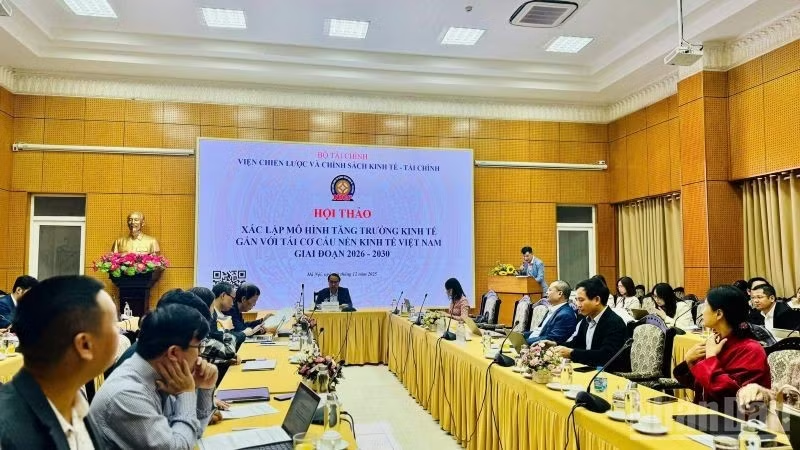
At the workshop, delegates shared a strong consensus that after the 2021–2025 period, Viet Nam’s macroeconomy has remained stable and achieved many positive outcomes. However, the advantage of low-cost labour is gradually fading as Viet Nam moves deeper into global value chains. Productivity growth remains modest, while capital resources and natural endowments are no longer sustainable pillars for the future.
In this context, participants agreed that the 2026–2030 period will be a “golden window” for determining the future trajectory of Viet Nam’s economy.
According to Master Nguyen Quoc Anh, Deputy Director of the National Institute for Economics and Finance (Ministry of Finance), Viet Nam needs a new growth model based on innovation, technology, and green development in order to achieve a double-digit GDP growth target during 2026–2030 and move towards the goal of becoming a high-income country by 2045.
To this end, he proposed three key strategic pillars: First, Viet Nam must shift from extensive to intensive growth, in which raising labour productivity through technological application, high-quality human-resource training, and modern governance will be decisive. Second, the economy must undergo strong restructuring towards modernisation, with long-standing bottlenecks such as institutions, infrastructure, and human-resource quality needing to be removed in a synchronised manner. The digital economy, green economy, and circular economy will serve as “the keys” to unlocking deeper global integration and enhancing competitiveness. Developing innovation hubs, semiconductor industries, renewable energy, and a low-carbon economy is no longer optional but inevitable. Third, a transparent and substantive system of performance indicators must be established.
Another important highlight he emphasised is the role of the private sector, which must become a pioneering force in transforming the growth model. Policies should ensure a fair competitive environment and encourage investment in high-tech and green industries.
He also stressed the role of the State in creating a “runway for take-off” in innovation: improving institutions, removing barriers, and mobilising financial resources to develop strategic infrastructure such as logistics, clean energy, and national digital infrastructure. Additionally, Viet Nam should tap new opportunities from international cooperation, venture capital, and technology transfer.
Delegates agreed that restructuring Viet Nam’s economy plays an essential role in shifting from the traditional growth model — dependent on capital, low-cost labour, and natural resources — to a new, more efficient and sustainable model based on science and technology, higher productivity, and addressing bottlenecks such as low productivity, bad debt, and environmental pollution. This will support green, innovative, and inclusive growth.
Furthermore, economic restructuring is a necessary “major reform” to help Viet Nam escape the middle-income trap, build a modern economy with higher productivity and sustainable growth, and strengthen resilience to global shocks in line with the requirements of the Fourth Industrial Revolution.
Sharing an analysis of public investment, Dr Can Van Luc, Chief Economist of the Bank for Investment and Development of Viet Nam (BIDV) and member of the Prime Minister’s Economic Advisory Group, proposed developing a more balanced financial market, enhancing international cooperation, diversifying financing channels, and drafting a reform plan for the financial sector. He also called for strengthening the role of the Viet Nam Development Bank (VDB) through restructuring and expanded application of information technology.
Meanwhile, Associate Professor Dr Le Xuan Ba, former Director of the Central Institute for Economic Management (CIEM), recommended several measures, including shifting education and training from passive to active learning; strengthening the link between theory and practice; and aligning training with socio-economic development needs and scientific and technological progress. He emphasised training that meets market demand.
Discussing international experiences in transforming and renewing growth models, Dr Vo Tri Thanh, Director of the Institute for Brand and Competitive Strategy, noted that countries which have succeeded in transforming their growth models all share a common feature: financial policy plays a developmental and enabling role, promoting innovation and proactively guiding economic restructuring. He also highlighted the importance of refining the financial policy framework to support the shift towards a sustainable, transparent, and efficient growth model.