Decentralisation and delegation of power have helped to enhance the proactive role of agencies and units, shorten the process of resolving issues, reduce pressure on higher levels, and create conditions for profiles to be processed at the grassroots level. Along with the implementation of administrative procedures, regardless of administrative boundaries, people and businesses have more choices in carrying out procedures, reducing the need for multiple trips.
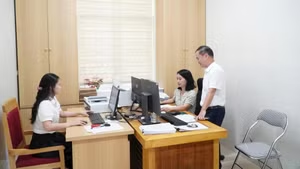
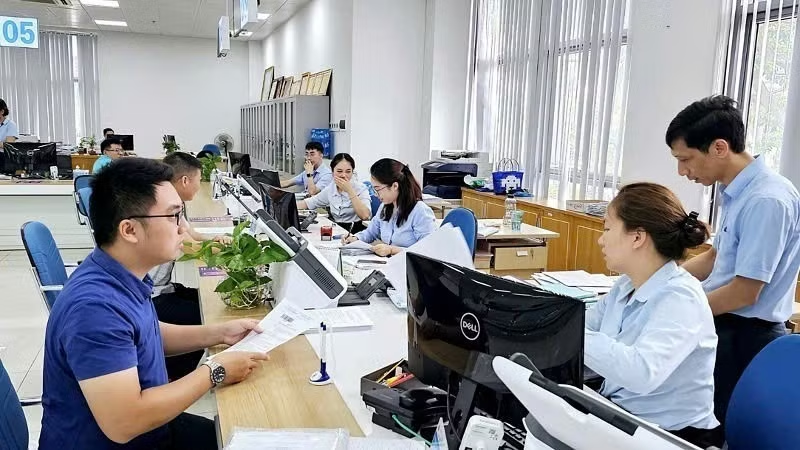
According to a representative of the Quang Ninh Provincial Public Administrative Service Centre, there are currently 2,210 administrative procedures under the province's functions and authority. 100% of administrative procedures have been announced and implemented regardless of administrative boundaries; all eligible public services are provided online throughout the entire process. Administrative procedure reform continues to be promoted through reviewing and reducing processing times and expanding decentralisation and delegation of authority in handling profiles.
Since May 2026, the smart kiosk model has been piloted at the Provincial Public Administrative Service Centre and nine localities, including Co To, Van Don, Hong Gai, Ha Lam, Quang Yen, Dong Trieu, Cua Ong, Tien Yen, and Ha Tu, and has yielded positive initial results.
Nguyen Van Thanh from Cam Pha Ward shared: “Implementing the two-tier local government model, local leaders are now closer to the people, more attentive to their concerns and aspirations, and more proactive in understanding the needs of both residents and businesses. Administrative procedures are resolved quickly, reducing costs and travel time for citizens and businesses when they come to complete procedures.”
According to the assessment of the Quang Ninh Provincial People's Committee, the decentralisation of power and authority basically ensures feasibility and is consistent with the two-tier local government model. The new regulations have clarified the scope and responsibilities of each level of authority, limiting overlapping and overlooked tasks, while many administrative procedures are resolved right at the commune level, contributing to improving the quality of service for citizens and businesses. The empowerment also creates conditions for local authorities to promote proactiveness and flexibility in governance, reflecting the principle that "local authorities make decisions, local authorities implement them, and local authorities take responsibility.”
Hoang Truong Son, Secretary of the Party Committee of Ky Thuong Commune, shared: “The implementation of the two-tier local government model has contributed to improving the effectiveness and efficiency of state management; strengthening decentralisation and delegation of power to the grassroot levels; promoting the proactive role of the commune level in managing its area, resolving administrative procedures, and serving the people and businesses. The local government apparatus has basically been operating stably, smoothly, efficiently, and effectively, gradually meeting the requirement of being 'close to the people, serving the people'.”
One year since putting the two-tier government model into operation, Ky Thuong Commune has become more proactive in managing its area and resolving issues arising from the grassroots. Many procedures that previously required approval through multiple levels, are now handled directly at the local level, contributing to shortening the time for processing documents and increasing flexibility in administration. Several fields such as land clearance, land management, urban order, and public service provision have seen clear improvements thanks to increased delegation of power to the commune level.
")
The restructuring has significantly streamlined the administrative apparatus. Reducing the number of units has removed unnecessary intermediate levels, allowing resources to be concentrated more effectively while strengthening decentralisation and delegation of power to grassroots.
Administrative management and reform have also achieved significant progress. To date, 100% of administrative procedures, from the provincial level down to communes, wards, and special zones, are available online. More than 90% of official work files are processed electronically, while over 98% of administrative procedures are completed on time or ahead of schedule. These achievements provide an important foundation for Quang Ninh to continue developing digital government and improving service quality for both residents and businesses.
"The success of the two-tier local government model should not be measured by how many units have been merged or how many intermediate layers have been removed. It must be judged by the actual quality of governance and the genuine satisfaction of people and businesses," stated Quan Minh Cuong, Secretary of the Quang Ninh Provincial Party Committee.
Quang Ninh Province has made it clear that its primary objective is not simply to achieve "stable operation" but to move towards "efficient operation that creates breakthrough development." The guiding principle is that issues which are already clear must be implemented decisively; overlapping responsibilities must be resolved; shortcomings must be boldly addressed; and successful models must be reviewed, standardised, and replicated. A streamlined administrative structure will not achieve its intended purpose if work becomes slower, if greater decentralisation does not lead to clearer accountability, or if stronger digital transformation still requires people to make repeated visits.
The implementation of the two-tier local government model also provides Quang Ninh with an opportunity to further refine its modern governance model and improve the quality of public services. Following the administrative restructuring, the province has ensured consistency between functions, tasks, authority, and organisational structures, while promptly recommending adjustments to address remaining shortcomings and obstacles. This approach helps maintain continuous, smooth, and uninterrupted operations for state agencies, residents, and businesses.
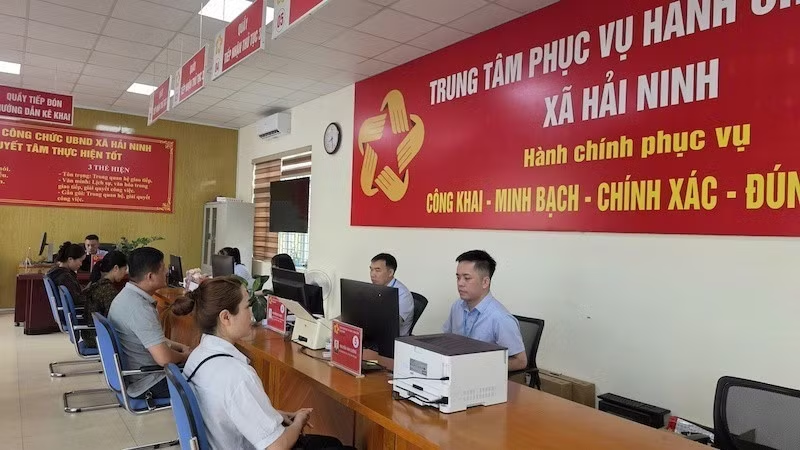
"The two-tier local government model must become the foundation of a modern, integrated, and interconnected governance system based on data and capable of responding quickly to new development requirements. Every commune, ward, and special zone must become a 'development hub' within the province's overall development framework, serving not only as a local governing authority but also as a direct participant in economic value chains, development corridors, growth poles and future innovation spaces across Quang Ninh," Quang Minh Cuong emphasised.
Building on the results achieved after one year of implementing the two-tier local government model, Quang Ninh Province is aiming to establish a governance system that is modern, flexible, and capable of coordinating rapid, green, and sustainable development while adapting to a coastal, heritage, and smart urban model that will act as an international gateway.
To achieve this goal, one of the province's key tasks is to continue improving the quality of its officials, civil servants, and public employees. Every official and Party member is expected to embrace innovation, strengthen their sense of responsibility, and set an example with the spirit of "new philosophy, new mindset, and new actions"; strengthen the fight against corruption, waste, and negative phenomena; resolutely combat manifestations of political ideology, moral, and lifestyle degradation; and build a team of cadres with strong political integrity, public service ethics, responsibility, and a desire to contribute, thereby helping to build Quang Ninh into a modern, prosperous, beautiful, and civilised city, increasingly affirming its position domestically and regionally.
This is considered a fundamental solution to enhance the long-term operational capacity of the new government model. Alongside this, the province continues to review and refine policies to attract high-quality human resources, especially in the fields of information technology, digital transformation, planning, investment, and public governance. Stabilising the workforce in disadvantaged areas, border regions, and islands is also a priority to ensure the stable and effective operation of the grassroots administrative apparatus.
With the achievements made during the implementation of the two-tier local government model, Quang Ninh has not only reaffirmed its pioneering role in streamlining the administrative apparatus but has also contributed to realising the aspiration of building a modern, professional, people-centred public administration and creating a breakthrough for sustainable development in the new era of the country.