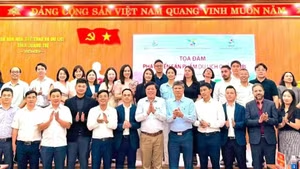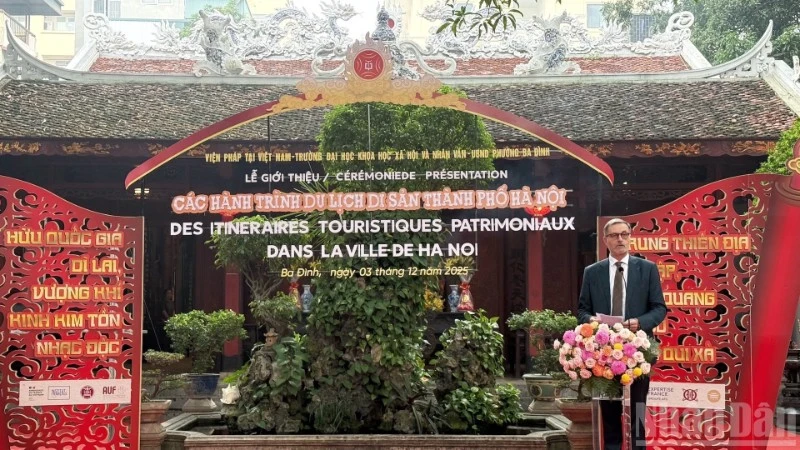
This is an activity within the FEF-R Patrimoine Project, funded by the Ministry for Europe and Foreign Affairs of France through the French Embassy and the French Institute in Viet Nam (IFV), in coordination with the University of Social Sciences and Humanities–Viet Nam National University, Ha Noi (USSH-VNU); the French School of the Far East (EFEO); and the Agence Universitaire de la Francophonie (AUF).
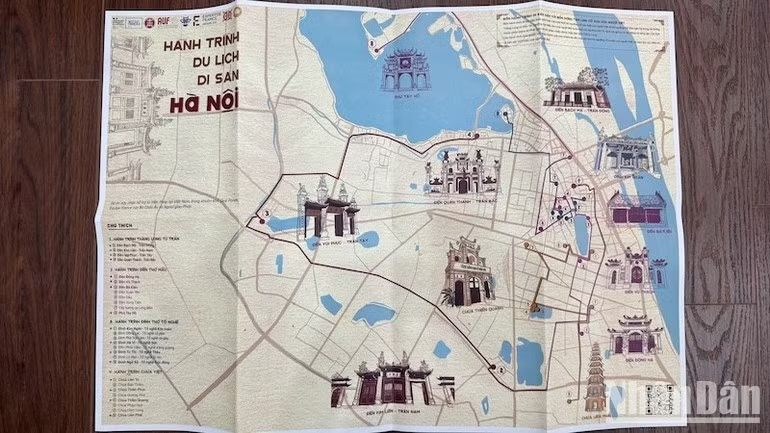
The initiative aims to introduce and promote the value of Ha Noi’s tangible, intangible, and digital heritage through four pilot heritage tourism itineraries, an interactive mapping system, the H-Heritage application, and QR code systems at many heritage sites in central Ha Noi.
Speaking at the ceremony, the French Ambassador to Viet Nam Olivier Brochet emphasised: “Thanks to the application of digital technology, especially QR codes and the interactive map system, Ha Noi is gradually becoming one of Asia’s pioneering cities in digitising heritage data, providing accessible, vivid, and intuitive information.”
He added: “Today, we are not only presenting heritage itineraries to the public but also laying the foundation for a new phase: building a city where heritage knowledge is a driver of sustainable development, a factor that enhances cultural and tourism attractiveness, and a tool for educating younger generations.”
According to Professor Dr Hoang Anh Tuan, Rector of the University of Social Sciences and Humanities–Viet Nam National University, Ha Noi: “Ha Noi is a city shaped by layers of cultural sediment, where each site and each street preserves long-standing stories, memories, and traditions. However, for these values to truly reach the public—especially young people and international visitors—we need new, modern, and more accessible approaches.”
From more than 100 surveyed heritage sites across Ha Noi, the research team selected 28 representative sites and grouped them into four heritage itineraries associated with four traditional Vietnamese belief systems: the Four Guardian Temples, Mother Goddess Temples, Craft Ancestor Communal Houses, and Ha Noi Pagodas. Each itinerary does not merely present a collection of sites but tells a cohesive story reflecting the spiritual structure and memory of Ha Noi—past and present.
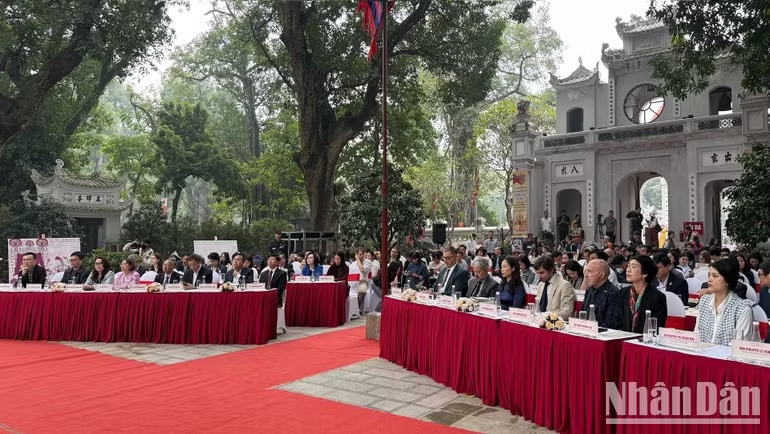
Dr Nguyen Thi Hiep, international technical expert and project team leader, expressed pride and gratitude for the dedication, love for heritage, perseverance, and scientific spirit of students, researchers, engineers, tourism experts, and community members who contributed to the project.
On this occasion, the project also launched a collective research volume comprising ten academic articles related to the Heritage Law, heritage sites, and the four itineraries; as well as reissued two books on Ha Noi’s deities, heritage sites, and temples.
According to the Organising Committee, “Ha Noi Heritage Tourism Itineraries” not only serve to promote culture and enhance tourism experiences but also provide data for researchers, lecturers, experts, and postgraduates; support cultural education in schools and extracurricular activities; raise students’ awareness of cultural heritage; and contribute to affirming the strategic role of France–Viet Nam cultural cooperation.


![[Video] Viet Nam among Top three Asian destinations for return visitors](https://en-cdn.nhandan.vn/images/nyM650OGFWrOVWc-xajqN-rTZ68Rlmc1fiGJOhBRYHErj-E25MBpvJqrpphXazfrpe9t-fYCGuQU4CN0yXo3Rg/du-lich-vietnam.jpg.avif)