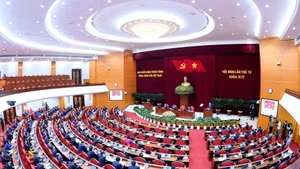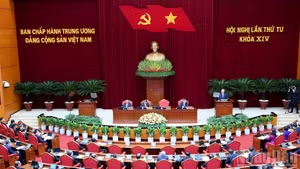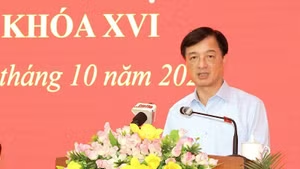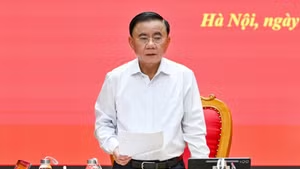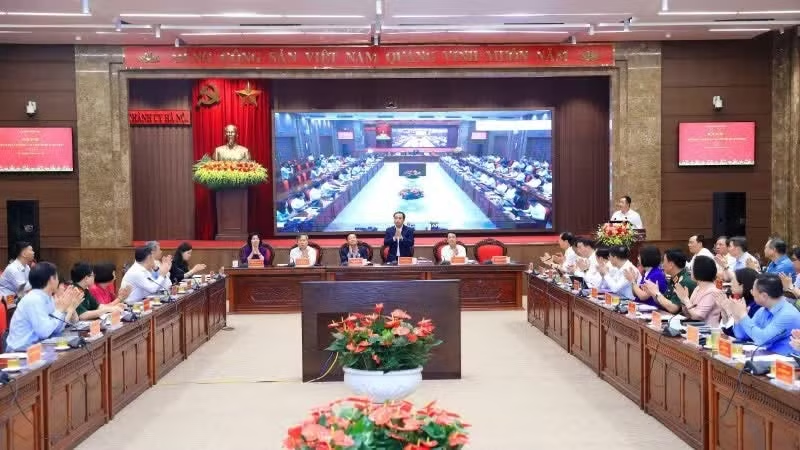
The conference was held in person at the municipal Party Committee headquarters, with an online connection to departments, agencies, and 126 communes and wards across the city.
According to Deputy Minister of Justice Nguyen Thanh Tu, the 2026 Capital Law, passed by the National Assembly in April, establishes a landmark legal framework, with its most significant feature being the strengthening of decentralisation and delegation of authority to Ha Noi.
He emphasised that the 2026 Capital Law delivers three major advances: institutional reform, a new approach to development thinking, and expanded development space.
In terms of institutions, the law grants Ha Noi the authority to develop policies and organise their implementation in line with the capital’s development requirements.
The city is also empowered to determine its organisational structure and personnel arrangements for implementation.
At the conference, Ha Noi Chairman Vu Dai Thang stated that immediately after the 2026 Capital Law was passed, the city issued key directives and guiding documents to ensure it would be implemented systematically, consistently, and effectively.
The implementation of the 2026 Capital Law must be closely aligned with the 100-year Capital Master Plan and the Politburo resolution on the development of the capital in the new era.
These three interrelated documents must be pursued in tandem in order to lay a lasting foundation for the capital’s long-term development.
Regarding implementation, city agencies and units have been instructed to thoroughly assess readiness and prepare all necessary conditions, with particular focus on the allocation of resources, personnel, and other enabling factors to ensure the Capital Law is effectively implemented from the outset.
One issue receiving particular attention is strengthening coordination between Ha Noi and provinces in the Capital Region to jointly implement regional integration measures in accordance with the law.
![[Infographic] Key points from General Secretary and President To Lam’s opening remarks at the 14th PCC’S 4th plenum](https://en-cdn.nhandan.vn/images/j0QNt7m_5iy1OXpnUKiwG61aYhTv_B140GWhfriF26JwZbNNJ8LWetfvXUhz4Az6/1-8220.jpg.avif)