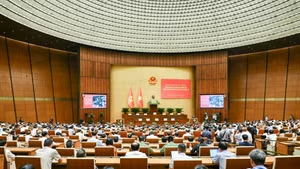
Chairman of the Ha Noi People's Committee Vu Dai Thang has signed Decision No.3489/QD-UBND, approving the pilot scheme for the “socialist commune and ward” model in Ha Noi.
The scheme aims to develop and pilot the “socialist commune and ward” model that translates into practice the values, objectives and defining characteristics of Vietnamese socialism at the grassroots level. It seeks to gradually establish a modern, service-oriented, transparent and effective model of local governance and development.
The initiative also aims to promote people's participation, improve quality of life, enhance public satisfaction and well-being, and provide a practical basis for refining evaluation criteria, policy mechanisms and implementation approaches before extending the model across the city.
The specific objectives of the project is to clarify the scientific, practical, political and legal foundations of the "socialist commune and ward" model while establishing a system of measurable indicators that can be monitored, evaluated and verified in practice. In this system, quality of life, public welfare, citizen satisfaction and happiness are considered the key composite indicators.
Under the project, Phuc Thinh and Thu Lam have been selected as pilot sites, while the remaining 124 communes and wards will begin applying relevant criteria during 2026.
Between 2027 and 2030, the model will be implemented comprehensively in the pilot localities alongside regular inspection and evaluation, while other communes and wards will continue adopting the framework flexibly according to local conditions. A mid-term review and refinement of the evaluation criteria are scheduled for 2030, followed by continued implementation during 2031–2035, with a final review planned for 2035.
The project identifies eight priority areas including: strengthening grassroots political institutions and improving governance effectiveness and public service delivery; developing integrated, modern infrastructure and smart living environments; promoting green, digital and circular economic development; ensuring social welfare, equity and inclusive development; fostering the cultural values and qualities of Ha Noi's people as elegant and civilised citizens; protecting a green, safe and sustainable living environment; safeguarding national defence, security and social order while expanding people-to-people diplomacy; and promoting science and technology, innovation and digital transformation.
To ensure effective implementation, the project emphasises the need to improve institutional and policy frameworks suited to grassroots administration, in line with the provisions of the 2026 Law on the Capital. It also calls for research into special policy mechanisms covering resettlement, site clearance, the upgrading of small residential areas and the reorganisation of urban development space.
At the same time, Ha Noi will focus on strengthening the capacity of grassroots officials and civil servants by promoting a more professional and modern public administration. Training programmes will be aligned with practical requirements, including service-oriented governance, digital transformation, local economic development and citizen engagement.
Resources will be allocated strategically, with priority given to the pilot localities and key tasks such as infrastructure development, digital transformation and improving the quality of public services, while also mobilising broader social resources.
Technology, particularly digital transformation, has been identified as a key instrument for enhancing governance and improving public services at the grassroots level. Ha Noi plans to develop an integrated data platform based on the principles of accurate, complete, clean, live, consistent and shared data, while expanding digital government through fully online public services and integrated systems for receiving and responding to citizens' feedback and recommendations.
The communication work is defined as an important task to build broad public consensus, and help people clearly understand the objectives, contents and benefits of the model, contributing to ensuring the effective implementation of the pilot.