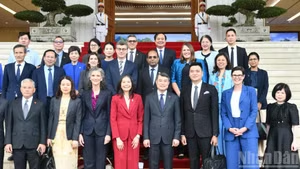
Amid a wide range of dynamic multilateral activities, Viet Nam’s active participation has been recognised by the international community as a highlight of proactiveness and responsibility, with increasingly substantive contributions to the global efforts to promote and protect human rights.
At the session, the Vietnamese delegation actively engaged in consultations on 38 draft resolutions and implemented numerous initiatives of high practical value. Notably, Viet Nam developed and delivered a joint statement on gender equality in the implementation of the Sustainable Development Goals (SDGs), co-sponsored by 67 countries. In parallel, Viet Nam co-hosted a side event with the Republic of Korea, Japan, and Thailand on the impact of online fraud on human rights. These are highly topical issues that are becoming increasingly urgent for many developing countries.
Viet Nam’s imprint at the 61st session once again reflects the consistent foreign policy of the Party and State. Previously, Viet Nam successfully completed two terms as a member of the Human Rights Council (2014–2016 and 2023–2025), actively participated in the Universal Periodic Review (UPR) mechanism, and promoted initiatives related to the rights of women, children, and persons with disabilities. Viet Nam has gradually affirmed its position as a reliable partner and a responsible member of the international community. The country stands ready to assume its role as a member of the Human Rights Council for the 2026–2028 term with confidence and resilience, strengthened by its development achievements and significant domestic political milestones.
In practice, Viet Nam’s approach to human rights has been realised through concrete, consistent, and measurable development policies.
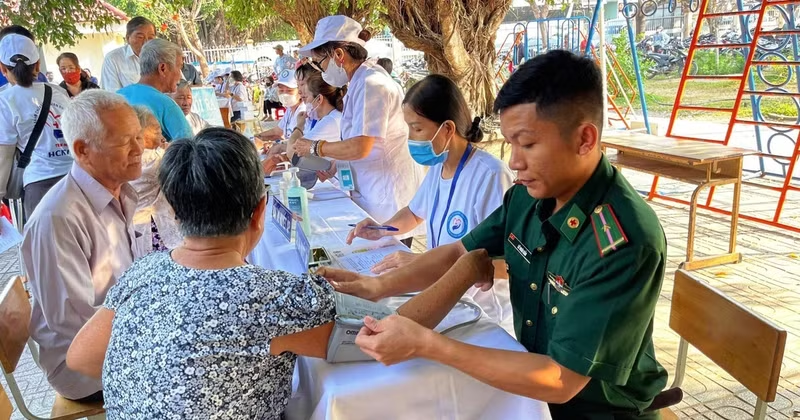
The United Nations Development Programme’s Human Development Report has recorded steady improvements in Viet Nam’s Human Development Index (HDI), placing it among the countries with the fastest HDI growth globally. The multidimensional poverty rate has declined rapidly from nearly 10% in 2016 to around 4.5% in 2020 and has continued to decrease in recent years. According to the Ministry of Agriculture and Environment, Viet Nam aims to maintain an annual reduction of 1–1.5 percentage points in multidimensional poverty, with 100% of poor communes escaping poverty status. The national health insurance system now covers more than 95% of the population (as of the end of 2025), while universal education has been maintained with steadily improving quality.
Many international experts regard Viet Nam as one of the countries that have effectively combined economic growth with social progress and equity. Rapid poverty reduction, expanded access to healthcare and education, and continuous improvement of the legal framework on human rights have created an inclusive development foundation where no one is left behind. This is also how Viet Nam contributes to the realisation of universal human rights values in a manner consistent with its historical conditions, cultural context, and level of development.
Notably, in the context of globalisation and deep international integration, Viet Nam does not separate domestic human rights implementation from its international responsibilities, as reflected in its active participation in the UNHRC and United Nations resolutions. In doing so, Viet Nam both learns from others and contributes its own experience, while also reinforcing its role as a reliable and responsible partner.
Despite its tireless efforts and significant achievements, Viet Nam continues to face distortions and sabotage from hostile forces, as well as from certain extremist organisations and ill-intentioned individuals. A common tactic employed by such actors is to select isolated individual cases and exploit unverified information, exaggerating them into systemic issues and attributing them to the nature of the political system, thereby making biased and negative assessments of the human rights situation in Viet Nam.
Religion and ethnicity, which are considered sensitive areas prone to misunderstanding, are often manipulated into artificial “flashpoints”, accompanied by unfounded allegations such as “religious repression” or “discrimination against ethnic minorities.” These actions aim to create information disorder, undermine public trust in state policies and laws, deny the leadership role of the Party, distort Viet Nam’s path towards socialism, and damage the country’s international reputation.
However, the reality in Viet Nam presents a very different picture. The State consistently pursues a policy of respecting and ensuring the right to freedom of belief and religion for all citizens. As of 2025, Viet Nam officially recognised 16 religions, with 43 religious organisations granted operating registration and more than 27.7 million followers, accounting for nearly 28% of the population. Thousands of places of worship have been built or renovated, and numerous major international religious events have been successfully organised, attracting large numbers of dignitaries and followers from both within the country and abroad. A vibrant and diverse religious life, closely intertwined with social life, is an undeniable reality. Political and social stability, economic growth, and the continuous improvement of living standards are the clearest indicators of the level of human rights protection.
In the face of increasingly sophisticated hostile activities, it is essential to promptly identify and respond with appropriate measures. Accordingly, alongside efforts to refute distorted narratives, relevant authorities must proactively provide comprehensive and transparent information to help both domestic audiences and the international community gain a full and accurate understanding. At the same time, continued efforts to refine institutions and improve the effectiveness of policy implementation at home remain a fundamental factor. Challenges such as regional development disparities and ensuring the rights of vulnerable groups in the context of digital transformation and population ageing require coordinated, long-term policy solutions.
In a world marked by profound changes, human rights are increasingly linked to global challenges such as climate change, pandemics, cybersecurity, and migration. No country can address these issues alone. With its experience as a nation that has endured war and poverty and is striving for development, Viet Nam can offer practical lessons in balancing development goals with human rights protection as well as national interests with international responsibilities. Its participation in global forums, most recently the 61st session of the UNHRC, demonstrates a shift from passive participation to proactive engagement, reflecting advances in diplomatic capacity and reaffirming confidence in the development path chosen by the Party that places people at the centre and view them as both the goal and the driving force of development.
In the face of false narratives, the most convincing response lies in the reality of development itself. A stable society, a growing economy and continuously improving living standards constitute the most compelling evidence. Viet Nam has sufficient grounds to remain steadfast, proactive, and responsible in joining the international community in promoting and protecting the shared values of humanity.