The Human Rights Communication Project in Viet Nam for the 2023–2028 period was approved by the prime minister under Decision No. 1079/QD-TTg (dated September 14, 2022).
After more than three years of implementation, the project has established a legal basis and a unified direction mechanism for human rights communication nationwide. On that foundation, communication activities have been organised in a structured and professional manner, with proactive participation from ministries, sectors, and localities.
Coordination has become closer, implementation methods are more flexible, and information has been provided in a timely manner, with a forward-looking approach closely aligned with real-life developments. This has helped raise social awareness, strengthen public trust, and build consensus in the process of policy implementation.
Through the communications network, domestic audiences and international friends have gained a clearer understanding of Viet Nam’s views, guidelines, efforts, and achievements in protecting and promoting human rights, thereby helping to reinforce the country’s image, credibility, and standing.
One of the project’s goals is to organise photo and archival exhibitions on human rights in Viet Nam and in several key locations overseas.
On that basis, the Ministry of Culture, Sports and Tourism has led the development of a common exhibition framework for nationwide implementation, while also supporting external information work effectively.
Exhibitions have been organised in a structured and professional manner, linked to major political and cultural events, while creating an engaging and accessible space for the public.
In late 2025, a series of experiential events, displays and recognition activities under the “Viet Nam Happy Fest 2025” held in Ha Noi attracted public interest and participation, becoming a distinctive cultural highlight of the year.
The festival demonstrated a new approach to human rights communication — placing people and citizens’ happiness at the centre — while vividly reflecting Viet Nam’s development achievements associated with ensuring fundamental rights in social life.
A number of exhibitions has been co-organised by the Ministry of Culture, Sports and Tourism and Viet Nam’s overseas representative missions in key locations such as Geneva (Switzerland), New York (the US), Bangkok (Thailand), and others, helping to introduce Viet Nam and its people and convey messages on human rights through diplomatic channels in combination with promotion of national image.
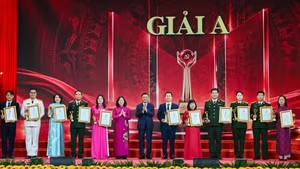
The 2025 Human Rights Communication Awards, organised online on the national image promotion platform (vietnam.vn), attracted wide public participation.
Implemented in the digital environment, the awards have encouraged people at home, the Vietnamese community overseas and international friends to create products introducing Viet Nam and its people.
Pham Anh Tuan, Head of the Department of Grassroots and External Information under the Ministry of Culture, Sports and Tourism, said that after two years of pilot implementation (2023–2024), and based on a practical review, the government decided to establish a dedicated award on human rights communication.
Over three years of implementation, the awards have attracted nearly 40,000 submissions, reflecting society’s growing and deepening interest in this field.
Products from the exhibitions and awards will be digitised, archived, shared, and utilised over the long term, gradually forming a rich repository and laying foundations for a human rights communication ecosystem.
Building on initial results, in the next phase of implementing the project, the Ministry of Culture, Sports and Tourism will continue to complete the human rights communication database.
Ministries and sectors will jointly build, develop, and update relevant communications data, connect it to the shared system, and ensure consistency and sustainable use.
Data sources and communication products will continue to be digitised, interconnected, and disseminated online in order to spread positive and humane information, helping to limit the impact of misinformation, fake news, and harmful content that undermines human rights. Alongside positive changes, practical implementation also shows that human rights communication remains uneven across localities.
Organisational restructuring and staff changes are creating new requirements for direction and coordination in implementing the project.
In response to these requirements, alongside developing a more professional and modern human rights communications ecosystem, human rights content should be integrated into major events held by ministries, sectors, and localities. The combined strengths of the press, social media, and international cooperation should be leveraged; greater emphasis should be placed on expanding the reach of human rights communications across fields; and external communications effectiveness should be enhanced in the context of increasingly deep international integration.