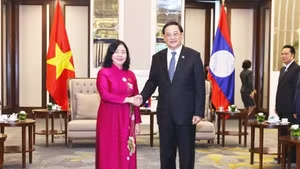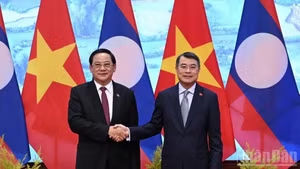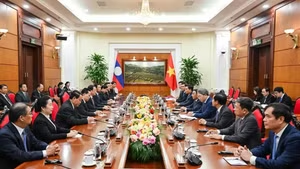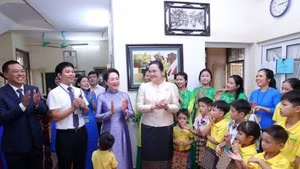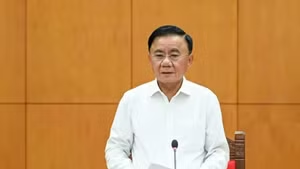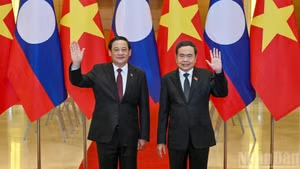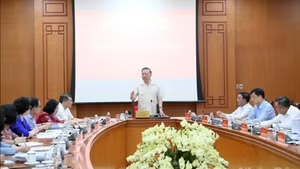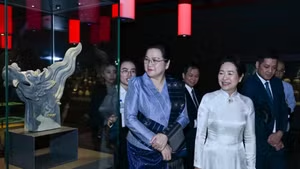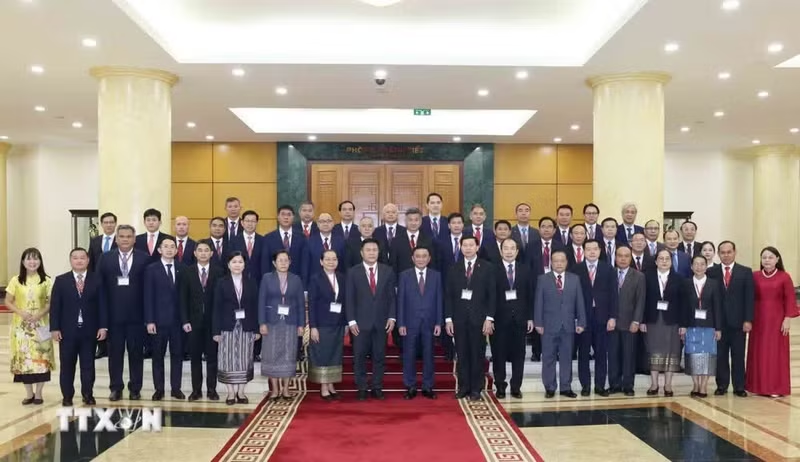
Politburo Member and Standing Member of the Communist Party of Viet Nam (CPV) Central Committee’s Secretariat Tran Cam Tu hosted a reception in Ha noi on November 3 for a delegation from the Lao People's Revolutionary Party (LPRP), led by Deputy Secretary of the Luang Namtha provincial Party Committee and Chairman of the provincial Administration Committee Khamphong Inmany, who is in Viet Nam for research and thematic exchanges.
The Vietnamese leader hailed the exchanges as a practical move to turn agreements by Party leaders into action and shore up the political foundation, trust and mutual understanding between the two Parties and States.
Tu cast Viet Nam–Laos ties as a special solidarity asset cultivated by generations of leaders and people, strategically vital to the construction and defence cause of both countries. With global and regional conditions shifting rapidly, he said the “great friendship, special solidarity, comprehensive cooperation, strategic cohesion” motto requires shared resolve and responsibility from all sectors and levels, especially the two Parties and States’ leaders.
He outlined three key steps for Party building and national development. These include formulating policies that are correct, creative, and tailored to the country's conditions, and translating these policies into laws and ensuring their comprehensive implementation. The final step is managing personnel effectively while strengthening inspection and supervision to ensure resolutions are executed thoroughly and promptly.
According to the Vietnamese leader, more than 40 years of renewal have delivered major, historically significant gains in both countries, validating the two Parties’ reform line as correct, creative and suited to local realities and global trends and giving both countries a base for the next phase.
The host briefed the Lao delegation on the 14th Party Central Committee’s fourth plenum, which passed resolutions on Party and political system building and rectification, renewing the Party’s leadership and governance methods, personnel work and talent attraction. It also weighed summaries of 100 years of Party-led revolution, 40 years of the Platform on national construction, strategic orientation for the next 100 years and Party Statute amendments. Viet Nam will continue sharing those lessons with the LPRP, he said.
Viet Nam always views the LPRP and Laos's victories as its own and has worked to distil theoretical and practical experience for Lao counterparts to study and apply as conditions allow, he said.
Khamphong, in reply, welcomed Viet Nam’s important gains and praised the exchanges, especially Viet Nam’s practical experience in Party building, management, administration and socio-economic development, calling it valuable material for the delegation to study and adapt to Laos.
The Lao Party, State and people always remember and value Viet Nam’s whole-hearted support and want continued cooperation, experience sharing and practical lessons to deepen the special Laos–Viet Nam solidarity, he said.
Members of the Lao delegation pushed for more experience sharing, stronger personnel training cooperation and tighter coordination in following the signed agreements to make Laos–Viet Nam ties deeper, more substantive and effective.