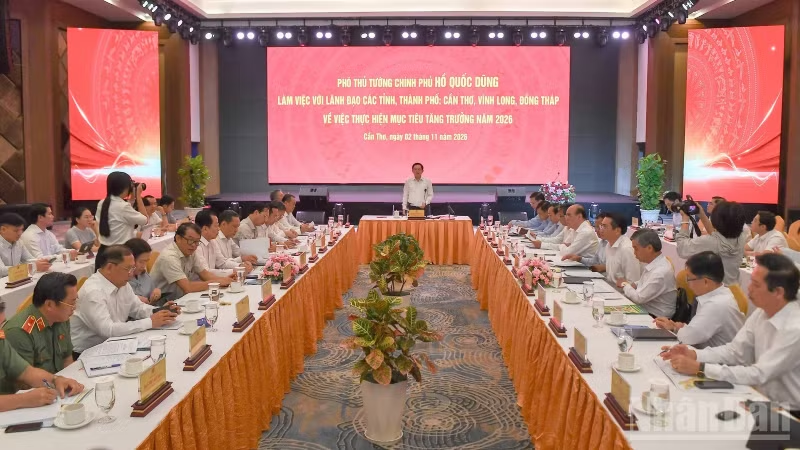
Can Tho regularly reviews and updates its growth scenarios based on quarterly GRDP results, translating the government’s assigned tasks into specific measures and aiming for full-year GRDP growth of 10.07%.
In the first nine months, the city’s GRDP was estimated to have grown by 7.89%, ranking 29th out of 34 provinces and cities nationwide and second among the five localities in the Mekong Delta. This was 0.72 percentage points below the target scenario of 8.61%.
Although growth remained below plan, the third quarter saw a positive improvement, reaching 9.29%, compared with 7.37% in the first quarter and 6.77% in the second. This marked a significant acceleration from the 6.09% growth recorded in the first half of the year.
However, socio-economic infrastructure — particularly strategic transport links, inter-regional connectivity, and logistics — remains underdeveloped and poorly coordinated, affecting investment attraction, competitiveness, and production and business costs.

In Dong Thap, GRDP grew by 7.44% in the first nine months of 2026, with industry and construction increasing by 10.86% and services by 8.23%. In the first 10 months, the industrial production index rose by 13.47%, exports reached 8.41 billion USD, up 7.51%, while total retail sales of goods and consumer service revenue amounted to 160.3 trillion VND, an increase of 15.55%.
The province attracted 23 new investment projects with total registered capital of nearly 10.778 trillion VND and saw the establishment of 2,577 new businesses. As of October 30, budget revenue has reached 19.798 trillion VND, equivalent to 83.27% of the estimate, while public investment disbursement stands at 7.6 trillion VND, or 66.5% of the adjusted target assigned by the prime minister. However, growth remained below expectations, while infrastructure, investment resources, and new production capacity had not matched the province’s potential.
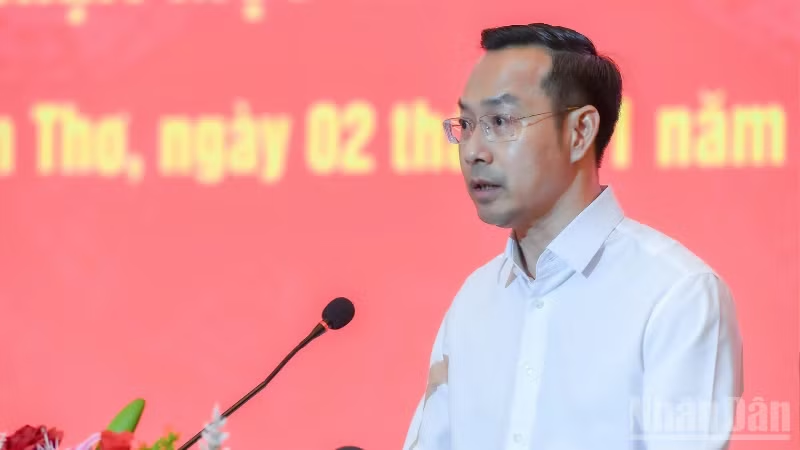
Vinh Long’s GRDP in the first nine months was estimated at 189.558 trillion VND, up 7.44% year on year. Growth stood at 6.63% in the first quarter, 7.97% in the second and 7.73% in the third quarter. Agriculture, forestry, and fisheries grew by 4.16%, while industry and construction expanded by 10.86% and services by 8.23%.
In his directives, Deputy Prime Minister Ho Quoc Dung urged Can Tho, Vinh Long, and Dong Thap to stay firmly on course to meet their assigned growth targets. He called on them to develop detailed growth scenarios for each industry, sector, and product, clearly assign responsibilities to leaders, conduct regular on-site inspections, and focus on removing bottlenecks.
He noted that the region’s riverine terrain and weak soil conditions drive up the costs of land filling, foundation treatment, and industrial park construction. Limitations in inter-regional transport infrastructure, logistics, seaports, and digital infrastructure also undermine competitiveness and investment attraction.
The quality of commune-level officials and civil servants also requires attention, as many responsibilities previously handled by district authorities, along with some provincial-level tasks, have been transferred to the commune level, while capacity and working conditions remain limited in some areas.
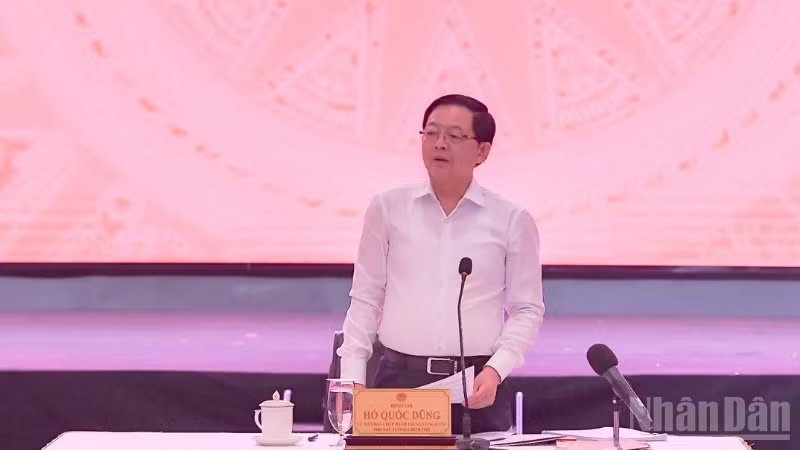
According to the Deputy Prime Minister, the localities must fully identify their difficulties and assess the situation accurately in order to devise appropriate solutions. Challenges do not mean that growth is unattainable. The three localities must closely follow government resolutions, conclusions of the Party Central Committee, and directives from the Prime Minister, while developing detailed scenarios based on actual conditions rather than relying on vague targets without concrete measures.
The scenarios must specify the contributions expected from each industry, sector, and key product, with detailed calculations of the output and value of agricultural commodities in which the region has an advantage, such as rice, shrimp, and fish. Local leaders must assign officials to oversee each sector and area, while departments and agencies should proactively identify problems and propose solutions.
The Deputy Prime Minister stressed that achieving the growth targets must be regarded as a key political task. The localities must regularly inspect and assess results, clearly defining the responsibilities of each agency, unit, and its head.
They were also instructed to promptly implement their medium-term public investment plans for the 2026-2030 period and draw up socio-economic development and public investment plans for 2027, allocating capital early so that projects can begin from the start of the year.
He called for urgent action to address stalled and delayed projects and remove obstacles relating to procedures, site clearance, and resources. Fully disbursing the allocated public investment capital would create additional room for growth while helping to complete infrastructure needed for long-term development.