Prior to the August General Uprising of 1945, Viet Nam’s revolutionary movement endured periods of profound tribulation. Following waves of “White Terror” unleashed by French colonialists — and particularly after the bloody suppression of the Soviet Nghe–Tinh movement (1930–1931) and the Southern Uprising (1940) — the Party’s cadre ranks suffered devastating losses.
Thousands of key cadres and Party members were arrested, imprisoned, or heroically gave their lives; numerous Party organisations, from the central to the local level, were dismantled, and communication lines were severed. Faced with these existential challenges, the Party demonstrated steadfast resolve and profound strategic vision regarding cadre management.
At the 8th Central Committee Plenum (May 1941) in Pac Bo (Cao Bang), the Party resolved to shift its strategic direction, prioritising national liberation and urgently preparing forces across all fronts — with a particular emphasis on training, cultivating, and deploying cadres to local areas.
The Party rapidly redeployed experienced cadres into clandestine operations while actively training a new generation of cadres through mass movements and short-term training courses in revolutionary base areas.
The Party placed a premium on building and expanding this new cadre force — particularly at the grassroots level — across the country, from rural to urban areas and from the highlands to the lowlands. These comrades maintained close ties with the grassroots, keeping a firm grasp of the situation of the people and the revolutionary movement in every hamlet, village, and commune.
Despite the enemy’s intense surveillance, manhunts, and repression, grassroots cadres steadfastly remained among the people, maintaining a deep bond with them; they actively disseminated the Viet Minh Front’s national salvation platform and mobilised the masses to join national salvation organisations.
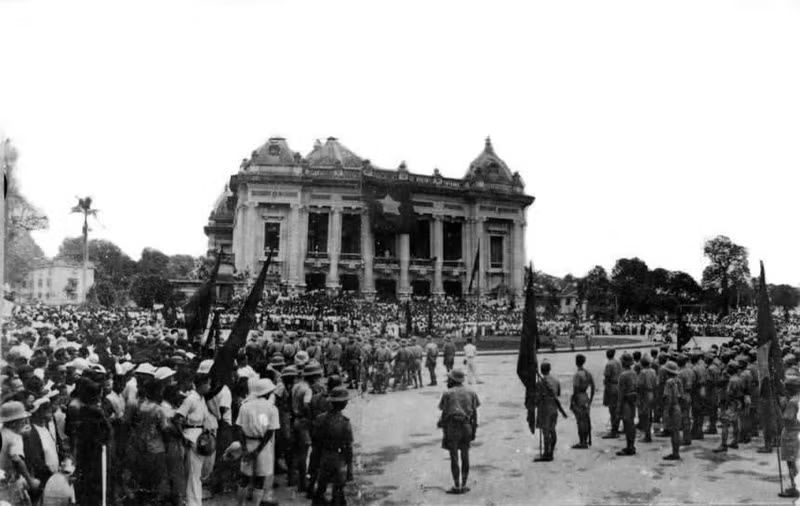
It was due to such meticulous and proactive preparation that, when the historic opportunity arose — following the Japanese ousting of the French and, crucially, the total unconditional surrender of fascist Japan in August 1945 — these grassroots cadres were able to effectively serve as the core of direct leadership.
instead of passively awaiting or relying on orders from superiors for every specific situation, the local cadres astutely grasped the spirit of the directive “The Japanese–French Clash and Our Action”, flexibly and creatively seizing the moment to lead the masses in uprising.
These grassroots cadres were the decisive factor driving the uprisings to unfold simultaneously and swiftly, minimising casualties across most localities nationwide — from major urban centres like Ha Noi, Hue, and Sai Gon to remote rural areas.
Immediately after the nascent revolutionary government was established, President Ho Chi Minh articulated the true nature of government officials at all levels — from the central government down to the villages and communes: “We must understand that government agencies, from the national level down to the villages, are all public servants of the people; that is, they exist to shoulder common tasks for the people, not to lord it over them”.
He frankly identified pernicious ailments such as abusing power, moral degradation, cronyism, and arrogance; at the same time, he required officials to fully grasp the principle: “Party officials and government officials alike — even I, as the highest-ranking official — are all servants of the people.”
The victory of the August Revolution of 1945 delivered profound lessons regarding personnel work. First, the interests of the Party, the nation, and the people must always be placed above all else, with a readiness to sacrifice personal interests and a commitment to absolute impartiality and selflessness. Second, officials must be intimately tied to the grassroots level and deeply connected with the people, relying on the people to build and develop the movement. Third, it is essential to identify and value talent, without discriminating between Party members and non-Party members. Fourth, there must be a resolute commitment to self-examination and self-correction, the courage to rectify shortcomings, and the determination to weed out corrupt or morally degraded officials.
In assessing the pivotal role of cadres in the revolutionary cause, President Ho Chi Minh distilled an enduring lesson: “Cadres are the root of all work; therefore, training cadres is the fundamental task of the Party”. He pointed out: “The success or failure of any undertaking depends on whether the cadres are good or poor”. The great victory of the August Revolution in 1945 stands as vivid, practical proof of that profound insight.
The historical lessons regarding the consolidation, development, and promotion of the cadre corps — particularly at the grassroots level — derived from the August Revolution preserve their profound theoretical and practical value, offering significant guidance for the Party’s current efforts in building and rectifying itself.
Documents from the Party’s 14th National Congress emphasise the requirement to “focus on building a grassroots cadre corps that is close to the people, dedicated to the people, and fully capable of fulfilling its duties”. This represents a significant advancement in the Party’s theoretical thinking and practical direction regarding cadre management.
The grassroots level is where the Party’s guidelines and the State’s policies and laws are directly translated for the people, and simultaneously, where the validity of these policies is tested in practice. Grassroots cadres work alongside the people, directly listening to and promptly addressing the legitimate aspirations, concerns, and difficulties of the public.
The victory of the August Revolution of 1945 delivered profound lessons regarding personnel work. First, the interests of the Party, the nation, and the people must always be placed above all else, with a readiness to sacrifice personal interests and a commitment to absolute impartiality and selflessness. Second, officials must be intimately tied to the grassroots level and deeply connected with the people, relying on the people to build and develop the movement. Third, it is essential to identify and value talent, without discriminating between Party members and non-Party members. Fourth, there must be a resolute commitment to self-examination and self-correction, the courage to rectify shortcomings, and the determination to weed out corrupt or morally degraded officials.
A strong grassroots cadre corps — politically steadfast, professionally competent, and dedicated to serving the people — will act as a solid bridge connecting the Party’s will with the hearts of the people. To meet the demands of the new situation while creatively applying the invaluable historical lessons of the August Revolution of 1945, grassroots-level personnel work must currently focus on comprehensively implementing the following key solutions.
First, raise awareness regarding the position and importance of grassroots-level officials. Party committees and organisations must thoroughly grasp the principle that “the grassroots level is the foundation”, thereby modernising their approach to the planning, recruitment, training, and deployment of these officials. It is essential to avoid underestimating the grassroots level or viewing it merely as a place for “temporary rotation”.
Second, revamp the content and methods of training and professional development for grassroots-level officials. Training must go beyond general political theory; it must be closely linked to local management realities, skills in mass mobilisation, the ability to handle complex grassroots situations, and digital transformation capabilities in public administration. Officials should be cultivated with a spirit of being “close to the people, dedicated to the people, and grounded in the community”, ensuring they know how to listen to and engage in sincere dialogue with citizens.
Third, refine policies and remuneration schemes while creating a favourable working environment. Appropriate mechanisms and policies are needed — commensurate with the pressure and workload faced by grassroots officials — to enable them to work with peace of mind and commit to long-term service.
Simultaneously, there must be strict implementation of the Politburo’s Conclusion No. 14-KL/TW, which advocates encouraging and protecting officials who are dynamic, creative, and willing to think boldly, act decisively, and pioneer breakthroughs for the common good; this helps alleviate the fear of making mistakes or facing accountability that currently affects some officials.
Fourth, prioritise elevating the capabilities and modern management mindset of grassroots-level officials in the new era. These officials must proactively shift toward a development-oriented management mindset that places citizen satisfaction at the heart of their service. It is essential to equip them with an innovative mindset, digital data analysis capabilities, risk management skills, and the ability to manage operations flexibly. These are core factors enabling the grassroots level to adeptly navigate rapid changes.
Fifth, strengthen inspection and supervision while rigorously screening the cadre. Alongside creating favourable conditions for and protecting officials, it is necessary to enforce strict discipline. Officials who have become morally degraded or corrupt, or who exhibit bureaucratic, arrogant, or callous behaviour toward the public — or who violate the law — must be resolutely removed from the apparatus.
President Ho Chi Minh once reminded government officials: “We must do our utmost to carry out whatever benefits the people, and do our utmost to avoid whatever harms the people”. That spirit must serve as the ultimate benchmark of professional ethics for every grassroots official today.