According to the World Bank’s 2023 Logistics Performance Index (LPI), Viet Nam ranks 43rd out of 139 countries and is among the top five in ASEAN. Logistics costs have fallen markedly, from over 20% of GDP in 2014 to around 16% today.
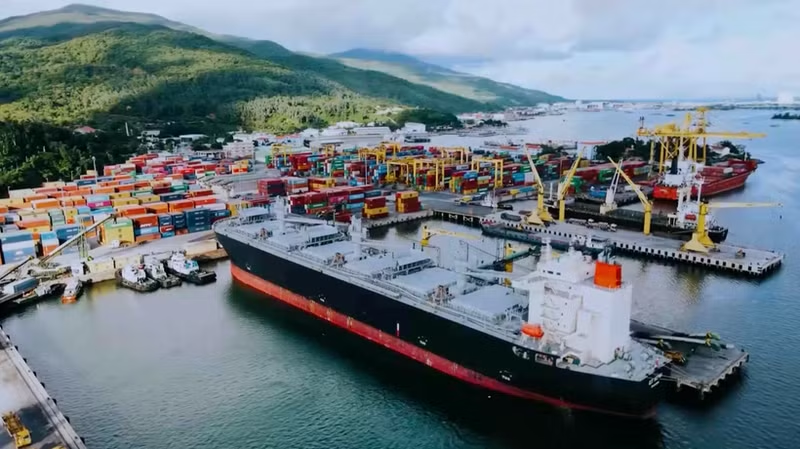
Infrastructure is increasingly synchronised, with substantial investment in seaports, airports, motorways, and logistics centres across key economic regions.
The logistics business community has expanded impressively, now comprising more than 34,000 enterprises, many of which are deeply integrated into global supply chains and employ advanced technology in management and operations. New-generation free trade agreements continue to create favourable conditions for Viet Nam’s logistics sector to integrate further and expand into international markets.
According to the World Bank’s 2023 Logistics Performance Index (LPI), Viet Nam ranks 43rd out of 139 countries and is among the top five in ASEAN.
These achievements play a crucial role in enhancing the competitiveness of Vietnamese goods, reducing import–export costs, promoting international trade, and facilitating domestic circulation.
Nonetheless, challenges remain: costs are still high compared with regional peers; regional linkages and infrastructure connectivity are not fully synchronised; most enterprises are small-scale with limited competitiveness and a lack of flagship firms. Human resources, institutional frameworks, digital transformation, and the green transition also lag behind requirements.
This calls for strong strategic and institutional reforms in logistics to adapt to the new context.
Amid global supply chain restructuring, Viet Nam must rapidly strengthen its logistics capabilities to maintain its position in global value chains, harness shifting investment flows, and respond effectively to geopolitical and economic fluctuations, new demands from cross-border e-commerce, and the rise of green logistics.
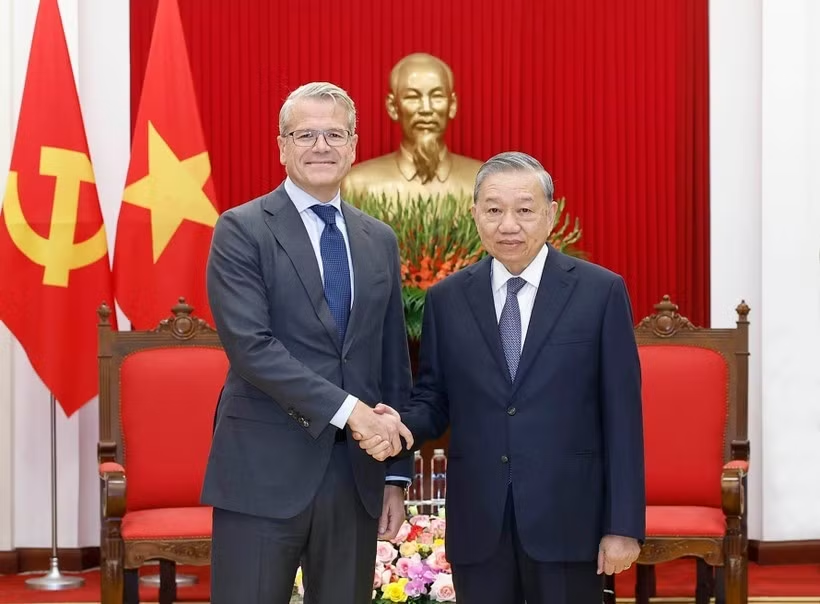
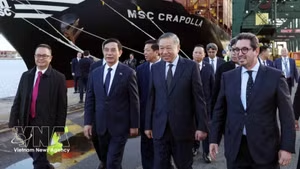
During his meeting in Ha Noi on November 18 with Vincent Clerc, Chief Executive Officer of Denmark’s A.P. Moller, Party General Secretary To Lam emphasised that Viet Nam is prioritising infrastructure development, including seaports, with a green orientation to serve sustainable development goals and bolster national competitiveness.
Acknowledging Maersk’s vision for green port and transport development and welcoming its plans to expand investment in Viet Nam—particularly in green and smart seaport systems and logistics services—General Secretary Lam encouraged the group to invest further in areas such as the marine economy.
He affirmed that Viet Nam is always ready to create favourable conditions for foreign investors to develop logistics projects that connect regions, major cities, and industrial zones nationwide and globally. He stressed that Viet Nam is among the world’s top 20 economies in terms of international trade scale and is accelerating the development of a comprehensive, modern, and seamless transport infrastructure system to enhance competitiveness.
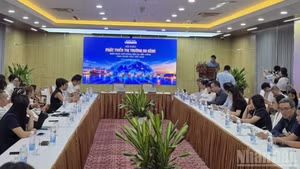
Speaking at the Viet Nam Logistics Forum 2025 on November 29 in Da Nang City, Prime Minister Pham Minh Chinh reiterated that the Party and State have placed strong emphasis on the logistics sector, implementing key policies and investing resources to support its growth.
Viet Nam’s logistics sector has the potential to achieve breakthroughs, integrate, and lead in the region by harnessing vision, innovation, and the strength of its people and businesses.
Prime Minister Pham Minh Chinh
He reaffirmed the Government’s commitment to building a national logistics ecosystem that is smart, modern, green, digital, competitive, and efficient, positioning the country as a leading logistics hub in Southeast Asia and beyond.
The Prime Minister further emphasised the Government’s determination to ensure political, social, and economic stability; address economic bottlenecks; promote green supply chains; reduce costs; and foster a stable, competitive, and transparent business environment with resilient, climate-adaptive infrastructure.
He urged the logistics business community to continue innovating in management and chain linkages, advancing digital and green transformation, while upholding the spirit of self-reliance, resilience, innovation, creativity, unity, and cooperation to expand markets regionally and globally.
He reiterated that Viet Nam’s logistics sector has the potential to achieve breakthroughs, integrate, and lead in the region by harnessing vision, innovation, and the strength of its people and businesses—turning challenges into opportunities and potential into tangible results through decisive action.
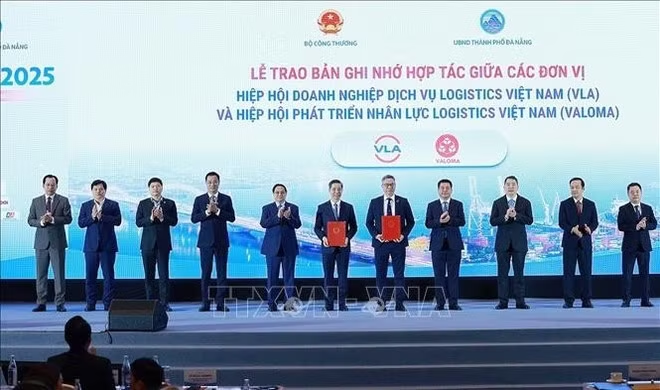
Representatives from international logistics giants such as DHL, Maersk, DB Schenker, Kuehne + Nagel, UPS, and CJ Logistics regard Viet Nam as a dynamic market with significant potential. They praised the country’s growth in imports–exports, e-commerce, and domestic logistics, despite certain challenges, positioning Viet Nam as a top emerging logistics market attracting global investment and operations.
Chief Executive Officer of Denmark’s A.P. Moller Vincent Clerc underscored that Viet Nam remains an important partner for Maersk, noting that the group’s vessels first docked at Vietnamese ports more than a century ago.
He provided updates on Maersk’s operations and cooperation with partners in Viet Nam, as well as the group’s strategic transformation in the country, with the vision of connecting Viet Nam to major global manufacturing and logistics hubs, thereby supporting deeper participation in global supply chains.
He stated that Maersk is seeking investment opportunities to develop large, modern, and green container ports, along with strategic logistics projects in Viet Nam. These initiatives aim to expand import–export turnover, promote sustainable economic growth, advance the transition to a low-carbon economy, adapt to climate change, and achieve net-zero emissions at the earliest possible time.
He affirmed that the group sees substantial potential and major opportunities in Viet Nam and hopes to contribute further to the country’s development.
Viet Nam’s logistics sector is set to achieve strong breakthroughs, contributing significantly to the nation’s rapid, robust, and positioning Viet Nam as a logistics powerhouse in the region and beyond.
Professor Dr Thomas Sim, President of the International Federation of Freight Forwarders Associations (FIATA), observed that Viet Nam’s exceptional geopolitical and geo-economic position places it at the intersection of global production–export hubs, key maritime routes, and inter-regional economic corridors.
He proposed several solutions to maximise this advantage and establish Viet Nam as a new-generation multimodal logistics powerhouse in ASEAN. These include massive investment in international gateways; prioritising the development of Lien Chieu Port and Da Nang International Airport into modern, synchronised hubs; building a highly efficient domestic logistics network with smart distribution centres and warehouses, ensuring seamless inter-regional connectivity; and strengthening regional connectivity through upgrades and expansions of cross-border transport infrastructure, particularly along the East–West Economic Corridor (EWEC), creating a seamless logistics artery from the Pacific to the Indian Ocean.
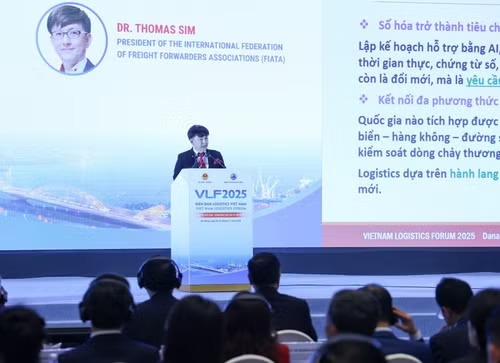
Consistent implementation of these solutions will not only enable Viet Nam to seize opportunities from global supply chain shifts but also significantly enhance national competitiveness, serving the cause of industrialisation and modernisation.
Domestic and international experts agree that with its unique geo-economic position, Viet Nam has all the conditions to become a new-generation multimodal logistics powerhouse in the region by focusing on gateway infrastructure investment, efficient domestic networks, regional connectivity, and resolute digital and green transformation. Notably, building smart, automated seaports is no longer optional but essential to avoid falling behind.
Under the Party’s sound leadership, the Government’s decisive direction, and the unity of businesses and people, Viet Nam’s logistics sector is set to achieve strong breakthroughs, contributing significantly to the nation’s rapid, robust, and steady progress towards industrialisation and modernisation, realising the aspiration for prosperous development, and positioning Viet Nam as a logistics powerhouse in the region and beyond.