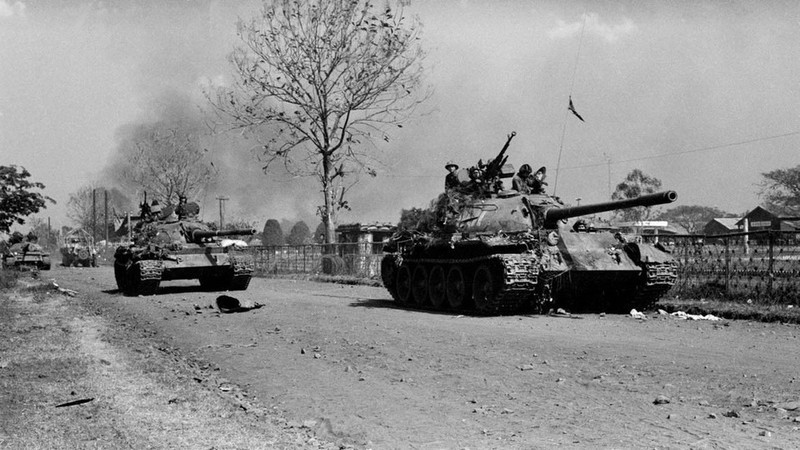
In the early morning of March 17, Vietnamese forces launched a direct attack on the headquarters of the enemy's 53rd Regiment, successively capturing targets such as the garage, warehouse, officers' club, and command bunker.
By 8:00 AM, Vietnamese army fully secured the headquarters.
At 11:00 AM on March 17, the 64th Regiment of the 320th Division quickly mobilised all forces to pursue and intercept the enemy, reaching the section of Route 7 near Mo Ria Pass (4 km east of Cheo Reo), cutting across the enemy's formation and blocking a large number of enemy forces in the Cheo Reo area.
By the afternoon of March 17, most of the retreating enemy forces were driven into “Cheo Reo Valley.”
On the same day, the 24th and 28th Regiments attacked and secured Phuoc An, eliminating one battalion of the enemy's 44th Regiment from combat.
The enemy gathered scattered troops in Chu Cuc, using artillery and bombing to destroy bridges on Route 21, attempting to hinder our pursuit.
In coordination with the main direction, on March 17, the 19th Regiment, along with local militia, liberated Kon Tum City, while the 95A Regiment, together with local armed forces, liberated Pleiku City.
On the Tri-Thien battlefield, in response to the rapid developments, on March 17, the Standing Committee of the Regional Party Committee and the Military Region Party Committee held a meeting and resolved to use all forces boldly and unexpectedly to attack on two fronts: from the east via Thanh Hoi along Route 68 and from the west via Tich Tuong and Nhu Le along Route 1, advancing into the southern region.
All forces were consolidated and adjusted to move towards the lowlands to fight the enemy, while mobilising the masses to rise up.
On the northern front, the 4th Infantry Regiment moved out to cut off the enemy at An Lo. On the southern front, they abandoned the high points 303 and 224, shifting to cut off enemy communications on Route 1 in the Luong Dien-Da Bac (Phu Loc) area. The latest start time for the attack was set for March 19, 1975.
In the Northeast Saigon battlefield, at 5:00 AM on March 17, the 7th Division launched an attack on Dinh Quan. Vietnamese forces quickly overcame the opening and captured the initial bridgeheads.
After a few moments of panic, the enemy resisted fiercely using stone barricades. The enemy's A37, F5, and AD6 aircraft flew high above the anti-aircraft range, dropping bombs.
The regiment had to halt the troops to dig trenches, replenish ammunition, and prepare for a new wave of attacks. On the afternoon of March 17, the 141st Regiment organised a second wave of attacks.
Faced with offensive from Vietnamese troops, the enemy abandoned their military base and artillery positions, fleeing into the cave clusters.
On the Vinh Tra-Military Region 9 battlefield, the command of the 951st Security Regiment and the 444th Battalion hastily withdrew from Thay Pho to Vinh Xuan on the morning of March 17, while the 1st Battalion of the 11th Regiment withdrew to Cau Ke.
Vietnamese troops liberated the communes of Huu Thanh, Thuan Thoi, and the Thay Pho weak zone for the second time, along with adjacent communes, creating favourable conditions for the units of Military Region 9 to expand the liberated area south and north of the Mang Thit River.