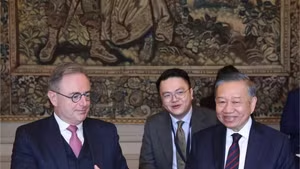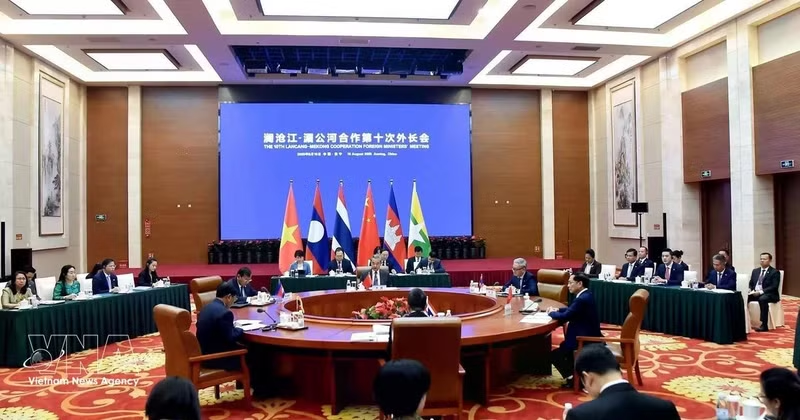
Trung wrote that over the past decade, the Mekong–Lancang River, which flows like a ribbon of life through six nations, has not only sustained millions of livelihoods but also symbolised enduring friendship and a shared aspiration for development. Building on this foundation, leaders of the six countries established the MLC mechanism in 2016, marking a significant step forward in subregional and regional connectivity.
Looking back on cooperation outcomes, the MLC has, in a relatively short period, developed into a prominent and effective subregional cooperation framework. Guided by principles of development priority, consensus, equality, voluntariness, mutual benefit, and respect for the United Nations Charter and international law, member countries have worked together to realise the vision of a peaceful, prosperous, and sustainable Mekong–Lancang region.
It has also complemented other Mekong-related frameworks such as the Greater Mekong Subregion (GMS) Programme, the Mekong River Commission (MRC), and the Ayeyawady–Chao Phraya–Mekong Economic Cooperation Strategy (ACMECS), helping countries address shared challenges, unlock opportunities, and generate common benefits.
The achievements of the MLC are evident across five key dimensions, Trung affirmed. First, the mechanism has strengthened political trust and cooperation among member states, providing a platform for exchanges at all levels. People-to-people exchanges, particularly through annual MLC Week activities, have further enhanced mutual understanding and friendship.
Second, cooperation in sustainable water resource management has made notable progress. Member countries have established the MLC Water Resources Cooperation Centre, organised annual water forums, and launched initiatives to enhance collaboration. Importantly, year-round sharing of hydrological data on the Mekong–Lancang River has improved the region’s capacity to respond to floods and droughts.
Third, regional connectivity has been significantly enhanced. Both “hard” infrastructure, such as transport networks, and “soft” connectivity, including visa facilitation and smart customs systems, have facilitated cross-border trade and economic integration. Major infrastructure projects are underway, including railway links between Viet Nam and China and expressways connecting Ha Noi with Vientiane, which are expected to foster new economic and logistics corridors.
Fourth, the scope of cooperation has expanded beyond the initial five priority areas to include emerging fields such as digital transformation and green development. Member countries have actively implemented initiatives like the “Green Mekong–Lancang Plan” and the “Safe Mekong–Lancang Action,” to jointly address climate change and transnational crime.
Fifth, the mechanism has consistently placed people and businesses at its centre. The Mekong–Lancang Cooperation Special Fund has supported around 1,000 projects across sectors such as smart agriculture, rural infrastructure, education, healthcare, and clean water systems. In Viet Nam, projects have been implemented nationwide, contributing to improved social welfare and local development.
As an active and responsible member, Viet Nam has consistently pursued a foreign policy of independence, self-reliance, cooperation and development, proactive international integration, and multilateralisation and diversification. Since the inception of the MLC, Viet Nam has made meaningful contributions in both strategic orientation and practical initiatives, while promoting synergies between the MLC and other Mekong cooperation frameworks with partners such as India, the US, Japan, and the Republic of Korea.
As the Mekong subregion and China are entering a new phase of development marked by both opportunities and challenges, Viet Nam has identified three key priorities for future MLC cooperation: strengthening mutual trust and dialogue based on international law and shared interests; enhancing practical cooperation in areas such as water management, innovation, infrastructure, energy, and supply chains; and placing people at the centre of all cooperation efforts to ensure tangible benefits in livelihoods, education, healthcare, and social welfare.
As the MLC enters its second decade, it stands not only as a testament to past achievements but also as a symbol of innovation and shared progress. Viet Nam remains committed to working closely with partner countries to advance the Mekong–Lancang Cooperation toward a shared future of peace, prosperity, and sustainable development, the minister affirmed.