In the context of increasingly complex climate change and the goal of achieving net-zero emissions, mangrove forests are being recognised as an important resource for participating in both domestic and international carbon credit markets.
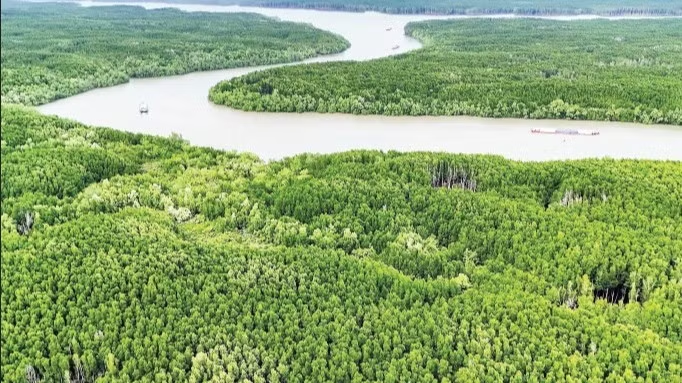
Currently, the country has more than 14 million hectares of forest, of which mangroves account for nearly 200,000 hectares, mainly distributed in the Mekong Delta, the north-eastern coastal region, the Red River Delta, and the central coastal areas.
Mangrove ecosystems play a particularly important role in coastal protection, biodiversity development, and providing livelihoods for local people, and are regarded as coastal carbon sinks.
Notably, mangroves have high biological productivity and a nearly closed blue carbon cycle.
According to scientists, the carbon reserves in global mangrove ecosystems are estimated at around 3.2 billion tonnes; in economic value terms, studies show that the value of carbon stored in mangroves ranges from 1,000–9,000 USD/ha/year, depending on ecological characteristics and geographical location.
In Viet Nam, the carbon reserves of mangroves are about 245 tonnes per hectare; on average, carbon in the biomass of living vegetation (including both above-ground and below-ground roots) accounts for 29%, while the remaining 71% is stored in the soil beneath the mangrove canopy.
According to data updated to June 2024, emission reduction potential from mangrove projects in Viet Nam has exceeded 1.1 million tonnes of CO2, far surpassing the initial target of 565,000 tonnes. However, realising the carbon credit potential of mangroves still faces many obstacles.
Research by Huynh Thi Hong Trang (Khanh Hoa University) and her colleagues shows that the biggest challenge lies in measuring and verifying carbon reserves, as mangroves are constantly affected by tides and geological changes, making data collection and maintaining consistent monitoring data difficult.
In addition, most carbon in mangroves is stored in roots and sediments, but measuring carbon in below-ground and soil is complex, costly, and prone to errors due to the difficult-to-access saline conditions.
Moreover, the sustainability of carbon credits from mangroves is also a concern, as these ecosystems are vulnerable to the impacts of climate change, storms, flooding, and coastal erosion, leading to the risk of re-emission of stored carbon.
Determining carbon reserves and carbon emissions from mangroves requires substantial financial resources, which is also a significant barrier.
Researchers said that in many developing countries, including Viet Nam, mangrove projects are often small in scale, resulting in carbon credits that may not be sufficient to offset initial costs, creating financial risks and reducing incentives to participate in the carbon market.
In addition, limitations in technical capacity for managing, protecting, and restoring mangroves, along with pressure from declining forest areas due to exploitation and land-use conversion, remain major challenges.
For Viet Nam, the carbon market is still new, and the legal framework continues to be completed. In particular, detailed regulations on trading, auctioning greenhouse gas emission quotas, and ensuring the security and safety of the carbon market are not yet fully synchronised or detailed. The quantity and quality of human resources with expertise in developing and appraising carbon credit projects also remain limited.
Therefore, to maximise the potential and benefits of mangroves, it is necessary to strengthen policy frameworks and benefit-sharing mechanisms, aiming to fully promote the economic and ecological value that mangroves can provide in the process of green development and climate change response of the country.
Many regulations related to emission reduction and carbon credits have been issued, including: Decree No. 06/2022/ND-CP on greenhouse gas emission mitigation and ozone layer protection; Decision No. 13/2024/QD-TTg on promulgating the list of sectors and facilities required to conduct greenhouse gas inventories; and Decision No. 232/QD-TTg on the establishment and development of the carbon market in Viet Nam.
According to the roadmap, during the 2023–2027 period, Viet Nam will focus on building regulatory and policy systems while piloting the operation of a carbon credit exchange, with the aim of officially launching it in 2028; by 2029, the domestic trading platform will be fully operational.
According to researcher Huynh Thi Hong Trang, to help mangroves effectively participate in the carbon market, Viet Nam needs to prioritise the development of a standardised carbon database and implement inter-provincial project models to scale up credit issuance.
At the same time, it is necessary to establish fair benefit-sharing mechanisms among the State, businesses, and local communities; encourage integrated livelihood models under forest canopies; promote public–private partnerships; and mobilise resources from international climate funds to both conserve ecosystems and effectively exploit opportunities from carbon credits.