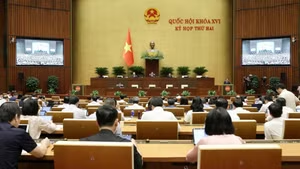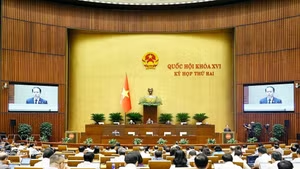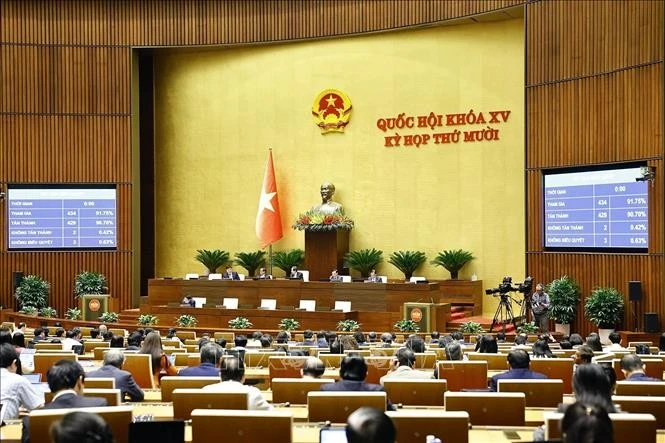
The AI Law, spanning eight chapters and 35 articles, cleared the legislature with 429 of 434 deputies in favour (90.7%). The Law on amendments and supplements to several articles of the Law on Intellectual Property, limited to three articles, won 432 of 438 votes (91.33%), while the amended Law on High Technology, with six chapters and 27 articles, garnered 437 of 441 votes (92.39%).
Presenting a report examining the draft AI Law, Minister of Science and Technology Nguyen Manh Hung said there was broad consensus on its urgency.
The draft law establishes core principles, prohibited acts, and a risk management framework. Its drafting approach draws on global experience in governing intelligence systems: regulating inputs through data management, governing the use of AI through legal and ethical frameworks, and managing outcomes through accountability mechanisms.
To strike a balance between regulation and innovation, the draft law incorporates strict safeguards for high-risk AI systems, drawing on models from the EU and the Republic of Korea, while also introducing robust mechanisms to foster development, similar to Japan. These include top-tier incentives for AI, controlled sandbox testing with partial or full exemptions of compliance requirements, a National AI Development Fund with special financial mechanisms, and a voucher scheme to support startups.
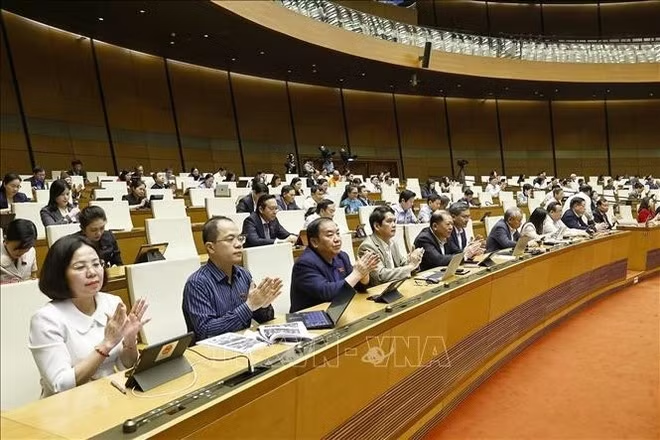
Proposals for an independent National AI Committee have been scrapped, and oversight will be centralised under the Government, with the Ministry of Science and Technology as the lead coordinator.
Regarding technical standards, conformity assessment will apply exclusively to high-risk systems named on a Prime Minister-approved list.
To prevent the law from becoming obsolete, the draft avoids fixed lists of technologies or rigid risk classifications. Clause 4 of Article 13 grants the PM authority to issue and continuously update the list of high-risk AI systems in “real time,” without the need for legislative amendments.
The Law on AI will take effect on March 1, 2026.