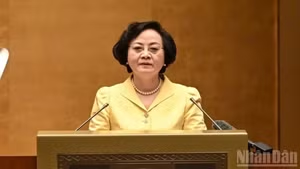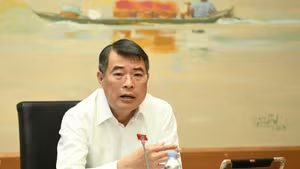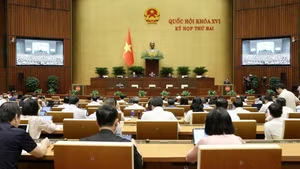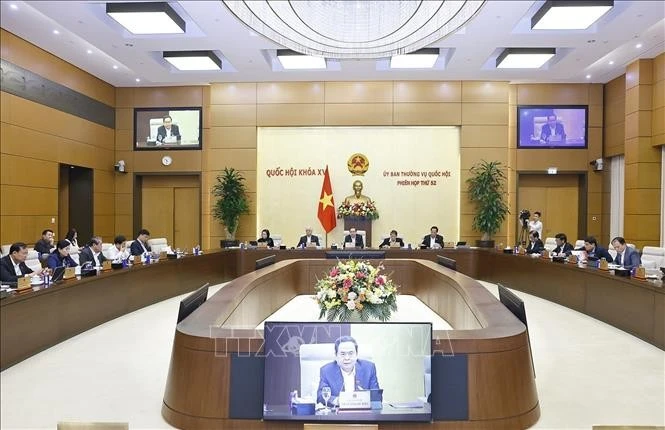
The NASC assigned the Ministry of Public Security, as the drafting agency, to work with the Standing Board of the NA's Committee for National Defence, Security and External Relations and relevant bodies to promptly revise and finalise the draft based on the NASC's recommendations and the verification report of the NA's Committee for National Defence, Security and External Relations before submitting to the NA Chairman for promulgation.
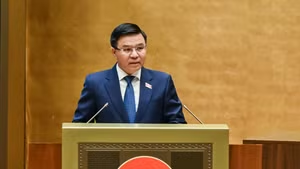
Presenting the draft, Deputy Minister of Public Security Nguyen Van Long said the amendments focus on revising regulations on the authority to inspect compliance with environmental law. Under the proposal, this authority will be shifted from district-level police to commune-level police, including chiefs of commune, ward and special zone police, as well as heads of police posts, to match new administrative decentralisation and the police force’s new organisational model.
The draft also proposes renaming the Environmental Police as the Environmental Crime Prevention Police.
Addressing the session, NA Chairman Tran Thanh Man underlined the urgency of the amendments, citing increasingly complex environmental violations. He stressed that the revisions must ensure consistency across the institutional framework and empower grassroots-level environmental police to close oversight gaps and improve the handling of minor offences.
He also highlighted the need to expand powers relating to the use of new technologies, including sensors and satellite data for real-time monitoring, and to strengthen inter-sectoral coordination with the Ministry of Agriculture and Environment, the Ministry of Health, and Viet Nam Customs in pollution response, food safety and waste-import control.
The same day, the NASC discussed the draft Law on Specialised Courts at the International Financial Centre.
According to the Supreme People’s Court, the draft law proposes establishing a specialised court in Ho Chi Minh City with jurisdiction over settling disputes arising at the International Financial Centre in both HCM City and Da Nang. The model is designed to incorporate principles of the common law system to ensure flexibility, specificity and alignment with international practice.
The court would operate with two levels of adjudication: first instance and appeal. For first-instance cases, the preferred option is for a single judge to preside, with a three-judge panel available for complex cases or at the request of the parties. Appeals would be heard by a panel of three judges. The chief justice of the specialised court would be appointed, dismissed or removed by the Chief Justice of the Supreme People’s Court to ensure system-wide consistency.
The NA Chairman said the specialised court must offer “exceptional international competitiveness” and that its organisation and operation must meet the expectations of international investors. He called for careful review of provisions on applicable law, including allowing parties to choose foreign law and international trade customs.
Concluding the discussion, Standing NA Vice Chairman Do Van Chien said the draft law meets the conditions for submission to the National Assembly under the fast-track procedure at its 10th session. He emphasised that the law must remain distinctive, outstanding and consistent with international norms to help attract global investors.