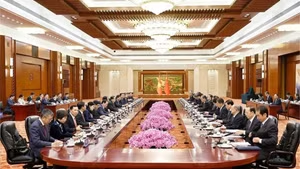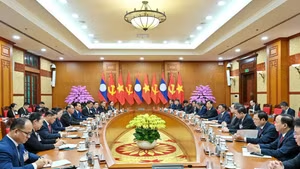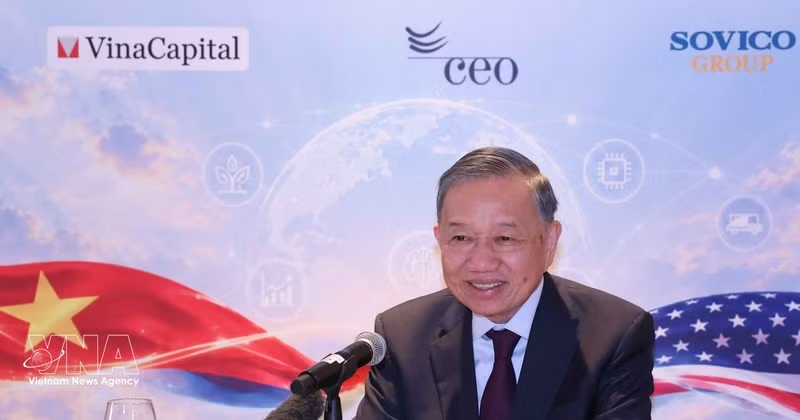
At the event, representatives of several US and multinational corporations shared views on promoting government initiatives to attract private capital; identifying new trends in global financial markets and their impacts on emerging markets such as Viet Nam; and global geopolitical issues, trends and opportunities for Viet Nam.
Others discussed solutions related to infrastructure development, including ways to address capital needs, the insurance market as a source of long-term capital for infrastructure development projects, opportunities for Viet Nam’s tourism sector, global energy trends and potential business projects in Viet Nam.
Representatives of Vietnamese corporations also presented potential areas for cooperation in tourism, aviation, energy and finance.
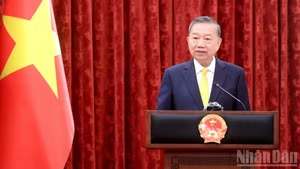
After listening to frank opinions from businesses, investment funds, international financial institutions and Vietnamese enterprises, as well as responses from ministries and sectors, General Secretary and President Lam said the views shared at the dialogue are highly valuable, as the participants not only discussed existing opportunities but also addressed a broader question: What does Viet Nam need to do to enter a new phase of faster, more sustainable development and secure a higher position in the global value chain.
The leader said Viet Nam does not lack development opportunities and has huge demand for infrastructure, energy, technology, digital transformation, urban development, logistics, healthcare, education and many new service sectors. The challenge in the coming period, however, is to turn these opportunities into projects that are high-quality, feasible, capable of mobilising capital and able to generate new productivity for the economy.
He said technology, energy and finance are three separate areas. Technology generates new productivity, energy provides the foundation for growth, and finance supplies the resources to turn ideas into projects. Only when these three elements are effectively connected can a higher-quality development model take shape. This is precisely where Viet Nam’s development needs naturally converge with the strengths of US businesses, investment funds and financial institutions.
Viet Nam considers science and technology, innovation and digital transformation important drivers of a new growth model. The US is home to world-leading companies in artificial intelligence (AI), semiconductors, cloud computing, software, automation, cybersecurity and research and development. These are areas that closely match Viet Nam’s transformation needs, he noted.
He called on US technology corporations to view Viet Nam not merely as a market or production base, but as a technology development partner. The success of a technology project should not be measured only by the amount of investment or revenue generated, but also by the number of Vietnamese engineers trained, the number of Vietnamese enterprises joining supply chains, the amount of research, design and solution development activities conducted in Viet Nam, and the new competitive capabilities the project creates for the Vietnamese economy.
The top leader of Viet Nam called on businesses and investors to adopt a long-term vision, while affirming that Viet Nam will ensure a stable and transparent policy environment and continue to improve its institutions. He expressed his hope that the meeting will lead to a pipeline of implementable projects, genuinely interested investors, appropriate capital structures, designated focal points responsible for implementation and clear timelines for addressing issues. Businesses should clearly state their needs and commitments, while investment funds and financial institutions should engage at an early stage to help design capital structures and standardise projects. Vietnamese agencies should work alongside investors within the legal framework to address bottlenecks, facilitate quality projects and maximise their spillover effects. This, he said, is how the two sides can move from opportunities to projects and from investment to new development capabilities.
The Party General Secretary and President stressed that Viet Nam is entering a new phase of development with many emerging opportunities. Technology, energy and finance only truly matter when they are brought together through good projects, strong businesses and sound institutions. If this can be achieved, technology, energy and finance will no longer be three separate stories, but three components of a new growth model for Viet Nam.
He called on US businesses, investment funds and financial institutions to work with Viet Nam to turn the ideas discussed at the meeting into implementable projects, good projects into long-term capital flows, and capital, technology and management expertise into new productivity, infrastructure, businesses and competitive capabilities for Viet Nam. This, he said, is also how sustainable values can be created for investors, businesses and the people of both countries.
The top leader expressed his confidence that with the increasingly substantive Viet Nam-US relations, the capabilities and experience of US businesses, investment funds and financial institutions, and Viet Nam’s determination to innovate and its aspirations for development, the two countries can turn today’s vast potential into concrete achievements in the years ahead.