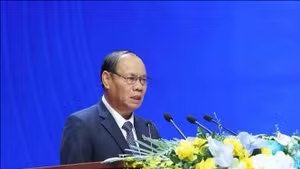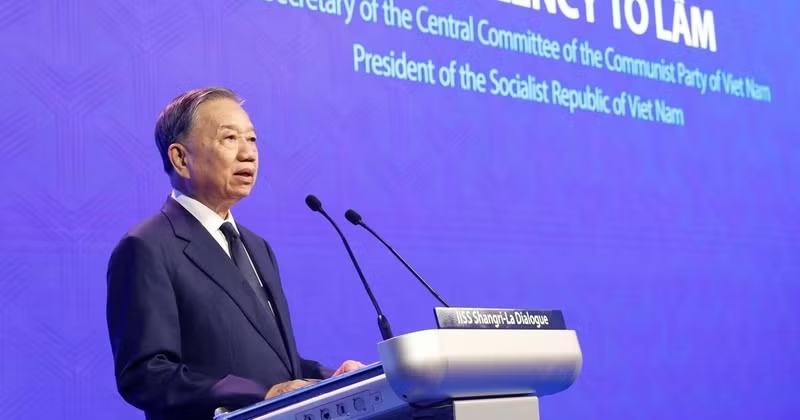
This was the assessment of regional experts, scholars and media outlets regarding General Secretary and State President To Lam’s recent visits to Thailand, Singapore and the Philippines, as well as his keynote address at the Shangri-La Dialogue.
Advancing relations with neighbouring countries
Thai scholar Supalak Ganjanakhundee observed that before presenting Viet Nam’s vision for regional peace and security at a major international forum, the top Vietnamese leader visited Thailand, one of the key members of the Association of Southeast Asian Nations (ASEAN). This underscored the importance Viet Nam attaches to ASEAN and its relations with neighbouring countries.
Commenting on To Lam’s keynote address at the Shangri-La Dialogue, Supalak highlighted Viet Nam’s emphasis on preventive diplomacy, dialogue, reconciliation, mediation and confidence-building mechanisms. According to Supalak, the call for risk-reduction measures reflects Viet Nam’s growing confidence as a regional actor willing to contribute to shaping the regional environment.
According to Supalak, another important message conveyed in the address was Viet Nam’s strong support for ASEAN centrality.
General Secretary and State President To Lam framed regional challenges through the lens of international order, development and strategic trust, highlighting the need for ASEAN to play a more proactive role in risk management and crisis prevention.
The Thai scholar concluded that the significance of the speech lies not in its immediate policy impact, but in what it reveals about Vietnam’s evolving perspectives on ASEAN.
Strengthening political trust within ASEAN
On June 3, Indonesia’s Kompasiana website published a commentary describing General Secretary and State President To Lam’s visits to three Southeast Asian countries as a significant diplomatic move that contributes to promoting peace, strengthening political trust and expanding economic cooperation in ASEAN.
The article noted that the tour reflected not only Viet Nam’s foreign policy orientation in a new stage of development but also the country’s increasingly proactive, practical and results-oriented approach to diplomacy.
Accordingly, the top Vietnamese leader’s engagements in the three countries underscored the growing role of high-level diplomacy in shaping strategic directions for bilateral relations, and laid foundations for long-term cooperation between Viet Nam and its regional partners.
The article emphasised that the warm and high-level receptions accorded to General Secretary and President Lam in all three countries as evidence of Viet Nam’s rising standing within ASEAN. His meetings and talks with the leaders of Thailand, Singapore and the Philippines opened up new avenues for cooperation at a time when all four nations are entering new development phases and adapting to an increasingly complex regional and international environment.
A central message of the speech was the call for greater dialogue, confidence-building and respect for international law as means of preventing conflicts.
The views presented by Viet Nam at the Shangri-La Dialogue clearly reflect its approach to contemporary security challenges, placing emphasis on preventive diplomacy, regional cooperation and the role of international law in maintaining peace and stability.
Veeramalla Anjaiah, Senior Research Fellow at the Centre for Southeast Asian Studies in Indonesia, described the speech came at a highly opportune moment and at a forum of particular significance to global and regional security. He noted that the address directly identified major challenges now confronting the world, including the crisis of the international order, development models, and strategic trust.
Anjaiah particularly praised Viet Nam's proposals to broaden consultation channels, flexible mediation mechanisms, incident-response contact groups, semi-official forums, and confidence-building efforts spanning military, security, law enforcement, academia, business, and civil society.
Assessing Viet Nam's stance on promoting strategic trust and reducing conflict risk, Anjaiah described them as strategic pillars for the country’s future.
According to the CSEAS researcher, Viet Nam's proposals to boost dialogue, build trust, and uphold international law could help create a more inclusive, stable, and sustainable regional framework in Southeast Asia and the broader Asia-Pacific.