For many years, USCIRF reports have often repeated old allegations, relying on unverified information, even from organisations and individuals with biases against Viet Nam, to make inaccurate evaluations. This has caused public concern about the purpose and credibility of these reports.
In the newly released report, USCIRF claimed that the State of Vietnam had “increased repression of independent religious groups,” citing several individual cases and religious facilities as examples. However, the report’s approach clearly shows bias, as the information is selected from a number of sources with prejudice against Viet Nam, while data reflecting the overall picture of religious policy and religious life in the country is largely ignored. Relying on unverified sources to draw imposed conclusions makes the report unconvincing and causes public outrage.
One of the examples mentioned in the report concerns incidents at Son Linh Pagoda in Kon Tum Province (now Quang Ngai Province) or Thien Quang Pagoda in Ba Ria–Vung Tau (now part of Ho Chi Minh City), which were said to have been destroyed or threatened with demolition. According to information from local authorities and competent agencies, these were matters related to land management and construction orders, handled in accordance with regulations of the current laws. USCIRF’s interpretation of these cases as “evidence of religious repression” is an unfounded inference. In reality, the Vietnamese law is applied equally to all organisations and individuals, without discrimination on religions.
The report also refers to restrictions on the exit of certain individuals and describes them as signs of “religious repression.” However, the Vietnamese law stipulates that exit postponement is only applied in specific cases related to legal obligations or the need to ensure security and social order. Linking normal administrative measures with the issue of religious freedom is a baseless interpretation.
Notably, USCIRF continues to repeat the allegation that the Viet Nam Buddhist Sangha is “a state-created organisation,” claiming that the state uses it “as a tool to control all Buddhist activities and suppress monks and followers with independent spirits.” This is an imposed assessment that does not reflect historical reality. The Viet Nam Buddhist Sangha was established at the National Buddhist Unification Congress in 1981 at Quan Su Pagoda (Ha Noi), with the participation of representatives of nine Buddhist organisations and sects, marking the first time Vietnamese Buddhism had a unified organisation nationwide, meeting the aspiration for unity of monks, nuns, and followers after many years of national division. Over the past more than 40 years, the Viet Nam Buddhist Sangha has developed strongly, with tens of thousands of pagodas and millions of followers, while actively participating in charitable and social activities and contributing to the national development.
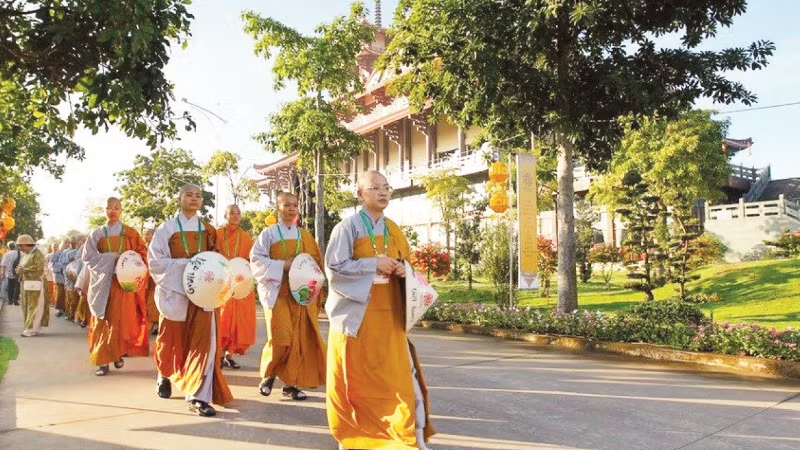
Looking at religious life in Viet Nam today, the picture is completely different from what USCIRF describes. According to the Government Committee for Religious Affairs, more than 95% of the population nationwide practise beliefs or religions. There are 43 organisations belonging to 16 religions that have been recognised and granted registration certificates, with nearly 28 million followers. Every year, thousands of religious festivals and activities are held openly, attracting large numbers of believers. These figures show that religious life in Viet Nam is not only guaranteed but increasingly diverse. Many religions have favourable conditions to expand pastoral activities, train dignitaries, and build places of worship. Numerous pagodas, churches, temples, and sanctuaries have been newly built or upgraded across the country, becoming centres of cultural and religious life for communities.
This reality is further demonstrated by major international religious events hosted in Viet Nam in recent years. Viet Nam has previously hosted the United Nations Day of Vesak three times — in 2008, 2014, and 2019 — and continued to host the event in 2025. This large-scale international religious event gathers thousands of delegates from many countries and territories. The fact that the global Buddhist community has repeatedly chosen Viet Nam as the venue for the United Nations Day of Vesak shows the open and stable religious environment in the country.
Not only Buddhism, but other religions in Viet Nam have also developed strongly. Indigenous religions such as Cao Dai, Hoa Hao Buddhism, and Tu An Hieu Nghia all have organisations recognised by the state and operate stably. In addition to purely religious activities, many religious organisations actively participate in social activities. According to the government’s 2025 report on religious affairs, religious organisations are operating thousands of charitable establishments, compassion classes, and centres for caring for the elderly and disabled children. These activities make practical contributions to social welfare and are widely recognised by the community.
Viet Nam’s consistent policy on freedom of belief and religion is clearly affirmed in the legal system and Party documents. The 2013 Constitution stipulates: “Everyone has the right to freedom of belief and religion, to follow or not to follow any religion.” The Law on Belief and Religion (2016) further specifies this right, creating a favourable legal framework for religious organisations and individuals to operate. The political report submitted to the 14th National Party Congress continues to affirm the guarantee of people’s right to freedom of belief and religion; to mobilise, unite, and gather religious organisations, followers, dignitaries, officials, and clergy to live “a good life and a good religion,” accompany the nation and actively participate in patriotic movements. Viewed from reality in Viet Nam, it can be affirmed that the right to freedom of belief and religion of the people is increasingly respected and better guaranteed. This is also the clearest response to the unobjective assessments in the USCIRF report.
In the context of increasingly deep international integration, Viet Nam is always ready for frank and constructive dialogue with partners on issues related to human rights, including the right of freedom of belief and religion. However, dialogue is meaningful only when it is based on respect for truth and goodwill. Only by looking at the objective reality of social life can the international community understand Viet Nam correctly and work together to promote the common values of humankind.
For many years, USCIRF has repeatedly issued reports showing prejudice against Viet Nam. Many opinions believe that these assessments of USCIRF may be influenced by certain political lobbying groups, or by sources of information lacking objectivity and goodwill, and therefore lack credibility and persuasiveness.
In the context of increasingly deep international integration, Viet Nam is always ready for frank and constructive dialogue with partners on issues related to human rights, including the right of freedom of belief and religion. However, dialogue is meaningful only when it is based on respect for truth and goodwill. Only by looking at the objective reality of social life can the international community understand Viet Nam correctly and work together to promote the common values of humankind.