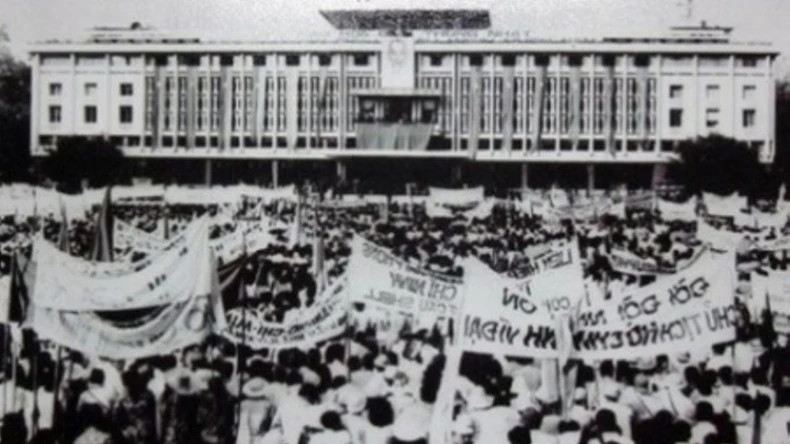
The flag of liberation flew high over the Independence Palace, over the Truong Sa Archipelago, and across sacred seas and territories of the Fatherland. The prolonged resistance war of Vietnamese people triumphed at last, and the long-cherished dream of national reunification became reality.
It marked the ultimate defeat of over a century of old colonial domination and more than two decades of neo-colonial occupation. It was a decisive victory of the Vietnamese people, Vietnamese history, and Vietnamese culture.
The glorious journey that carried the national flag — the flag of the Party, the flag of our beloved President Ho Chi Minh — to its final destination was forged from the blood, sweat, tears, and wisdom of countless compatriots, cadres, and soldiers. It marked a new milestone in the Ho Chi Minh era, following in the heroic tradition of Bach Dang, Chi Lang, Dong Da, and the resounding Dien Bien Phu Victory.
The Political Report at the Fourth National Congress of the Communist Party of Vietnam in February 1976 solemnly affirmed: “Years may pass, but the victory of our people in the resistance war against the United States for national salvation will forever be recorded in the history of our nation as one of its most brilliant chapters — a shining symbol of revolutionary heroism and human intellect. It will also enter world history as a great feat of the 20th century, an event of immense international significance and profound historical relevance, inspiring confidence and hope among hundreds of millions of people around the world struggling for peace, national independence, democracy, and socialism.”
Speaking at the massive rally in front of Hanoi’s Grand Opera House on May 1, 1975, Prime Minister Pham Van Dong sent a message of goodwill across the Pacific: “We send to the US people a greeting of peace and friendship.” (Nhan Dan Newspaper, May 2, 1975).
This message reflected Vietnam’s steadfast tradition of peace and justice — a deep-rooted desire to befriend all peoples of the world. The letters from President Ho Chi Minh to US Presidents stand as a timeless testament to that priceless legacy of peace. The support and cooperation with the Allies during and after the difficult August Revolution of 1945 laid a foundation of trust for the future. Even during the fiercest bombing campaigns over northern Vietnam, President Ho Chi Minh still expressed his “respect for the US people—those who are intelligent, peace-loving, and democratic.” He remarked that, instead of coming as armed soldiers, “if they come as technicians to assist us, we will warmly welcome them as brothers.”
The B-52s brought destruction to Hanoi and left their mark at Huu Tiep Lake. Yet even amidst the thunder of artillery in April 1975, the evacuation flights for the US citizens over Saigon were allowed to take off safely—a quiet testament to Vietnamese humanitarian commitment.
The long journey of searching for missing US personnel, sharing war records, locating Vietnamese martyrs, clearing unexploded ordnance, decontaminating dioxin-affected areas, and providing humanitarian aid to Agent Orange victims—these are all acts of goodwill that affirm trust and test the sincerity between two nations and two peoples.
It was a long, arduous journey with many twists and turns, but both sides still persevered to reach the destination - the journey of reconciliation, healing, and cooperation between former enemies to upgrade to a Comprehensive Strategic Partnership between Vietnam and the United States that has become a model for international relations in the new era. To overcome sad memories, painful memories! To not forget, but to understand them so that together we can continue to write a new, more responsible, and better history.
In July 2015, a historic meeting between US President Barack Obama and General Secretary Nguyen Phu Trong at the White House signalled the US’ recognition of Vietnam’s political system. It marked the dawn of a new era of cooperation and development, following years of persistent efforts to overcome ideological and systemic differences.
In April 2025, amid rising global trade tensions, General Secretary To Lam held a phone call with US President Donald Trump shortly after the announcement of reciprocal tariffs on Vietnamese exports. This timely and decisive step — initiating dialogue on trade relations, import duties, and a potential bilateral agreement — reaffirmed the spirit of cooperation built on mutual respect, patient dialogue, and pragmatic negotiation. It demonstrated both nations’ commitment to resolving differences and pursuing mutual benefit, placing national interests above all in a world still shaped by conflict, competition, and contradiction. Such a world demands adaptability, strategic calibration, and active, flexible engagement.
Today, Vietnam maintains comprehensive strategic partnerships with 12 countries, including four permanent members of the United Nations Security Council — the United States, China, Russia, and France. We aim for GDP growth of 8% or higher in 2025 and double-digit growth in the 2026–2030 period. We are accelerating breakthroughs in science, technology, innovation, and digital transformation. A sweeping reform of our political and administrative apparatus is underway — with an unprecedented scale — to create new space for national development. We continue the critical mission of Party-building and political system reform in tandem with an unyielding fight against corruption, wastefulness, and moral decay, fighting “against what is obsolete and broken to give rise to the new and wholesome,” as President Hồ Chí Minh once wrote in his will.
Half a century has passed since national reunification under the sacred skies of the Hung Kings. Fifty years is not a long time, but it is enough for a nation to rise like a dragon, for a developing country to reach the threshold of prosperity. Opportunities do not wait. Non-traditional challenges — climate, pandemics, digital disruption — could overwhelm us if we fail to anticipate and prepare for them. If we do not reform, if we fail to grow in proportion to the sacrifices made for reunification, if we become complacent, it would be a betrayal of history, of our ancestors, of the blood shed by generations of heroes, and of the people's enduring dream of a powerful Vietnam.
If peace and stability are not secured; if economic growth falters and we fall into the middle-income trap; if the material and spiritual well-being of the people stagnates; if our national defence and security are not solidly maintained, then not only our borders, but our future itself, will be at risk.
In his article “Vietnam is One, the Vietnamese People are One” commemorating the 50th anniversary of reunification, General Secretary To Lam declared: "We must not allow our nation to fall behind. We must not let our people miss their opportunity. We must not repeat the cycles of history. Therefore, we must place national interests above all else. We must act not for short-term gain, but for long-term future."
To achieve this, the most vital force is not wealth, resources, or foreign investment, it is the unity of the Vietnamese people — regardless of religion, political affiliation, or ethnicity. As proclaimed by President Ho Chi Minh at the founding of the Democratic Republic of Vietnam:
"If you are Vietnamese, you must stand up and fight against colonial rule to save the country.” (Call for National Resistance)
Before 1975, we followed “the fire burning in our hearts” for a unified Vietnam. Half a century later, that unity must become the driving force for a strong, thriving Vietnam — measured in real values, in tangible progress, in lasting achievements.
With the new guiding principle that “Every Vietnamese must unite and work together to build a prosperous nation,” Vietnam charts its path forward. On this journey, as emphasised by the General Secretary, the most fundamental and decisive factor lies in forging a unified mindset and shared vision: “National reconciliation does not mean forgetting history or erasing differences but accepting diverse perspectives in a spirit of tolerance and respect.” This is in pursuit of a singular, overarching goal: “to build a Vietnam that is peaceful, unified, strong, civilised, and prosperous,” so that future generations will no longer be haunted by “war, division, hatred, and the loss and suffering once endured by their forebears.”
We have identified the bottleneck of all bottlenecks in our path to development: the institutional system. But within that broader deadlock, we must also candidly acknowledge a more intangible yet equally critical barrier: the “bottleneck of the heart”. Preserving the Hien Lương Bridge, once a symbol of the North–South divide, as a historical and cultural relic for future generations is a meaningful way to remember the cost of war and separation.
Yet, if certain “dividing lines” still linger in the hearts of people, they must be named and dismantled. Through political will. Through concrete mechanisms and policies. Through consistency between words and actions; between central and local governments; between the homeland and the diaspora.
Through the absence of discrimination — not only in the economic sphere but extended across political, cultural, and social life — the resources, intellect, and contributions of every Vietnamese, regardless of whether they come from the public or private sector, whether they are Party members or not, whether they reside within the country or abroad, must be respected, treated equally, unlocked, and meaningfully valued. Only then can they shine and contribute fully to a prosperous, strong nation.
The goal of peace and reunification that generations have pursued must now become the launchpad, the foundation, and the demand for us to reach new heights — a Vietnam that is wealthy, powerful, democratic, just, and civilised.