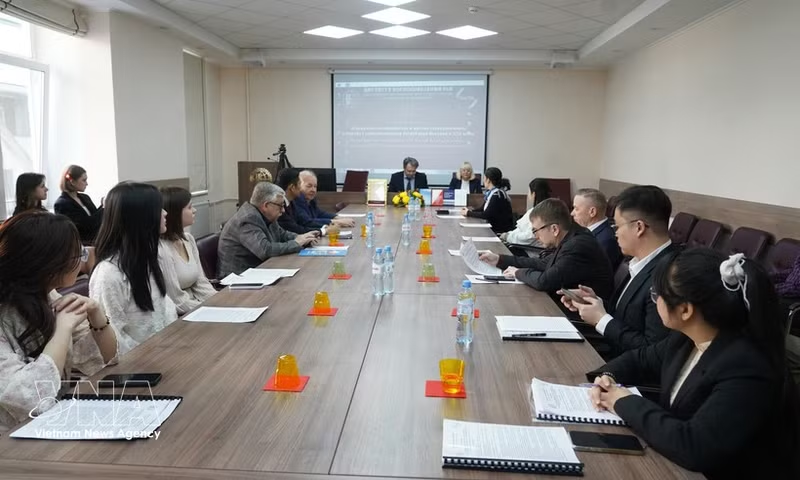
The seminar took place at the Institute of Oriental Studies (IOS) under the Russian Academy of Sciences, as part of the week-long international conference “The Sixth V.G. Rastyannikov's Readings: Potential of BRICS and partner countries in a changing global landscape” from March 23–30.
The event, came shortly after Prime Minister Pham Minh Chinh’s successful visit to Russia, adding further relevance to the discussions. It drew a large number of Russian and Vietnamese scholars, both in person and online.
In his opening remarks, IOS Director Dr. Alikber Alikberov underscored the importance of in-depth research into Viet Nam’s development model, affirming that Viet Nam is not only a traditional strategic partner of Russia but also an important link in the economic and security architecture of the Asia-Pacific region.
The seminar brought together dozens of leading Viet Nam studies experts from prominent Russian research institutions, featuring 12 in-depth presentations that offered multidimensional analyses of Viet Nam’s recent transformations across sectors.
One of the key highlights was the presentation on Viet Nam’s efforts towards strategic autonomy delivered by Prof. Dr. Vladimir Maryzin, Director of the Centre for Vietnamese and ASEAN Studies of the Far East Institute of the Russian Academy of Sciences. The paper examined how Viet Nam is adapting to evolving global economic fluctuations.
Meanwhile, Dr. Petr Tsvetov, a leading historian and expert at the same centre, provided a comprehensive analysis of Viet Nam’s relations with major powers such as Russia, China, and the US under the leadership of Party General Secretary To Lam. His remarks highlighted Viet Nam’s flexible and pragmatic foreign policy.
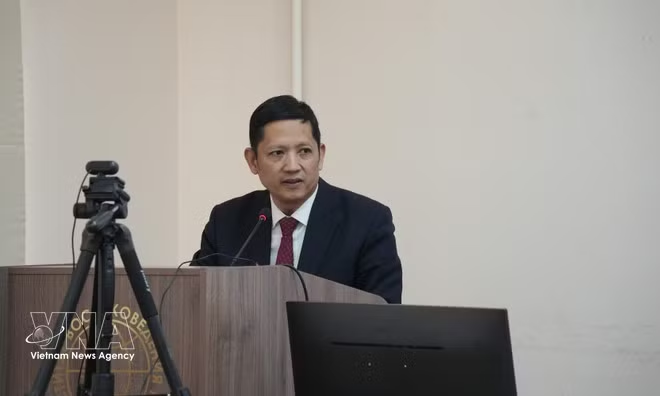
Regarding the bilateral cooperation, Dr. Nguyen Quoc Hung, Director of the “Tradition and Friendship” Fund to promote the Russia – Viet Nam cooperation, stressed that the bilateral relations are opening up new opportunities for cooperation, particularly in high-quality human resource training, science and technology transfer, logistics, and energy.
However, Hung said that the key to successful cooperation between the two countries lies in their ability to overcome infrastructure and legal barriers, ensure a stable investment environment, and safeguard intellectual property rights.
Many experts also addressed the current state of Russia – Viet Nam relations and the impact of an emerging multipolar world on bilateral ties. Notably, some young Vietnamese delegates highlighted Viet Nam’s role in expanding cooperation with the BRICS group as a potential driver in promoting a more equitable global order.
According to Pham Quang Truong Minh, a final-year master’s student in international economics at Plekhanov Russian University of Economics, BRICS’s guiding principles, along with Russia’s 2023 foreign economic strategy, underscore multipolarity as an inevitable global trend. He observed that this vision aligns closely with Viet Nam’s foreign policy, as both aim to maximise benefits across all global partnerships.
Minh described this as a unique window of opportunity for Viet Nam to position itself as an important global pole, towards advancing self-reliance, localisation, technological autonomy, and promoting the application of artificial intelligence in production and business, creating new products and making inroads into new markets.
The seminar delivered a strong message on strengthening intellectual linkages, contributing to deepening the Russia – Viet Nam comprehensive strategic partnership in a more substantive, effective, and sustainable manner in the 21st century.