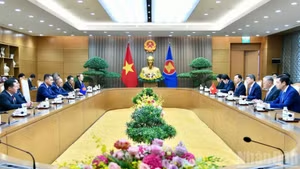
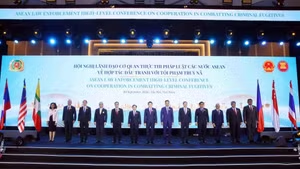
The message of cooperation, dialogue and solidarity for the future of the subregion was clearly articulated by leaders at the 12th Cambodia–Laos–Myanmar–Viet Nam (CLMV) Cooperation Summit and the 11th Ayeyawady–Chao Phraya–Mekong Economic Cooperation Strategy (ACMECS) Summit, which recently concluded successfully in Ha Noi.
The national flags of the Mekong subregion countries fluttering in the golden sunshine of a winter afternoon in Ha Noi symbolised the solidarity, consensus and shared determination of the countries to build a prosperous future for the region. The participation of high-level leaders and numerous journalists from member countries at the two summits held in Ha Noi on November 28 demonstrated the importance and appeal of these cooperation mechanisms, as well as Viet Nam’s growing international standing.
Creating breakthroughs in subregional cooperation
One of the notable highlights of the two summits was the strong consensus and determination among national leaders to deepen subregional cooperation, making it increasingly substantive and effective while delivering tangible benefits to people and businesses.
The summits agreed on new cooperation orientations across most priority areas to accommodate the current development context and needs.
According to Politburo member and Minister of Foreign Affairs Le Hoai Trung, the leaders agreed to enhance the role of the CLMV and ACMECS mechanisms in regional cooperation, strengthen resilience, foster cohesion among member countries and transform the subregion into a shared development space.
At the 12th CLMV Summit, the leaders agreed on several major orientations. First, connectivity was identified as an overarching priority for the 2027–2028 period. Second, cooperation areas would be renewed, focusing on sectors that generate new growth drivers and the implementation of concrete initiatives. Third, new approaches would be adopted to resource mobilisation and implementation. Member countries encouraged businesses to participate from the project development stage.
A particular highlight of the 12th CLMV Summit was the agreement to implement two initiatives proposed by Viet Nam. Under the “Four-Country Smart Dry Port Corridor” initiative, member countries will jointly explore ways to connect dry ports with border gates, airports and seaports. Meanwhile, the “CLMV Heritage Journey” initiative seeks to connect heritage sites through cross-border tourism routes, enabling the four countries to jointly tell the stories of civilisations along the Mekong River.
The summit welcomed Viet Nam’s CLMV Scholarship Programme 2.0 for Cambodia, Laos and Myanmar, which expands its scope to include English-medium education, postgraduate education and vocational training.
Minister of Foreign Affairs Le Hoai Trung noted that the initiatives proposed by Viet Nam are expected to boost intra-regional trade, contribute to the development of high-quality human resources and promote people-to-people exchanges.
At the 11th ACMECS Summit, the leaders agreed to maintain ACMECS as an important subregional mechanism that complements the ASEAN Community-building process, aligning subregional development with broader regional integration. To promote sustainable development under the three pillars of ACMECS, the leaders discussed ways to enhance infrastructure, digital and institutional connectivity, as well as environmental protection, cooperation in water resource management and air pollution control.
The positive outcomes of the two summits clearly reflected the countries’ efforts to translate cooperation potential into concrete and substantive results, creating breakthroughs in regional cooperation and contributing to a peaceful, stable and secure environment conducive to inclusive and sustainable development across the subregion.
Highlighting Viet Nam’s contributions
After a productive day of discussions, the 12th CLMV Summit and the 11th ACMECS Summit concluded successfully.
Beyond highly appreciating the strategic and long-term outcomes of the two summits, Mekong leaders and partners were also impressed by Viet Nam’s thoughtful reception, warm hospitality and professional organisation as the host country.
Myanmar President Min Aung Hlaing expressed particular appreciation for Viet Nam’s close coordination in organising the ACMECS Summit. Viet Nam’s active and proactive contributions helped reaffirm its growing role and standing, as well as its commitment to working together to build a peaceful, stable and prosperous future for the Mekong subregion.
Immediately after the summits, ASEAN Secretary-General Kao Kim Hourn highlighted Viet Nam’s highly innovative approach in its capacity as CLMV Chair. For the first time, Viet Nam broadened participation beyond the four CLMV countries by inviting external partners and representatives of the private sector and business community. This represents an important step towards mobilising additional resources and engaging more partners in supporting subregional development.
Meanwhile, an article published by Thai PBS World noted that the 12th CLMV Summit and the 11th ACMECS Summit in Ha Noi were of considerable significance to efforts to strengthen resilience and regional connectivity. The summits provided opportunities for countries to identify shared priorities and translate dialogue into concrete cooperation programmes, thereby building a stable, cohesive and sustainably developing Mekong subregion.
The article highlighted Viet Nam’s advantages in external relations and its ability to maintain cooperation with all parties. Its foreign policy of independence, self-reliance, resilience, multilateralisation and diversification has enabled Viet Nam to expand relations with major powers and numerous international partners.
These factors provide favourable conditions for Viet Nam to contribute more actively to promoting dialogue, strengthening mutual trust and building consensus among Mekong subregion countries.
For Viet Nam, the successful organisation of the two summits represents an important step in implementing the foreign policy set out at the 14th National Party Congress, particularly in promoting the essential and ongoing role of external affairs and international integration, while making active and proactive contributions to economic integration and connectivity across the Mekong subregion.
Minister of Foreign Affairs Le Hoai Trung emphasised that the outcomes of the two summits help consolidate and deepen solidarity, friendship, cooperation and strategic cohesion between Viet Nam and its neighbouring countries, while expanding development opportunities.
Nurturing sound relations and building a peaceful and sustainably developing Mekong subregion is a shared mission towards a brighter future for all member countries.