The issuance of Resolution No. 16-NQ/TU by the Ha Noi Party Committee and the project approved by the Ha Noi People's Committee to develop and pilot the "socialist communes and wards" model, together with its official launch in Phuc Thinh and Thu Lam Communes, once again underscores the capital's role as a pioneer in advancing national governance reform.
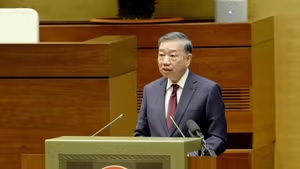
The initiative puts into practice the vision put forward by Party General Secretary and State President To Lam on building "socialist communes and wards", bringing the values of socialism into everyday life at the grassroots level, where government is closest to the people and directly addresses their most pressing concerns.
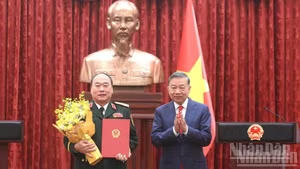
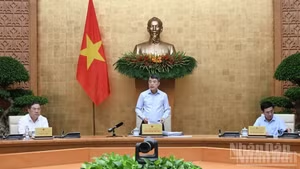
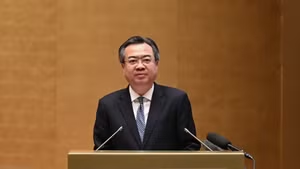
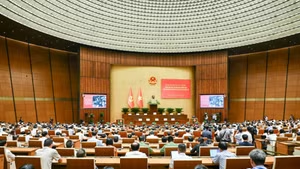
At the conference to launch the pilot project in Phuc Thinh and Thu Lam Communes, Secretary of the Ha Noi Party Committee Tran Duc Thang called on the city's entire political system to fully recognise the significance of the model and regard it as a key political task.
He stressed that Ha Noi must take the lead and serve as a model in developing socialist communes and wards, with implementation outcomes and public satisfaction serving as the ultimate measure of success.
The most fundamental innovation of the "socialist communes and wards" model lies in a new approach to governance mindset. Whereas local development was previously assessed mainly through indicators such as economic growth, budget revenue, and the number of investment projects, the quality of life, public satisfaction, and people's happiness are now regarded as key benchmarks for evaluating the performance of grassroots authorities.
This is also consistent with the Party's enduring approach to building socialism: that all development achievements must ultimately serve the people. Accordingly, the model aims to establish modern, transparent, effective, and efficient grassroots administrations; promote democracy by enabling citizens to participate in building, supervising, and evaluating government; accelerate digital transformation and innovation; improve the quality of public services; foster cultural development; ensure social security; and create green, safe, and civilised living environments.
Phuc Thinh and Thu Lam Communes were selected to pilot the "socialist communes and wards" model since July 16 following a comprehensive assessment of their infrastructure, development potential, governance capacity, and the readiness of their grassroots political systems to embrace reform. Between now and 2030, the two pilot communes will implement 54 criteria covering the project's eight core areas, while the city will conduct regular inspections, monitoring, and evaluations to refine both the criteria and the operational framework.
At the same time, the remaining 124 communes and wards across the city will gradually adopt criteria suited to their own local conditions. By 2030, Ha Noi will review and further improve the model before continuing its implementation, conducting a comprehensive assessment and progressively expanding it during the 2031–2035 period.
When development is measured by quality of life, public satisfaction, and people's happiness and every policy is designed to serve the people, promote democracy, accelerate digital transformation and innovation, foster cultural development, and ensure social security, the values of socialism will be translated into tangible outcomes for every community and every family.
If successfully implemented in Phuc Thinh and Thu Lam Communes, the "socialist communes and wards" model will provide a practical foundation for expansion across Ha Noi and offer valuable experience for further improving the country's grassroots governance model during the new stage of national development.