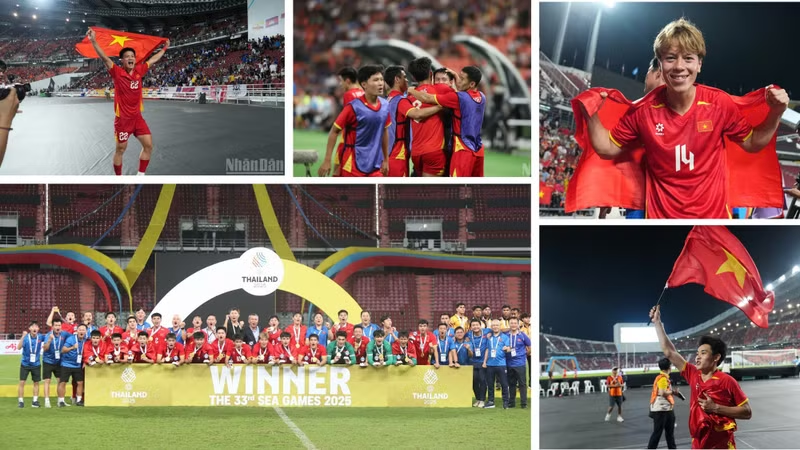
Unexpected success
The Vietnamese football kicked off 2025 with great enthusiasm, defeating arch-rivals Thailand twice to win the ASEAN Championship. In July, the Viet Nam U23 reaffirmed its position as number one in Southeast Asia with a victory over hosts Indonesia. Most recently was a dramatic comeback at Rajamangala Stadium to win the gold medal at the regional sports games.
For the first time in history, the Vietnamese football won all three of Southeast Asia's biggest tournaments in the same calendar year. Notably, all these titles were achieved by defeating the host teams in the final round.
Beyond these three triumphs, seven national teams qualified for the Asian Championship finals, including the women's national team, the U20 and U17 women's teams, the U23 and U17 men's teams, and the men's and women's futsal squads. This number will also rise to eight when the men's national team completes its task in the 2027 Asian Cup Qualifiers in March 2026. This is a historic achievement, as only three Asian football nations have reached this milestone: Japan, Viet Nam, and Australia (which joined the Asian Football Confederation 20 years ago).
Sweet fruits thanks to long-term vision
In the context of socio-economic fluctuations, the Vietnamese football must overcome many difficulties and challenges, such as increasingly high professional standards and fierce competition among regional and continental football nations. Specifically, many countries are accelerating the naturalisation process to improve the quality of their squads.
As Viet Nam Football Federation (VFF) President Tran Quoc Tuan noted, this year’s remarkable success is the sweet fruit of a 10-year preparation process. In recent months alone, the VFF has organised 14 overseas training camps across different age groups, enabling young players to gain invaluable match experience. This meticulous preparation not only helped the U22 Vietnamese team win Gold at the SEA Games 33 but also built a solid foundation for long-term goals.
These results are testament to persistent accumulation and the sound development orientation of the Vietnamese football in recent time.
Winston Lee
General Secretary of the ASEAN Football Federation (AFF)
Furthermore, the VFF continues to propose sending the Vietnamese U21 team to participate in the 2026 ASIAD in Japan. This direction will contribute to preparing a core force for the SEA Games 34 in 2027 and, further, the 2028 Los Angeles Olympic Qualifiers. In the context of increasingly fierce competition among Asian football nations, the ASIAD should be seen as a tournament to promote the following generational transition, where young players like the U21 team can experience the atmosphere of top-level competition and hone their skills against leading opponents in the continent.
Aspiration for bigger horizons
“Only with a talented generation can the Vietnamese football truly transform,” President Tran Quoc Tuan affirmed, underscoring a shift from short-term thinking to long-term investment strategy, even at the expense of immediate gains, to build a robust human-resource foundation for the future.

Head coach Kim Sang-sik echoed this view: “All our players currently compete in the V-League; none have gone abroad. I hope they can move to other environments to develop and elevate their standards. We must think of bigger goals, such as the World Cup. Without a target, there is no motivation.”
Clearly, the VFF’s strategy is to continue investing in youth teams, particularly the U20 generation. Over the next two years, they will represent Viet Nam at the SEA Games and ASIAD; this will also be a quality generation of players for the national team, aiming for the World Cup dream.