Based on votes from affiliated units and industry-and-trade media outlets, the Ministry of Industry and Trade (MOIT) has announced the 10 standout sector events of 2025, as follows:
1. Another breakthrough year for policy advice and institutional reform, creating a new “runway” for development ahead of an era of national rise
In 2025, the MoIT proactively advised on the development of strategic policies to spur the economy, industry, trade and investment, and to remove key bottlenecks—providing a basis for the Party Central Committee, the National Assembly and other competent authorities to issue a series of breakthrough policy directives, resolutions and laws, including the Politburo’s Resolution No 70-NQ/TW on ensuring national energy security through 2030 with a vision to 2045; the 2025 Law on Chemicals; the Law on E-commerce; and measures on decentralisation and delegation of powers in the industry and trade sectors, among others.
This was the year in which the sector clearly reaffirmed its political resolve and its “development-creating” role through institutions – paving the way for fast, sustainable long-term growth and fundamentally addressing many long-standing institutional bottlenecks.
2. Industry rebounds, surging 9.5%; manufacturing up 10.6%—the highest in five years
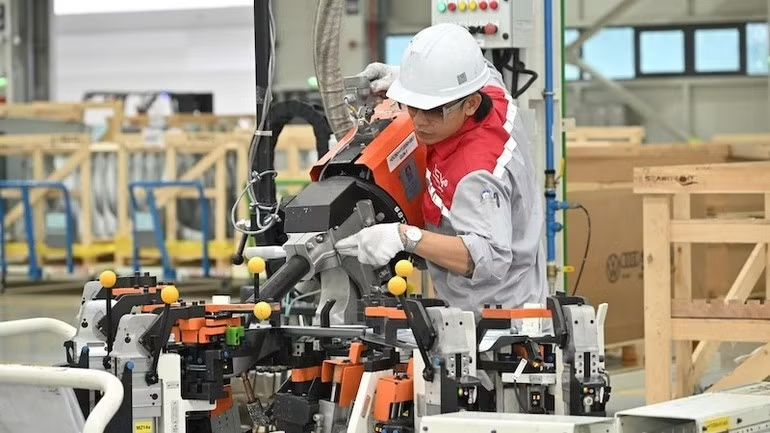
2025 witnessed a strong recovery and powerful acceleration in industry, especially in manufacturing. Value added in industry rose 9.5% year on year, while manufacturing increased 10.6% — the highest figure in many years — providing a major driver for macroeconomic growth.
Industrial output rebounded on the back of the Government’s and the MoIT’s efforts to remove obstacles, help businesses weather difficulties and shift production models—despite major headwinds from global supply-chain disruptions and extreme weather, storms and floods. Notably, Viet Nam’s industrial fundamentals strengthened, with domestic firms increasingly integrating into global supply chains and contributing nearly 50% of industrial output (up from around 35% in 2020).
3. Strategic input supplies for production were well secured, while the domestic market expanded strongly, up nearly 10%. Vietnamese goods accounted for 90% of distribution channels, strengthening internal demand as a new engine of growth.
In 2025, the domestic market continued to serve as a crucial “backstop” for the economy. Total retail sales and consumer-service revenues are estimated at 7,000 trillion VND, up nearly 10% from 2024—the strongest growth in many years and more than 71% higher than 2021.
Viet Nam’s consumer market expanded rapidly and is currently ranked 32nd globally, with further improvement possible. The ASEAN Consumer Sentiment Index 2025 showed Viet Nam at 67 points, leading the region.
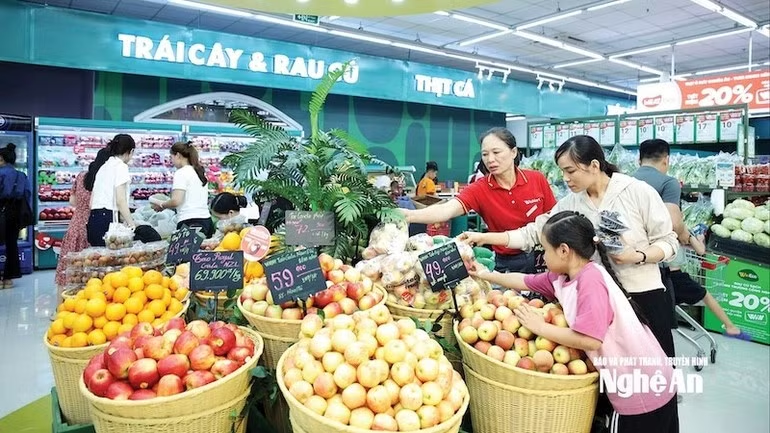
The 2025 markets for petrol, electricity, coal and energy ran smoothly thanks to well-prepared supplies; prices of food and key raw materials were kept under control, helping to hold average inflation at around 3.4% (the 11th consecutive year Viet Nam has kept inflation below 4%).
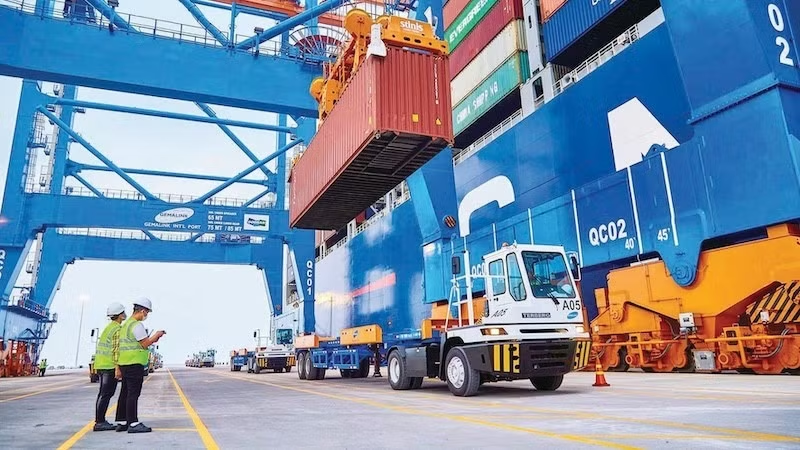
4. Trade hits an all-time high of over 920 billion USD; exports exceed 470 billion USD, placing Viet Nam among the world’s top 15 trading powers
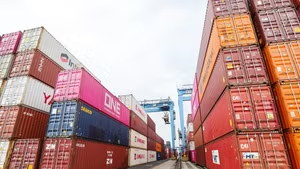
Despite turbulence in the global economy and difficulties stemming from new tariff policies in the US, Viet Nam’s trade activity in 2025 set a new record, supported by proactive and flexible policy advice and implementation. Total merchandise trade in 2025 is estimated at around 920 billion USD, the highest ever; exports are estimated at 470 billion USD.
As a result, Viet Nam has officially risen into the group of the 15 largest trading nations globally and ranks second in ASEAN. The trade balance also recorded a surplus for the 10th consecutive year (since 2016), with a sizeable surplus (estimated at 22 billion USD in 2025).
In 2025, MOIT rolled out coordinated measures to help businesses maximise the benefits of FTAs and steadfastly implement the Strategy for Exports and Imports of Goods to 2030. Programmes to build an FTA-utilisation ecosystem, provide market information, guide compliance with standards, promote sustainable development, and strengthen brand value were implemented in a deeper and more practical manner.
5. E-commerce continued to grow at pace while becoming more sustainable, topping 31 billion USD and accounting for 10% of total retail sales and two-thirds of the digital economy.
Viet Nam’s e-commerce continued to flourish in 2025, reinforcing its role as a pillar of the digital economy. Market size is estimated to exceed 31 billion USD, more than doubling compared with 2020; it accounts for around 10% of national retail sales of goods and consumer-service revenues and two-thirds of the digital economy.
E-commerce has become a core distribution channel, with over 60 million Vietnamese consumers shopping online – double the 2020 figure. Average per-capita e-commerce spending in 2025 reached 400 USD/person/year.
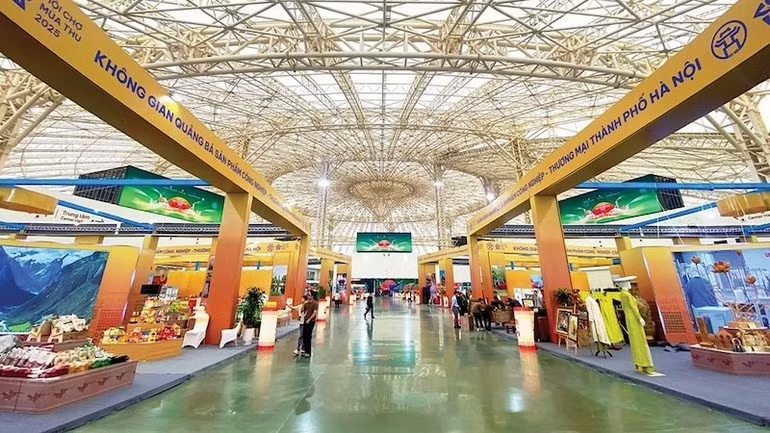
6. Trade promotion made a strong breakthrough, lifting Viet Nam’s standing, brand and soft power, with the country’s soft power ranking rising by seven places thanks to trade.
2025 marked not only a comprehensive shift in trade promotion, but also a sharp rise in national brand value. With a strategic orientation aligned with digital transformation, green development and sustainable growth, trade-promotion activities helped build a connected ecosystem, markedly improving Vietnamese businesses’ competitiveness on the global economic map.
In 2025, Viet Nam’s National Brand value reached 519.6 billion USD (up 2.5%), holding 32nd place worldwide. Many corporate brands expanded globally. According to Brand Finance, Viet Nam’s soft-power standing made a significant leap, ranking 52nd out of 193 countries.
7. Competition management, consumer protection and trade remedies to support domestic production made major strides.
2025 marked a major step forward in improving Viet Nam’s legal framework for trade remedies, as MOIT drafted and submitted for Government issuance Decree No. 86/2025/ND-CP dated April 11, 2025, detailing provisions of the Law on Foreign Trade Management on trade-remedy measures, replacing Decree No. 10/2018/ND-CP.
Alongside Decree No. 86/2025/ND-CP, MOIT also issued guiding circulars on trade remedies effective from July 1, 2025. These circulars provide guidance on procedures for filing investigation requests, handling confidential information and correcting data.
8. Continued streamlining of the apparatus, decisive reform and administrative-procedure cuts; taking the lead in assigning officials to the grassroots, supporting the two-tier local-government model
In response to the requirement to review and streamline the organisational apparatus under Resolution 18-NQ/TW to enhance effectiveness and efficiency, MOIT submitted to the Government Decree No. 40/2025/ND-CP dated February 26, 2025, defining the ministry’s functions, tasks, powers and organisational structure.
Accordingly, MOIT now has 22 units, a reduction of six focal points—equivalent to 21.4% compared with the previous term. Compared with 2007, the number of affiliated units has fallen by 15 focal points, equivalent to more than 40%.
9. Economic integration continues to be comprehensively renewed
International economic integration work in 2025 moved into a deeper phase with a new organisational set-up and methods. The consolidation of the National Steering Committee for International Integration and the introduction of the FTA Index provided a quantitative measurement tool, helping localities become more proactive in integration and in implementing FTAs.
Amid rising protectionism, the sector remained committed to market diversification and deeper international integration. Facing new US tariff policies that created major difficulties for trade and production, MOIT promptly advised Party and State leaders and the Government so that responses could be proactive, flexible and timely.
MOIT also continued to promote negotiations on potential FTAs and diversify markets and supply chains with high-potential regions, demonstrating strategic vision in expanding export-market networks, creating new space for businesses and laying a firm foundation for Viet Nam to secure more new FTAs in 2026.
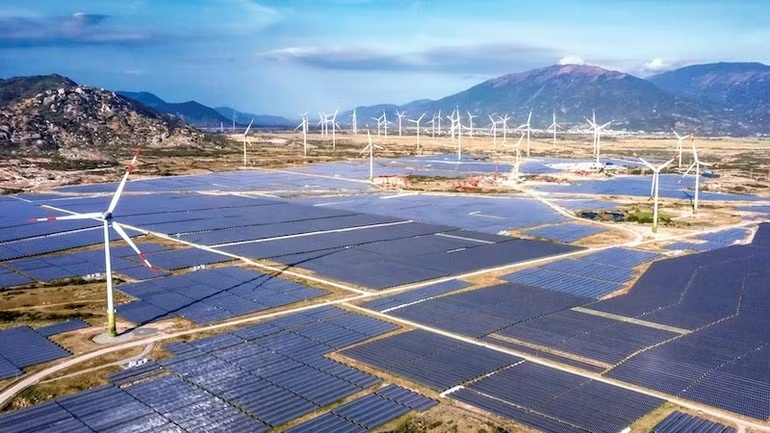
10. Energy breakthrough—Viet Nam leads ASEAN and ranks in the world’s top 20 for total installed power capacity
In 2025, energy supplies such as electricity and petrol were ensured even as global supply faced significant difficulties. It was also a year of many breakthroughs in energy policy and infrastructure, laying the groundwork for the country to enter an era of national rise.
2025 also saw fast-tracked delivery of major energy projects: the completion of the 500kV Lao Cai–Vinh Yen transmission line and the rollout of electricity import projects to prevent any repeat of power shortages. Notably, the Lo B–O Mon gas-to-power project chain (with total investment of about 12 billion USD) was officially launched, with fabrication of the offshore platform and associated infrastructure beginning in August 2025.
By the end of 2025, Viet Nam’s power system ranked first in Southeast Asia and was among the world’s top 20 largest power systems by installed capacity, reaching around 90,000MW.