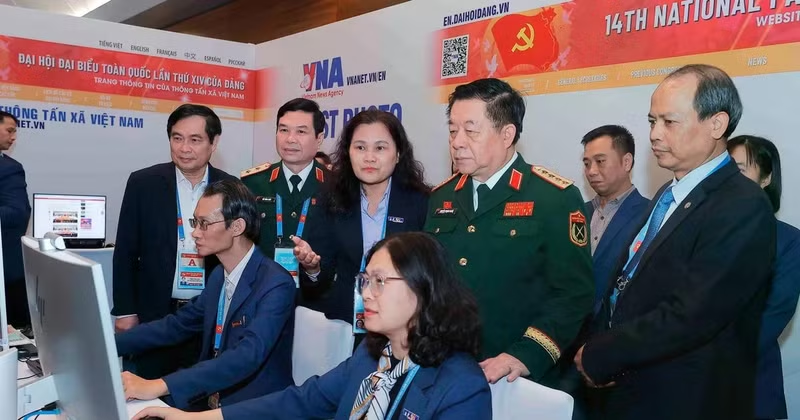
Speaking to the media after visiting the Congress's press centre on January 20, Nghia highlighted the greatly scientific consolidation of three documents, namely the Political Report, the Socio-economic Report and the Review Report on the Party building, into a central report.
The report, he said, is not merely an appeal but an action-oriented and highly feasible document designed to build consensus within the Party and across society to realise targets, especially strategic breakthrough ones.
According to the general, while every Party congress holds great significance, the 14th Congress is particularly momentous as it not only reviews the five-year implementation of the Resolution of the 13th Congress, but also assesses 40 years of the Doi moi (Renewal) process at a time when the country is entering a new development phase.
He cited Party General Secretary To Lam as noting at the opening session that this is a historic moment for Viet Nam to move into a new era of national development aimed at peace, independence, democracy, prosperity, affluence, civilisation, and happiness.
The congress, Nghia said, is also an occasion to reaffirm the foundation and conditions necessary for realising the people’s aspirations and President Ho Chi Minh’s last wish, as expressed in his Testament, of building a peaceful, unified, independent and prosperous Viet Nam that stands shoulder to shoulder with world powers.
He emphasised that it sends a powerful message of “Solidarity – Democracy – Discipline – Breakthrough – Development”.
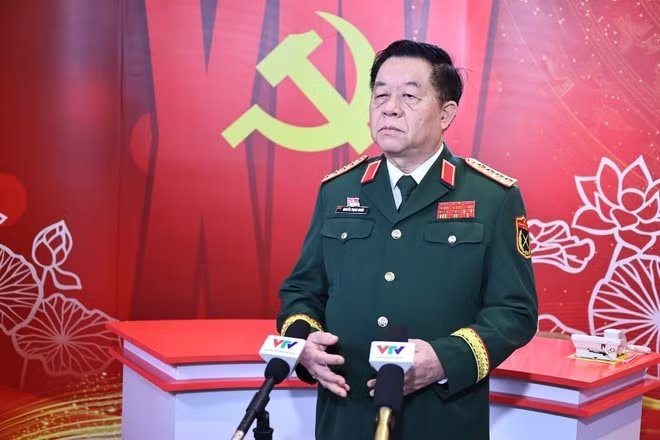
Regarding defence and military affairs, he underlined that the draft documents of the 14th Congress mention several major viewpoints, including ensuring the Party’s absolute, direct and comprehensive leadership over the army; building a revolutionary, regular, elite and modern army; and building a clean, strong, and exemplary Military Party Organisation.
To implement these viewpoints, principles of action were identified clearly. They include pressing on with building the army absolutely loyal to the Party, the Fatherland, and the people; promoting the army as an absolutely loyal political force and combatant force of the Party and the people; upholding and spreading the noble values and image of "Uncle Ho's soldiers"; and enhancing the army's role as a force born from the people and fighting for the people.
The general stressed the need for various measures to be taken, including strengthening the Party building, enhancing solidarity and discipline, improving combat training quality, mastering science and technology, renewing leadership methodology, expanding international integration, and maintaining close ties with the people. He highlighted the importance of thoroughly implementing the directives of Party General Secretary To Lam at the 12th Party Congress of the Army and the 15th meeting of the Central Military Commission.
Specifically, they are about steadfastly adhering to the Party's military and national defence policies; steadfastly building a politically strong army; promoting the building of a revolutionary, regular, elite, and modern People's Army; promoting international integration and defence diplomacy; preventing the risks of war and conflict; and preventing all manifestations of ideological and political degradation, moral decay, and lifestyle deviations, as well as "self-evolution" and "self-transformation" within the Party organisation of the army and the entire military.
On communications and public outreach, Nghia said the 14th Congress has benefited from early guidance by the Politburo and the Secretariat. Relevant sides, including ministries, central agencies, the Party Central Committee's Commission for Information, Education and Mass Mobilisation, the Ministry of Culture, Sports and Tourism (previously the Ministry of Information and Communications), and media agencies, have shown proactive and methodical performance in disseminating information, helping bring Party orientations closer to the people and strengthening public trust.
He noted that communications efforts have been closely linked with major milestones, including 40 years of Doi moi, the achievements of the 13th Congress term, the 80th founding anniversary of the Socialist Republic of Viet Nam, and the implementation of the 12th Party Central Committee's Resolution 18-NQ/TW on streamlining the political system towards greater efficiency and effectiveness.
The strong application of digital technology, he added, has created a powerful and multi-channel communications network, enabling domestic and international audiences to access timely, accurate, and comprehensive information about the Congress.
Nghia praised the strong sense of responsibility shown by media agencies, including the Viet Nam News Agency, in contributing to the success of the Congress.