When heritage becomes an ecosystem for cultural industries
Throughout Hue’s development history, culture and heritage have never been merely values of the past. Royal court music, imperial architecture, festivals, ao dai, cuisine, craft villages, and folk arts remain part of contemporary life. The challenge is to transform these values into competitive creative products that generate economic value without compromising the authenticity of the heritage.
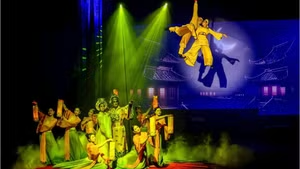
With eight heritage sites and traditions inscribed by UNESCO, Hue has exceptional cultural resources. In 2026, Hue is focusing on fields such as film, fashion, cuisine, and digital heritage tourism, while developing key products including ao dai, cuisine, Hue folk songs, and performing arts. Notably, the approach is shifting from “preserving what already exists” to “preserving for development and developing for preservation.”
One prominent example is Hue’s ao dai. From a traditional garment, the ao dai connects with weaving, tailoring, embroidery, design, photography, communications, and tourism. The “Knowledge of Making and Wearing Hue’s Ao Dai” has been recognised as a national intangible cultural heritage, alongside efforts to build the “Hue — Capital of Ao Dai” brand. Its value therefore lies not only in the product itself but also in the creative chain behind it, creating more jobs, improving livelihoods, and expanding markets.
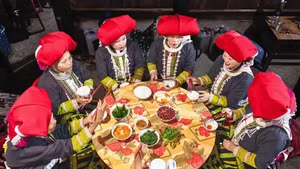
Hue cuisine is another area with considerable potential. Royal dishes, folk dishes, Hue cakes, Hue beef noodle soup, and other specialities can be developed into tourism products, gifts, media content, and brands. Efforts to join the UNESCO Creative Cities Network in the field of gastronomy will help turn cultural advantages into competitive capacity.
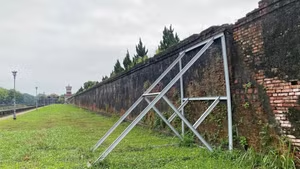
According to economic experts and cultural researchers, the key point is that cultural industries cannot be separated from heritage. Heritage must serve as the foundation and source of inspiration for creativity. Kien Trung Palace in Hue Imperial City clearly demonstrates this approach. Following its restoration, the building has regained its appearance as an important architectural structure within the Hue Citadel, becoming a distinctive space for the public to visit and experience. The value of investment in conservation has thus been extended to tourism, services, and education.
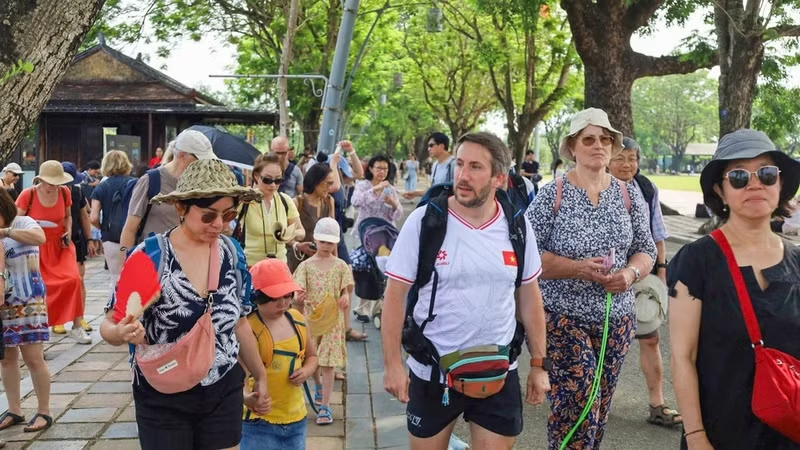
According to the Hue Monuments Conservation Centre, Hue’s heritage sites welcomed nearly 3.2 million visitors in 2025, generating 473 billion VND in entrance revenue and a further 41.7 billion VND in service revenue.
According to the Hue Monuments Conservation Centre, Hue’s heritage sites welcomed nearly 3.2 million visitors in 2025, generating 473 billion VND in entrance revenue and a further 41.7 billion VND in service revenue. These figures show that each visitor not only generates tourism revenue but also contributes resources for conservation and the livelihoods of artisans, tour guides, and people working in services, accommodation, and food and beverage.
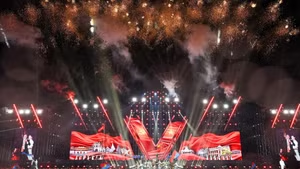
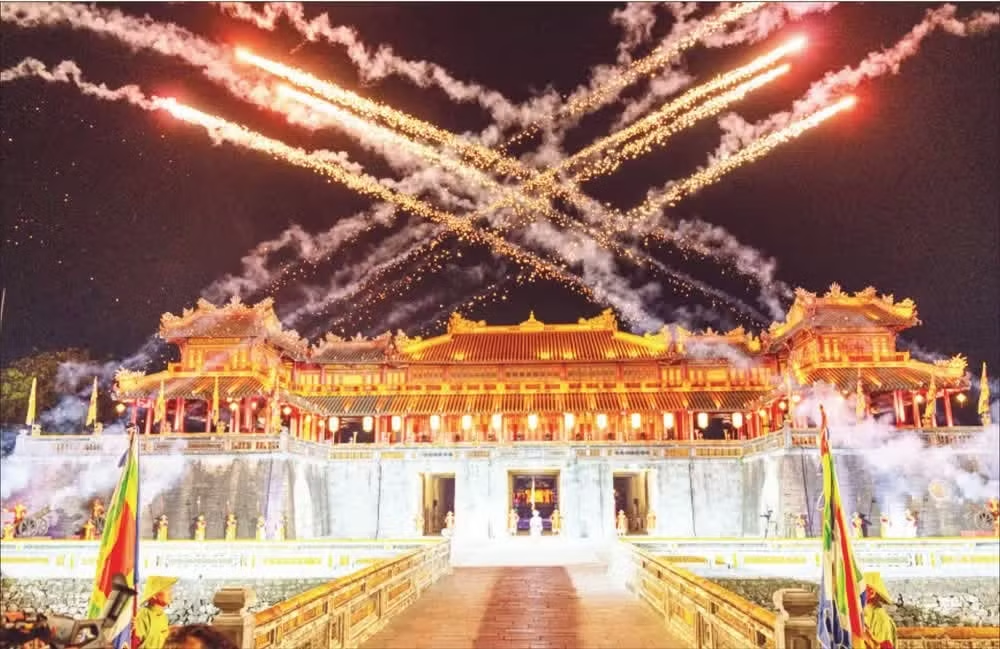
Hue Festival continues to be one of the key drivers. After more than 20 years of building its brand, Hue Festival is being oriented towards a year-round festival model, creating a continuous flow of visitors and linking artistic activities with heritage spaces. During the 2025 National Tourism Year, Hue organised more than 170 events and welcomed around 6.3 million visitors, up 61.5% from the previous year, while tourism revenue reached more than 13 trillion VND, up 64.4%.
Growth momentum has continued in the first seven months of 2026. Tran Thi Hoai Tram, Director of the Hue City Department of Tourism, said that the city welcomed around 5.1 million visitors, up 26.9% year on year, including around 1.6 million international visitors, with tourism revenue estimated at more than 12.088 trillion VND.
The services sector continues to be an important driver of the city’s economy. These figures show that major cultural events have enhanced the destination’s appeal, creating spillover effects for accommodation, dining, transport, shopping, the arts, and communications.
As a result, the festival and heritage products have become a distinctive economic and cultural institution of the heritage city.
From cultural products to growth resources
If Hue Festival creates a “flow of visitors”, ao dai creates a “flow of products”, and royal heritage creates a “flow of experiences”, digital transformation has opened a development space for Hue that goes beyond geographical boundaries.
The city is planning to apply virtual reality, augmented reality, digital maps, smart interpretation, e-tickets, and digital heritage tourism, while also building a cultural industry data ecosystem, a digital promotion platform, and business connections.
Hoang Viet Trung, Director of the Hue Monuments Conservation Centre, affirmed that the above orientation is aligned with the goal of turning Hue into a distinctive heritage city of Viet Nam.
With the city targeting GRDP growth of 10% or higher in 2026, it is highlighting the advantages of its eight UNESCO heritage designations and calling for heritage to be “turned into assets”, transforming cultural values into products, services, jobs, and revenue.
According to economic experts, the city currently lacks a comprehensive database on businesses, artisans, creative spaces, and cultural products. It also lacks leading businesses, creative centres, and mechanisms to support start-ups, while the application of e-commerce and digital content distribution remains limited.
If these bottlenecks can be addressed, digitised heritage could become educational materials, online tourism products, films, games, virtual exhibitions, or digital commercial products.
For example, royal motifs could be incorporated into fashion, graphics, and gifts; historical stories could become film scripts; and traditional dishes could be developed into brands.
Therefore, Hue needs to build a cultural industry ecosystem in which the state creates the institutional and infrastructure framework; cultural institutions ensure authenticity; researchers provide knowledge; artists and designers create products; businesses organise production and distribution; technology expands markets; and the community serves as the custodian and beneficiary.
With its wealth of heritage, Hue must therefore pursue growth with a distinctive identity - developing the economy without sacrificing heritage; creating new products while continuing to tell the story of Hue; and leveraging cultural values while also increasing resources for conservation and people’s livelihoods.
Assoc. Prof. Dr. Tran Dinh Thien
According to Assoc. Prof. Dr. Tran Dinh Thien, former Director of the Viet Nam Institute of Economics and a member of the National Policy and Finance Advisory Council, with its wealth of heritage, Hue must therefore pursue growth with a distinctive identity — developing the economy without sacrificing heritage, creating new products while continuing to tell the story of Hue, and leveraging cultural values while also increasing resources for conservation and people’s livelihoods.
To this end, Hue needs to develop creative spaces and attract businesses to film, music, fashion, cuisine, and digital content as well as train human resources, protect intellectual property rights, expand markets, and strengthen domestic and international linkages.
The goal of establishing a cultural industry space or complex connecting businesses, artists, designers, training institutions, investors, and the community is a necessary step.
From a former imperial capital rich in cultural layers, Hue now has an opportunity to shape its own development model — modern but not detached from tradition, growing rapidly without sacrificing heritage, and integrating deeply while preserving its cultural identity.
If successful, the cultural industry will become a new economic sector and a means of connecting heritage, people, creativity, and markets, turning values passed down through generations into resources for the future.
This is also an opportunity for Hue to demonstrate that a city can grow through the depth of its own culture, taking heritage as its foundation, creativity as its driving force, people as the centre, and the cultural industry as one of the new drivers of sustainable development.