The project “Research on the Development of Halal Tourism in Hue City” is a scientific and technological research task jointly implemented by the Hue Department of Science and Technology and the Institute for South Asian, West Asian and African Studies during the 2026–2027 period.
This is one of the urgent scientific studies of both theoretical and practical significance, aiming to propose feasible recommendations and solutions for developing Halal tourism in Hue in line with the socio-economic development goals and orientations of the Hue People's Committee.
Capitalising on the potential of a multi-billion-dollar market
The Halal tourism market (Muslim-friendly tourism) is regarded as one of the fastest-growing segments of the global tourism industry. In recent years, the rapid expansion of the global Halal economy has created favourable conditions for Viet Nam's tourism industry to participate more deeply in this market.
According to Dinh Manh Thang, Vice Chairman of the Viet Nam Tourism Association and Chairman of the Hue Tourism Association, the latest report on the global Halal tourism market shows that the sector continues to grow steadily, with revenue projected to increase from 245 billion USD in 2022 to 325 billion USD by 2030. With nearly 2 billion Muslims worldwide, the Halal market is considered one of the fastest-growing segments of global tourism.
Thang noted that although Viet Nam welcomed around 21 million international visitors in 2025, Muslim visitors accounted for only around 600,000 arrivals, representing approximately 3% of the total. Meanwhile, the tourism industry aims for Halal visitors to account for around 15% of all international arrivals by 2030, equivalent to 6–7 million visitors, making this market one of the key drivers of tourism growth.
To achieve the goal of attracting Halal tourists, Viet Nam's tourism industry in general, and Hue in particular, must overcome numerous challenges. These include an underdeveloped Halal ecosystem, a shortage of suitably trained human resources, the absence of a unified standards system, limited market connectivity, and insufficient awareness among tourism and service businesses of the Halal market's potential.
Developing Halal tourism is not only about tapping into a new market segment with relatively high spending power; it is also about improving destination quality, diversifying international visitor markets and enhancing the competitiveness of Viet Nam's tourism industry. Against this backdrop, Hue has begun laying the foundations for Halal tourism development through scientific research, workforce training and raising awareness among tourism businesses.
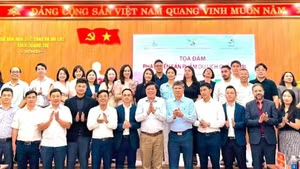
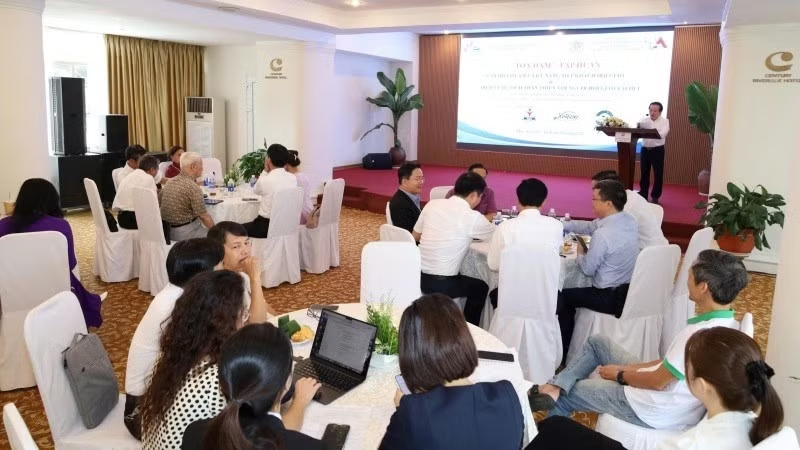
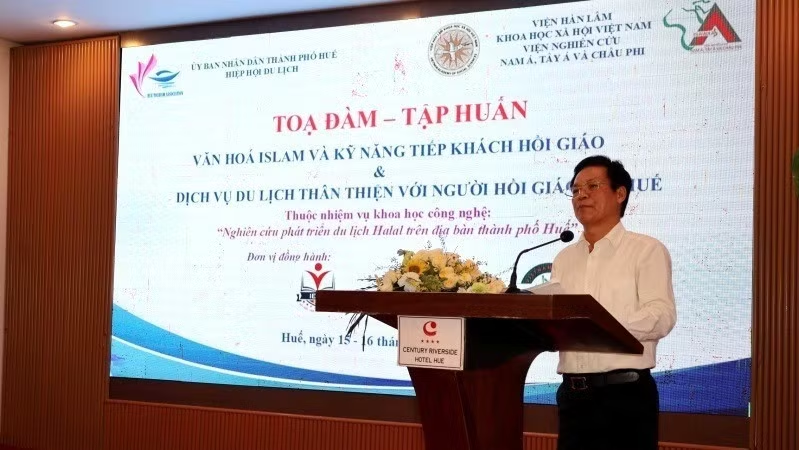
On July 15 and 16, the Institute for South Asian, West Asian and African Studies (under the Viet Nam Academy of Social Sciences), in collaboration with the Hue Tourism Association and relevant organisations, organised a seminar and training programme entitled “Islamic Culture, Skills for Welcoming Muslim Guests, and Muslim-Friendly Tourism Services in Hue”. The programme forms part of the scientific and technological project “Research on the Development of Halal Tourism in Hue City”.
According to Assoc. Prof., Dr Le Phuoc Minh of the Institute for South Asian, West Asian and African Studies, Hue possesses many advantages for attracting Muslim visitors. The Complex of Hue Monuments, a UNESCO World Cultural Heritage Site, together with its high-quality resort facilities and the expansion of air routes connecting Viet Nam with the Middle East, South Asia and Africa, provides favourable conditions for attracting this market.
Assoc. Prof., Dr Le Phuoc Minh added that, alongside the growing diplomatic relations between Viet Nam and many Muslim-majority countries, Hue has an opportunity to expand its international visitor markets, particularly among travellers with medium to high spending power. However, turning this potential into reality requires the city to develop a comprehensive Halal ecosystem covering accommodation, restaurants, tourism products, human resources and policy mechanisms to support businesses.
Building a Halal tourism ecosystem by changing perceptions
According to Dinh Manh Thang, Vice Chairman of the Viet Nam Tourism Association and Chairman of the Hue Tourism Association, the rapid expansion of the global Halal economy is creating numerous opportunities for Viet Nam's tourism industry to engage more deeply with this market. With its favourable geographical location, abundant tourism resources, stable political environment and distinctive cultural identity, Viet Nam possesses considerable advantages for developing Halal tourism.
According to experts, developing Halal tourism is not simply a matter of opening a few restaurants or adding Halal-certified dishes to menus. It requires the coordinated development of an entire service ecosystem encompassing accommodation, food services, transport, tourist attractions and a workforce with a sound understanding of Islamic culture and the religious practices of Muslim visitors.
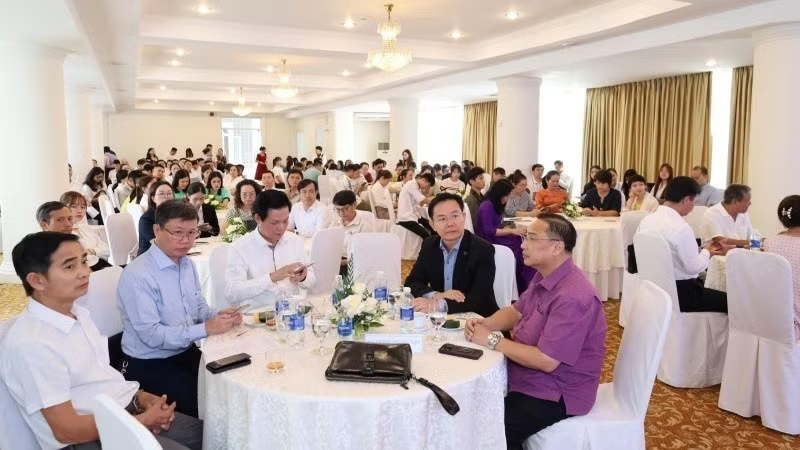
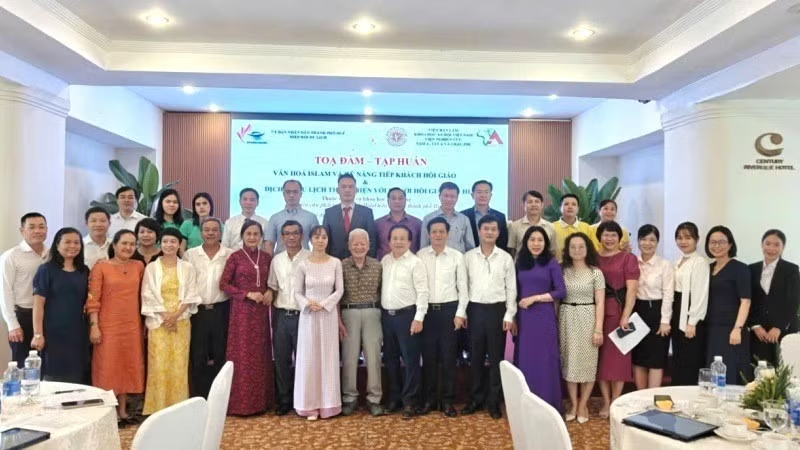
For Hue, this process must begin with changing the perceptions of tourism businesses. The training programme “Islamic Culture, Skills for Welcoming Muslim Guests, and Muslim-Friendly Tourism Services in Hue” brought together nearly 100 participants from 25 travel companies, hotels, restaurants and tourism training institutions across the city.
During the programme, leading experts on the Halal economy and Islamic culture shared essential knowledge on Muslim customs and lifestyles, visitors' needs, Halal service standards and appropriate service skills. Upon completion of the course, participants received certificates, laying the groundwork for businesses to gradually develop Halal-oriented products and services.
Assoc. Prof., Dr Le Phuoc Minh said that preliminary surveys indicate that the number of Muslim visitors to Hue remains very modest, accounting for less than 5% of international arrivals, with most staying only for a short period. One of the main reasons is the shortage of suitable infrastructure, such as prayer facilities, Halal-certified hotels and restaurants. At present, the city has only one Halal-certified restaurant. In addition, the workforce has not yet received systematic training, while mechanisms to support businesses in developing Halal services have yet to be established.
According to experts, this situation is also common in many other localities across Viet Nam. Therefore, Hue's decision to combine scientific research with workforce training from the outset is regarded as essential preparation to avoid missing the opportunities offered by this highly promising market.
Beyond the objective of attracting an additional segment of international visitors, developing Halal tourism will also contribute to improving destination quality and expanding the wider Halal economy, including food, cosmetics, pharmaceuticals, logistics, finance and related service industries. It also presents an opportunity to attract investment from Muslim-majority countries.
At a time when Viet Nam's tourism industry is seeking new drivers of growth, Hue's proactive efforts to undertake research, provide training and gradually build a Halal tourism ecosystem demonstrate a long-term approach founded on service quality and cultural understanding.
“When businesses are equipped with comprehensive knowledge, practical skills and appropriate service standards, Hue will be able to open wider the door to the hundreds-of-billions-of-US-dollars Halal tourism market, thereby reinforcing its image as a friendly, professional destination that is ready to integrate into the evolving trends of global tourism,” said Assoc. Prof., Dr Le Phuoc Minh.

![[Video] Viet Nam among Top three Asian destinations for return visitors](https://en-cdn.nhandan.vn/images/nyM650OGFWrOVWc-xajqN-rTZ68Rlmc1fiGJOhBRYHErj-E25MBpvJqrpphXazfrpe9t-fYCGuQU4CN0yXo3Rg/du-lich-vietnam.jpg.avif)