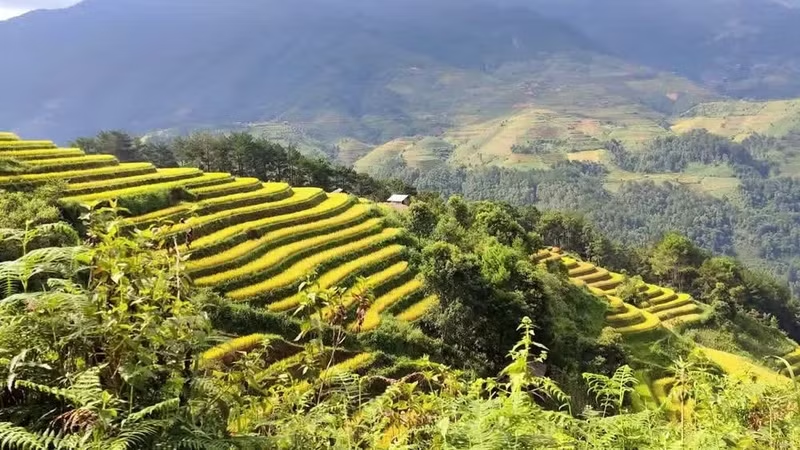
On October 6, a conference was held in Ban Lien Commune (Lao Cai) to assess the feasibility and development of a tourism product titled “Exploring the Route Connecting Terraced Field Cultural Heritage”.
Prior to this, from October 3-6, a delegation of over 50 participants—comprising tourism officials, travel agency representatives, and journalists—travelled the entire route to evaluate road conditions, accommodation, and stopover points.
According to the provincial Department of Culture, Sports and Tourism, the locality welcomed an estimated 9.8 million visitors—including approximately 1.36 million international tourists—during the first nine months of the year; total tourism revenue reached 40.88 trillion VND, representing about 80% of the annual target.
The province is home to three terraced field systems recognised by the State; notably, the Mu Cang Chai terraced fields are designated as a Special National Relic, with a protected area spanning 852.9 hectares.
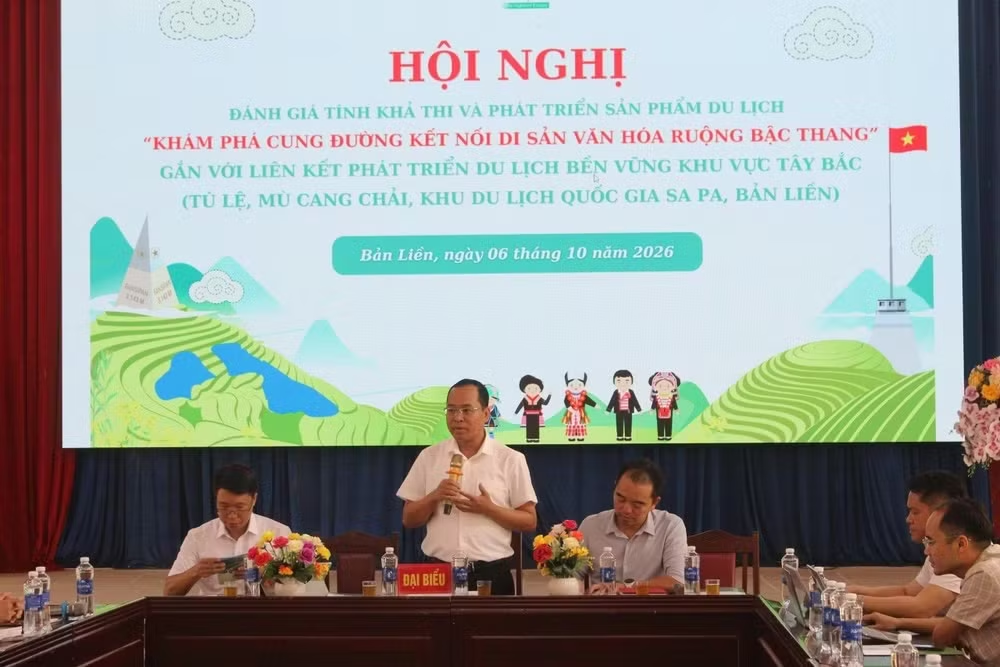
However, this advantage has thus far been exploited only on a seasonal basis. From the beginning of the year through October 4, Mu Cang Chai Commune welcomed 197,570 visitors, exceeding its annual target by 16.2%; notably, 119,700 of these arrivals occurred during the five-week “Golden Season Festival” (August 31 to October 4).
This means that approximately 60% of the total visitor volume for the nine-plus-month period was concentrated into just over a month. Tourism revenue for the commune reached 423.2 billion VND, averaging over 2.1 million VND per visitor—only about half the provincial average (approximately 4.1 million VND).
During peak weeks, transportation, accommodation, and the environment face significant strain, whereas many service providers remain quiet for the rest of the year. Giang A Tang, Vice Chairman of the Mu Cang Chai Commune People’s Committee, stated that the locality is developing products tailored to specific times of the year and strengthening partnerships with travel agencies to extend visitor stays and increase spending.
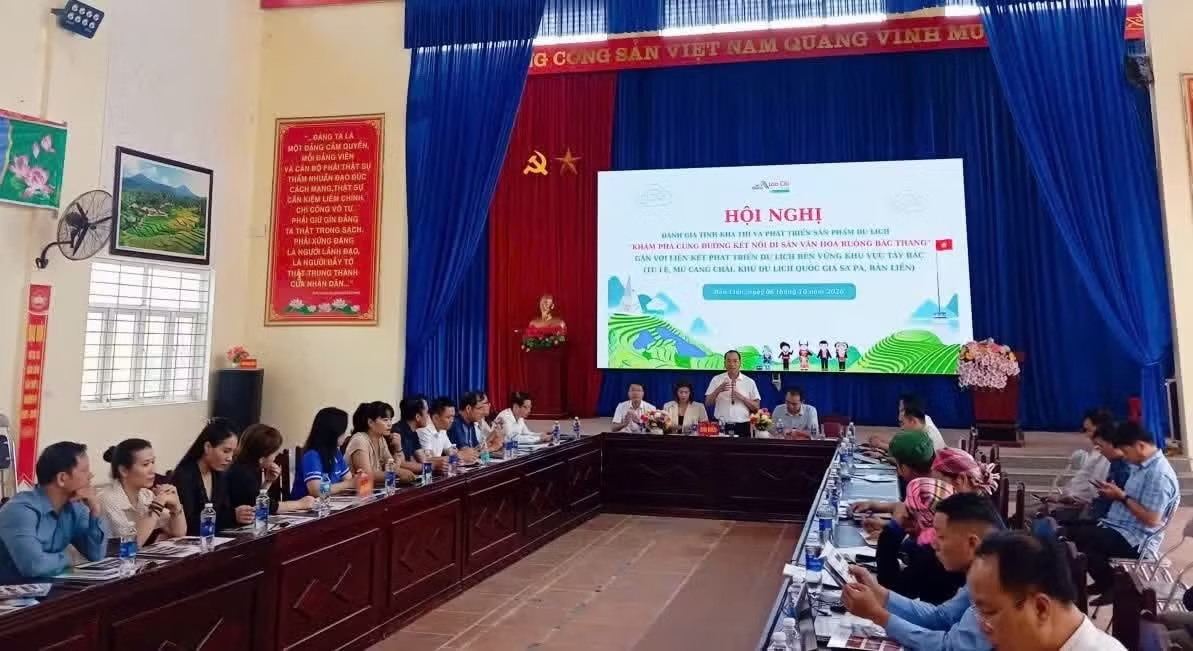
Meanwhile, in Ban Lien, Commune People’s Committee Chairman Luong Manh Ha reported that the commune welcomed approximately 6,800 visitors in the first six months of 2026—surpassing the total for the entire year of 2025 (about 4,500)—though this figure remains modest compared to the province’s established tourism destinations.
This disparity mirrors the broader landscape of tourism in Lao Cai. At a meeting with tourism businesses held in Sa Pa on July 8, 2026, many participants noted that Lao Cai’s product mix relies heavily on Sa Pa and sightseeing-focused offerings, making the sector vulnerable to fluctuations in weather or market conditions.
Consequently, some locations suffer from seasonal overcrowding while others remain under-visited, and a few bear the brunt of the province’s entire visitor influx. Individual destinations struggle to address these imbalances on their own.
Lao Cai has recently stepped up its cooperation efforts. The province is part of a tourism partnership involving eight expanded Northwest provinces and Ho Chi Minh City for the 2026–2030 period; on October 1, it signed a collaboration agreement with Tuyen Quang province, with plans to establish five inter-provincial routes.
Ha Van Sieu, Deputy Director of the Viet Nam National Authority of Tourism, emphasised the need for localities to adopt a fresh mindset regarding collaboration. He advocated for creating a shared tourism development space characterised by joint products, branding, markets, data, and coordination mechanisms.
Lao Cai’s terraced rice field routes offer a strategic advantage for establishing internal tourism connections before expanding into inter-provincial itineraries.
Speaking at the opening of a conference to assess the feasibility and development of the “Exploring the Cultural Heritage Route of Terraced Rice Fields” tourism product, Pham Tat Thanh—Deputy Director of the Lao Cai Investment, Trade, and Tourism Promotion Centre—noted: “If we simply take tourists to a single viewpoint to photograph the terraced fields and then leave, we are tapping into only a tiny fraction of the resource’s true value.”
He argued that while the terraced fields serve as the unifying thread of the journey, the actual tourism offerings should centre on local cuisine, homestay experiences, opportunities to learn about traditional crafts, and meaningful interactions with the community.





![[In Pictures] Nui Chua Rock Park: A million-year-old outdoor museum of landforms on the Khanh Hoa coast](https://en-cdn.nhandan.vn/images/nyM650OGFWrOVWc-xajqNz57td8idIAL_VG9puyG2UZEKOnmq1DVlT1--ZclbO3z2WBaWZhbt6O3e8kjPZqJMWkfEz7RO9qhcwg8o8LQFK8/ndo-br-cao-nguyen-da-moi.jpg.avif)