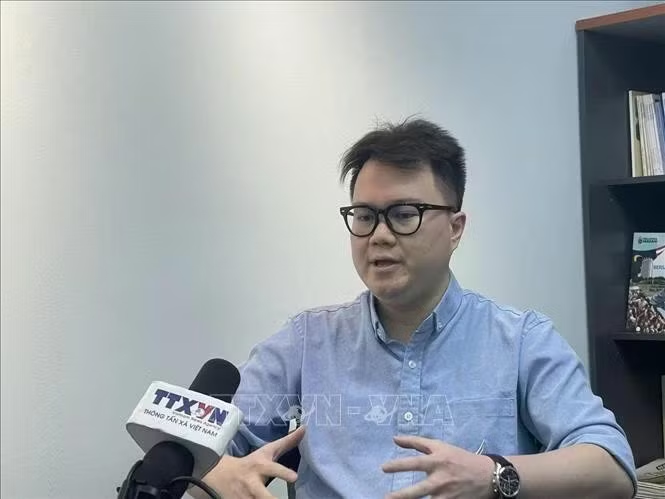
Speaking to Viet Nam News Agency correspondents in Malaysia, the researcher noted that with the strong consensus of nearly 1,600 delegates, the Congress entrusted Party General Secretary To Lam with a “powerful mandate”, ushering in a new phase of administrative reform, digital economic development and a clearer affirmation of Viet Nam’s role as an influential middle power on the international stage.
Enzo highlighted that unity and high-level consensus of Party was also reflected through the shorter duration of the 14th National Party Congress compared to previous terms. He stressed that this showed strong unity within the top leadership as well as broad support for the strategic agenda put forward.
He stressed that this foundation of political stability carries strategic significance for Viet Nam’s long-term development, reinforcing investor trust and ensuring policy continuity. Consistency in policymaking, he said, provides reassurance to international financial institutions and foreign investors, particularly amid ongoing global uncertainties. The Congress also reaffirmed Viet Nam’s foreign policy of independence, self-reliance, flexibility and steadfastness.
Assessing the development targets, Enzo said the 14th National Party Congress set out ambitious economic goals for the 2026–2030 period, with a vision extending to 2045. General Secretary Lam’s commitment to maintaining annual economic growth of around 10%, though challenging in the current global context, is viewed as achievable thanks to far-reaching administrative and economic reforms already underway.
The goal of attaining upper-middle-income status by 2030, he added, carries special significance as it coincides with the centenary of the Communist Party of Viet Nam.
The researcher also praised Viet Nam’s efforts to streamline its state governance apparatus, noting that the restructuring and consolidation of ministries and agencies are expected to enhance administrative efficiency. Viet Nam is steadily moving away from a labour-intensive growth model towards higher value chains driven by a knowledge-based economy and innovation.
New growth models highlighted at the Congress – including the digital, green and circular economies – aim to ensure sustainable development and environmental protection. Greater investment in education, innovation and strategic infrastructure was identified as a key driver enabling Viet Nam to integrate more deeply into regional and global value chains, he underlined.
On the external front, Enzo observed that the 14th National Party Congress reaffirmed Viet Nam’s position as an influential middle power. Viet Nam is actively expanding cooperation with partners in the Southern Hemisphere and BRICS, while strengthening relations with major powers and contributing to peace, security and stability in the East Sea through dialogue and constructive engagement, he stated.
According to Enzo, the 14th National Party Congress was not only a milestone in personnel work but also a marker of strategic thinking. With firm political stability and a strong reform roadmap, Viet Nam is moving closer to its goal of becoming a developed and prosperous nation, while assuming greater responsibility for peace and stability in the region and the world.
![[In Pictures] General Secretary and President To Lam and his spouse visit and present books to Royal Library of Belgium](https://en-cdn.nhandan.vn/images/3NY4Z6Du1Md1PrS_s0ZZOrwc5xDfq4rRua69depr-TBkwatGjBcD9lagzrI2BmGDo4nKYA9qjKDjuB3-yYloL_1KbNBr00klMZQFyHQxQ6Jq6GzFfAiY0m5agKw6jNtArN4QnVntX8RQeUmD7pdCq7nwvn3e235v3kufpokBN_s/1-tong-bi-thu-chu-tich-nuoc-va-phu-nhan-tham-tang-sach-cho-thu-vien-hoang-gia-bi.jpg.avif)