In the context of a volatile global economy, remittances are not only a meaningful Tet (Lunar New Year) gift for millions of families but also a valuable resource, contributing to macroeconomic stability and promoting sustainable growth.
A valuable resource for the economy
According to the International Organization for Migration (IOM), global migration flows currently reach approximately 304 million people. As part of this trend, the community of over 6 million Vietnamese people living and working in more than 130 countries and territories has become an important economic bridge to their homeland. The diversity of this community, from labourers and students to professionals and entrepreneurs, creates a sustainable flow of remittances.
In reality, remittances show a clear cyclical pattern, usually increasing sharply from the fourth quarter and peaking around the Lunar New Year. This is the time when Vietnamese people living abroad send money home to support their families in renovating their houses, covering Tet holiday expenses, investing in production and business, or saving for long-term plans. In Ho Chi Minh City alone, which receives approximately 60% of the country’s remittances, remittances reached nearly 8 billion USD in the first nine months of 2025, an increase of over 6% compared to the same period in 2024.
Notably, despite a slight decrease in the third quarter of 2025 compared to the previous quarter, remittances still maintained an impressive growth rate of 18% year-on-year. It was estimated that remittances to Ho Chi Minh City for the whole year 2025 reached approximately 10.5 billion USD. On a national scale, Foreign Minister Le Hoai Trung stated that remittances reached a record high of over 16 billion USD, representing a significant material resource and making a practical contribution to the country’s development.
Associate Professor, Dr. Dinh Trong Thinh, a financial and banking expert, also noted that remittances play a multifaceted role in the economy. Besides improving the lives of millions of households, this foreign currency flow contributes to improving the national balance of payments, increasing foreign exchange reserves, stabilising exchange rates, and strengthening the value of the Vietnamese Dong, thereby supporting and enhancing the effectiveness of the monetary policy of the State Bank of Viet Nam. More importantly, remittances help the country reduce its dependence on foreign loans, thus reducing financial pressure and debt repayment costs.
Recognising the importance of remittances, commercial banks have turned this service into a fiercely competitive “race”, especially during the peak Tet (Lunar New Year) season. To attract this flow, banks are not only relying on traditional promotional programmes but are also focusing on comprehensive digitalisation strategies. A highlight of this year’s remittance season is the extensive cooperation between domestic banks and leading international money transfer corporations.
Southeast Asia Commercial Joint Stock Bank (SeABank) has partnered with MoneyGram to implement a 24/7 online remittance receiving solution on the SeAMobile application. This solution allows money to be transferred directly to the recipient's account without needing to visit a branch, eliminating barriers of time and geographical distance.
For many consecutive years, Viet Nam has been among the top 10 countries receiving remittances worldwide, and is entering the peak season for receiving foreign currency from abroad. With a scale of over 16 billion USD annually, remittances are affirming their role as a “soft capital” with a significant ripple effect on the economy.
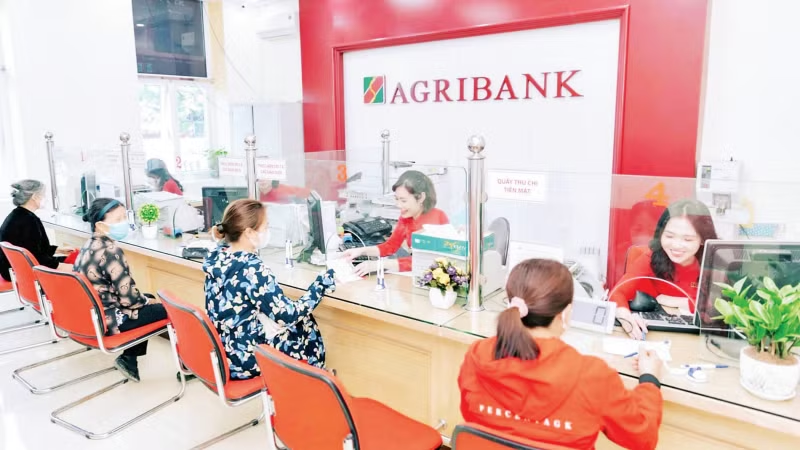
Meanwhile, the Viet Nam Bank for Agriculture and Rural Development (Agribank), the largest payment agent of Western Union in Viet Nam, is launching the “Remittance Season 2026” programme. Accordingly, from December 15, 2025 to February 28, 2026, Agribank will implement direct prize draws at branches and mini-games on social media.
The combination of Agribank’s extensive branch network and Western Union’s more than 174 years of experience has created a safe and reliable money receiving channel for people in remote areas.
Other banks such as Ho Chi Minh City Development Commercial Bank (HDBank) are also participating by signing cooperation agreements with TerraPay (UK) to expand payment services, etc. In general, the current trend is to optimise the exchange rate for remittances, reduce service fees, and shorten transaction times to the lowest possible level to compete with unofficial money transfer channels.
Towards sustainable development
Changes in banking services have directly impacted the habits of remittance recipients. Bich Hanh (Ho Chi Minh City) shared that previously, whenever her sister sent money from Germany, her family often had to rely on acquaintances to bring it back or use unofficial intermediary channels, which was time-consuming, costly, and risky. Now, things are completely different.
“It only takes a few minutes for the money to arrive in my account. I can withdraw cash or make payments immediately via phone. At the end of the year, there are even free services, good exchange rates, and gifts from the bank – it’s very convenient,” Bich Hanh said.
Not only Hanh’s family, but many people also say that receiving remittances through banks is now much simpler and more transparent. This convenience is contributing to bringing remittances into the official system, limiting uncontrolled money transfer channels, and helping to manage and use the money more effectively for the economy.
It is predicted that in 2026, remittances will continue to maintain their growth momentum thanks to positive changes in domestic policies. One of the highlights is the 2024 Land Law (amended), with its more streamlined procedures, making it easier for overseas Vietnamese to own land and property in Viet Nam. With easier investment in real estate, a stronger influx of foreign capital is expected.
In addition, remittances are also shifting geographically. In Ho Chi Minh City alone, while Asia still accounts for the largest share (50%), followed by the Americas (30%), remittances from emerging markets such as Africa have seen a breakthrough growth of up to 150%, indicating the expansion of the Vietnamese community’s activities and work worldwide.
Despite its increasingly important role, remittances remain voluntary and heavily dependent on overseas Vietnamese’s confidence in the domestic economic environment. Therefore, to attract and effectively utilise this resource, the core remains maintaining macroeconomic stability, controlling inflation, managing exchange rates flexibly, and ensuring the safety of the banking system. Along with that, to maximise the effectiveness of remittances, experts believe that more strategic directions are needed.
A research team led by Dr. Trinh Thi Thu Hang (Faculty of Economics, Viet Nam National University, Ha Noi) proposed that the policy system needs to be improved to encourage overseas Vietnamese to send money back in various forms such as savings, production investment, business capital contributions, startups, or participation in community projects. Directing remittances towards areas such as education, healthcare, science and technology, and green finance will create sustainable value for society, avoiding the situation where money flows only into asset speculation, causing market instability.