In his article entitled “Viet Nam–Indonesia: Cherishing Seven Decades of Bilateral Relations,” published in the Policy Brief Special Edition, Professor Sakhuja offered an in-depth assessment of more than 70 years of Viet Nam–Indonesia relations, noting that over seven decades of formation and development, the relationship has transcended the confines of conventional bilateral cooperation to emerge as a key pillar of the regional architecture.
Established in the 1950s, at a time when both nations were emerging from prolonged struggles for national independence, the relationship has been forged by deep political trust, converging strategic interests, and a shared vision of peace, stability, and sustainable development in the region.
The two countries share rare commonalities in modern history, as both secured independence through arduous and protracted struggles, nurturing a strong sense of national self-reliance and an enduring determination to safeguard sovereignty. According to the scholar, these shared historical experiences and aspirations have fostered a profound mutual understanding, laying a solid foundation for the official establishment of diplomatic relations on December 30, 1955.
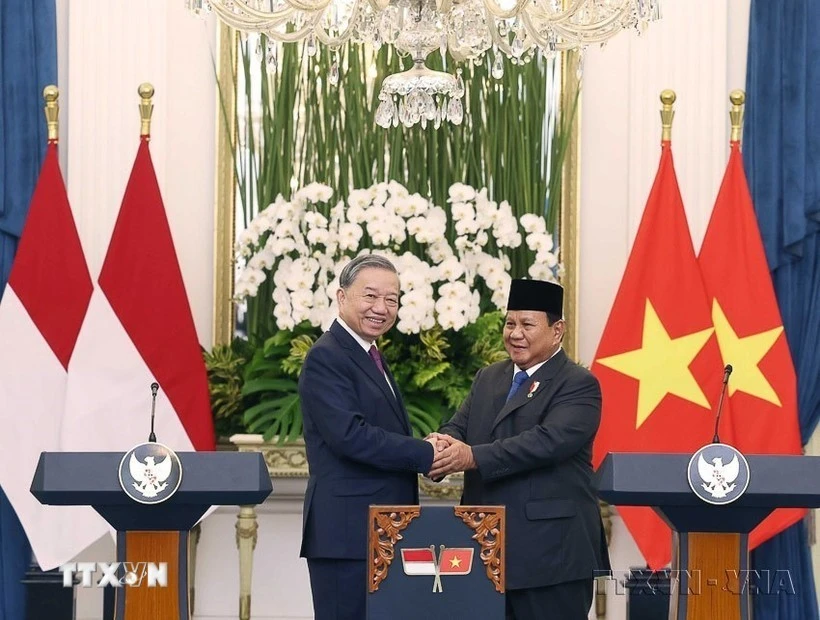
From a traditional friendship, the two countries have progressively elevated their relationship, reaching the Strategic Partnership level in 2013 and, notably, the Comprehensive Strategic Partnership in March 2025 during Party General Secretary To Lam’s visit to Indonesia. Professor Sakhuja described this upgrade as a “historic turning point,” reflecting the highest degree of political trust between the two nations.

Geopolitically, both Viet Nam and Indonesia hold key positions in the Indo-Pacific. Viet Nam lies along vital maritime routes and supply chains linking Northeast Asia with mainland Southeast Asia, while Indonesia – the world’s largest archipelagic state – commands strategic sea lanes such as the Malacca, Sunda, and Lombok Straits. This strategic complementarity positions the two countries as natural partners in advancing regional economic connectivity.
Economics, the author observed, has emerged as the most dynamic pillar of bilateral relations. Indonesia is currently Viet Nam’s second-largest trading partner within ASEAN, while the latter ranks as the former’s fourth-largest. Both sides aim to raise bilateral trade to 18 billion USD by 2028. Strategic investment cooperation also features prominently, exemplified by VinFast’s planned 1.2 billion USD investment in an electric vehicle manufacturing plant in Indonesia. Beyond its economic value, the project symbolises Viet Nam’s growing capabilities in green technology and innovation, aligning closely with Indonesia’s energy transition and sustainable development goals.
As a maritime security expert, Professor Sakhuja underscores the importance of defence and security cooperation, assessing that Viet Nam and Indonesia share a common vision of a free, open, and rules-based Indo-Pacific, with the 1982 United Nations Convention on the Law of the Sea (UNCLOS) as a fundamental legal cornerstone. The successful conclusion of negotiations on the delimitation of the exclusive economic zone (EEZ) stands as a compelling testament to both countries’ commitment to resolving sensitive issues peacefully, contributing to stability and order in the East Sea.
At a broader level, they are core members of ASEAN, jointly bearing responsibility for maintaining intra-bloc unity and ASEAN centrality amid intensifying major power competition. According to Professor Sakhuja, close coordination between Ha Noi and Jakarta is crucial in shaping a coherent Southeast Asian voice at regional and global forums.
After seven decades of partnership, the author concluded, Viet Nam and Indonesia are entering a new phase of bilateral relations. Beyond serving their national interests, this relationship reflects the increasingly prominent role of both countries as responsible middle powers, actively contributing to the shaping of the region’s security and economic architecture.