Q: Could you please outline the purpose and significance of the Prime Minister’s official visit to the Russian Federation?
A: The official visit to the Russian Federation by Prime Minister Pham Minh Chinh from March 22 to 25, 2026 carries great importance. The visit is made at the invitation of senior Russian leaders, including Prime Minister of the Russian Federation Mikhail Mishustin, who paid an official visit to Viet Nam in January 2025.
This visit represents a practical implementation of Viet Nam’s foreign policy of independence, self-reliance, resilience, peace, friendship, cooperation and development, as well as multilateralisation and diversification, as adopted at the 14th National Congress of the Party. It also demonstrates the pioneering role of foreign affairs in fulfilling its key and regular mission of mobilising maximum resources, creating opportunities and fostering favourable external conditions for national development in the new era.
It also provides an opportunity for both sides to reaffirm their enduring traditional friendship and sincere, trustworthy cooperation, while, with a forward-looking vision, strengthening and deepening ties in both breadth and depth, towards comprehensively elevating bilateral cooperation.
During the visit, the Prime Minister will hold numerous exchanges with senior Russian leaders, visit economic, scientific and educational institutions, review the implementation of existing cooperation agreements, address outstanding difficulties and obstacles, and create new momentum to advance bilateral cooperation in traditional areas.
Both sides will also discuss major directions for future cooperation, including launching and initiating specific projects aligned with Viet Nam’s current development priorities, such as new energy, infrastructure and transport connectivity, high technology, biomedicine, healthcare, and high-quality human resource training—areas where Russia has strong expertise and experience.
Prime Minister Pham Minh Chinh will also meet with the Vietnamese community in Russia, offering encouragement amid current challenges, listening to their concerns and aspirations, and conveying the consistent policy of the Party and State to care for overseas Vietnamese, protect their legitimate rights and interests, and promote national unity and collective strength.
I am confident that this official visit will have comprehensive significance, contributing to the continued strong, substantive, effective and sustainable development of the Viet Nam–Russia Comprehensive Strategic Partnership, for the benefit of both peoples and for peace, cooperation and development in the region and the world.
Q: In implementing the foreign policy set out at the 14th National Party Congress, how can the traditional friendship between Viet Nam and Russia be further elevated in the coming period?
A: In recent years, Viet Nam–Russia relations have been maintained and developed on the solid foundation of traditional friendship and a Comprehensive Strategic Partnership.
Political trust has been steadily strengthened. The two countries regularly maintain high-level exchanges and contacts. Bilateral cooperation mechanisms continue to operate effectively. Traditional areas of cooperation such as defence-security, economic-trade, energy-oil and gas, science-technology, and education-training have been increasingly enhanced, while people-to-people exchanges have been continuously strengthened. At the same time, both sides have gradually expanded cooperation into new areas such as innovation, digital transformation, green transition and advanced technologies.
I am confident that this official visit will have comprehensive significance, contributing to the continued strong, substantive, effective and sustainable development of the Viet Nam–Russia Comprehensive Strategic Partnership, for the benefit of both peoples and for peace, cooperation and development in the region and the world.
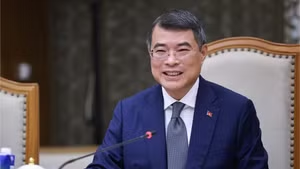
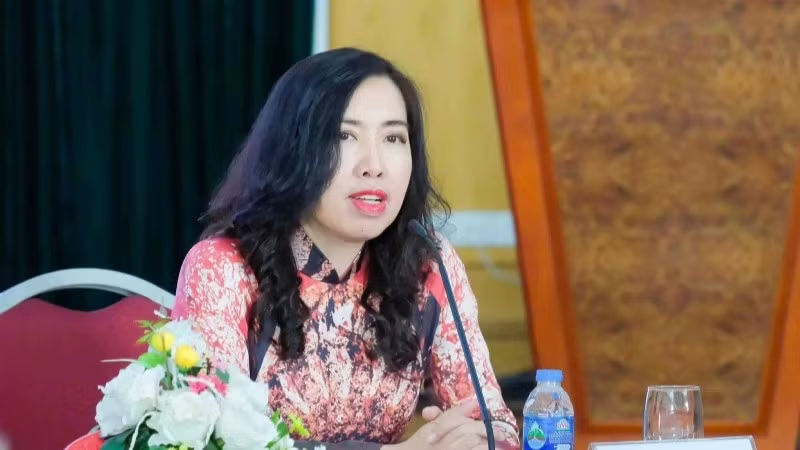
Deputy Minister of Foreign Affairs Le Thi Thu Hang
Looking ahead, it is essential to implement synchronised, comprehensive and effective foreign affairs activities across all three pillars: Party diplomacy, State diplomacy, and people-to-people diplomacy. In addition to strengthening cooperation in the aforementioned areas, both countries should further promote humanitarian cooperation and people-to-people exchanges, particularly in education and training, culture, arts, sports and tourism, while enhancing the role of the Vietnamese community in Russia.
In education and training, building on longstanding cooperation, many generations of Vietnamese students trained in Russia have become an important human resource for national development. In the new development era, as Viet Nam faces an urgent need for high-quality human resources, both countries should further intensify cooperation in education and training, particularly in areas where Russia excels, such as digital technology, quantum technology, biomedicine, basic sciences and classical arts.
In terms of humanitarian cooperation, to ensure that Russian cultural values remain close to the Vietnamese people and to preserve the image of a dynamic and resilient Viet Nam in the hearts of the Russian people, both sides should prioritise youth exchanges, regularly organise cultural, artistic and sporting exchanges, and hold cultural days in each country and across localities. In 2025, marking the 75th anniversary of diplomatic relations, the Viet Nam Cultural Festival was held at Red Square. In 2026, the Cross Year of Science and Education between Viet Nam and Russia will feature hundreds of activities and events in both countries.
Tourism cooperation has seen strong recovery in recent times and should be further expanded, including improving legal frameworks to facilitate travel for citizens of both countries.
The Vietnamese community in Russia, numbering around 80,000 people, has been and continues to be an important bridge for bilateral relations. The vast majority work diligently, maintain strong ties to their homeland Viet Nam while integrating into their second home, the Russian Federation, and contribute positively to both countries. Many have become successful entrepreneurs and highly qualified professionals.
To further promote the role of the overseas Vietnamese community, Viet Nam should continue to support and protect their interests and create conditions for them to contribute to national development, while also encouraging Russia to provide favourable conditions for them to live, work and study, thereby contributing to the socio-economic development of both the Russian Federation and Viet Nam.